
Most small businesses think they need more website traffic.
Sometimes they do.
But a lot of businesses already have a different problem: the wrong people are landing on the wrong pages with no clear path to become a lead.
That kind of traffic doesn’t create growth. It creates noise.
People visit the site. They look around. They leave. Nothing gets captured. Nothing gets followed up on. Nothing turns into a booked call.
That’s why more traffic isn’t always the fix.
The better goal is qualified traffic.
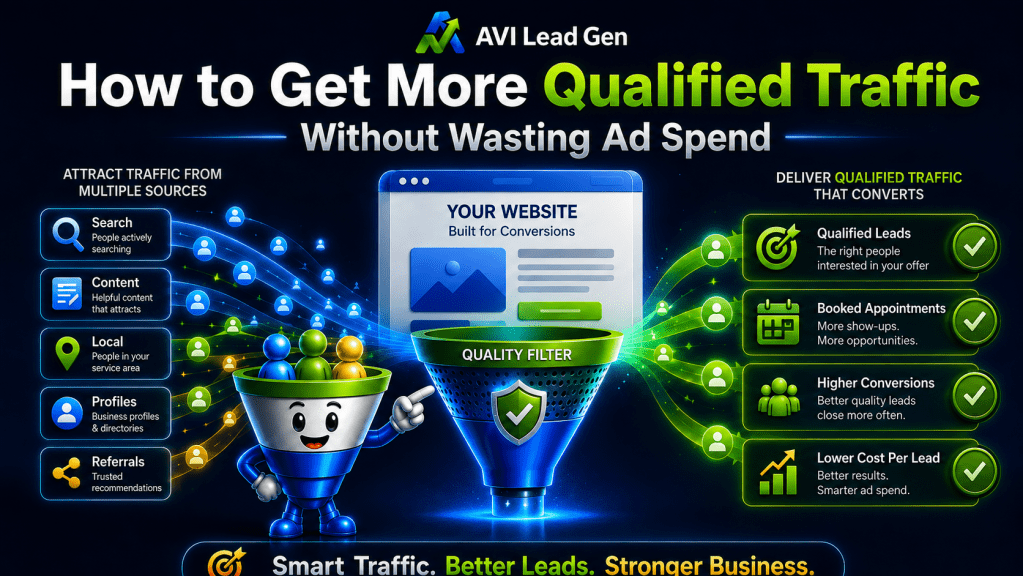
Qualified traffic means the right people are finding your business, landing on pages that match what they need, and getting a clear next step that moves them toward becoming a lead, appointment, or customer.
At AVI Lead Gen, we don’t look at traffic as a standalone marketing metric. We look at it as the first stage of a larger lead generation system.
Traffic matters.
But to convert traffic, what happens after the click matters even more.

More Traffic Isn’t Always the Fix
Traffic feels like progress because it’s easy to measure.
More visitors.
More clicks.
More impressions.
More pageviews.
But those numbers don’t always tell you whether the right people are showing up.
A website can get hundreds or even thousands of visitors and still fail to generate quality leads.
That usually happens for one of three reasons.
The audience is wrong.
The page doesn’t match the visitor’s intent.
The website doesn’t have a strong enough system to capture and follow up with the opportunity.
This is where small businesses can waste a lot of time and money searching for lead generation bottlenecks.
They run ads, publish content, post on social media, or chase SEO traffic without knowing whether those visitors are likely to become customers.
Then when the traffic doesn’t convert, they assume they need even more traffic.
But if the system is weak, more traffic just sends more people into the same broken path.
A better question isn’t:
“How do we get more visitors?”
A better question is:
“How do we attract the right visitors and give them a clear path to take action?”
That shift changes the whole strategy and enables you to take action on what to fix first.

What Qualified Traffic Actually Means
Qualified traffic is made up of visitors who have a real reason to care about what you offer.
They aren’t random browsers.
They’re more likely to have a problem, need, goal, or situation that matches your service.
A qualified visitor usually has at least one of these traits:
They’re actively searching for a solution.
They have a problem your business can solve.
They match the type of customer you want to serve.
They’re in the right location or service area.
They have enough intent to compare options.
They’re open to taking action soon or learning what the next step looks like.
This doesn’t mean every qualified visitor is ready to buy today.
Some people are early in the research stage. Some are comparing providers. Some are trying to understand the problem before they contact anyone.
That’s normal.
The point is that qualified traffic has a reasonable chance of becoming something valuable if the rest of the system is built correctly.
For example, someone searching “how to get more leads for my small business” is probably more relevant to AVI than someone searching “funny marketing memes.”
Someone searching “lead generation website for small business” has clearer intent than someone reading a broad article about general branding ideas.
Someone looking for “appointment booking automation for service business” is probably closer to the problem AVI solves than someone casually browsing web design inspiration.
Traffic quality depends on fit and intent.
The better the fit, the more useful the traffic becomes.

A Realistic Example
Imagine a small business gets 1,000 website visitors in a month.
At first, that sounds good.
But when the owner looks closer, the numbers are disappointing.
Most visitors land on the homepage.
Few click to a service page.
Almost nobody fills out the form.
The leads that do come in are vague or poor fit.
The business has no clear way to know which traffic sources created real opportunities.
The owner starts thinking, “We need more traffic.”
Maybe they do.
But the bigger issue might be that the traffic they already have isn’t being matched to the right message, page, offer, or follow-up path.
Now imagine the same business gets fewer visitors, but those visitors are better matched.
They land on a page about the specific problem they searched for.
The page explains who the service is for.
The call to action matches the visitor’s stage.
The form captures useful context.
The CRM tags the lead source.
Follow-up starts automatically.
Strong-fit leads are guided toward booking.
Results are tracked by source.
The second scenario may produce fewer total visitors, but better opportunities.
That’s the point of qualified traffic.
The goal isn’t to win the biggest traffic number.
The goal is to attract visitors who are more likely to enter the lead generation system and move forward.

The Step-by-Step System for How to Attract High-Intent Website Visitors
Qualified traffic doesn’t happen by accident.
It comes from knowing who you want to attract, understanding what they’re trying to solve, and matching each traffic source to the right page and next step.
Here’s the process.
Step 1: Know Who You’re Trying to Attract
Before you worry about SEO, ads, social media, or content, you need to know who you’re trying to reach.
This sounds obvious, but many businesses skip it.
They want “more customers,” but they haven’t clearly defined what a good customer looks like.
That makes it difficult to create useful content, write strong pages, choose the right keywords, or judge whether traffic is valuable.
Start with questions like:
Who is the ideal customer?
What problem are they trying to solve?
What situation usually causes them to look for help?
What service are they most likely to need first?
What objections or questions do they have before reaching out?
What makes someone a poor fit?
What does a strong-fit lead usually have in common?
The more clearly you understand the buyer, the easier it is to attract the right traffic.
This also helps your website copy.
Instead of writing vague marketing language that could apply to anyone, you can speak directly to the people who are most likely to need your help.
Qualified traffic starts with qualified messaging.

Step 2: Match Traffic Sources to Buyer Intent
Not all traffic sources behave the same way.
Someone who finds you through Google Search may have a very different level of intent than someone who sees a social media post.
That doesn’t make one source good and another bad.
It means each source needs to be understood differently.
Google Search often captures existing demand. The person is already searching for a problem, service, or solution.
Google Business Profile can capture local intent. The person may be looking for a nearby provider or checking whether your business is credible.
Paid search can capture high-intent traffic quickly, but only if the ad, keyword, landing page, and offer are aligned.
Social media often builds awareness and trust, but it may not produce immediate leads unless the audience and message are strong.
Referral traffic can be very valuable because the visitor may already have some trust before they arrive.
Direct traffic often comes from people who already know your name, saw your brand somewhere else, or returned after a previous touchpoint.
Each source has a role.
The mistake is treating all traffic the same.
A strong lead generation system matches the source, intent, page, and next step, enabling traffic conversion.
Step 3: Build Pages for Specific Problems
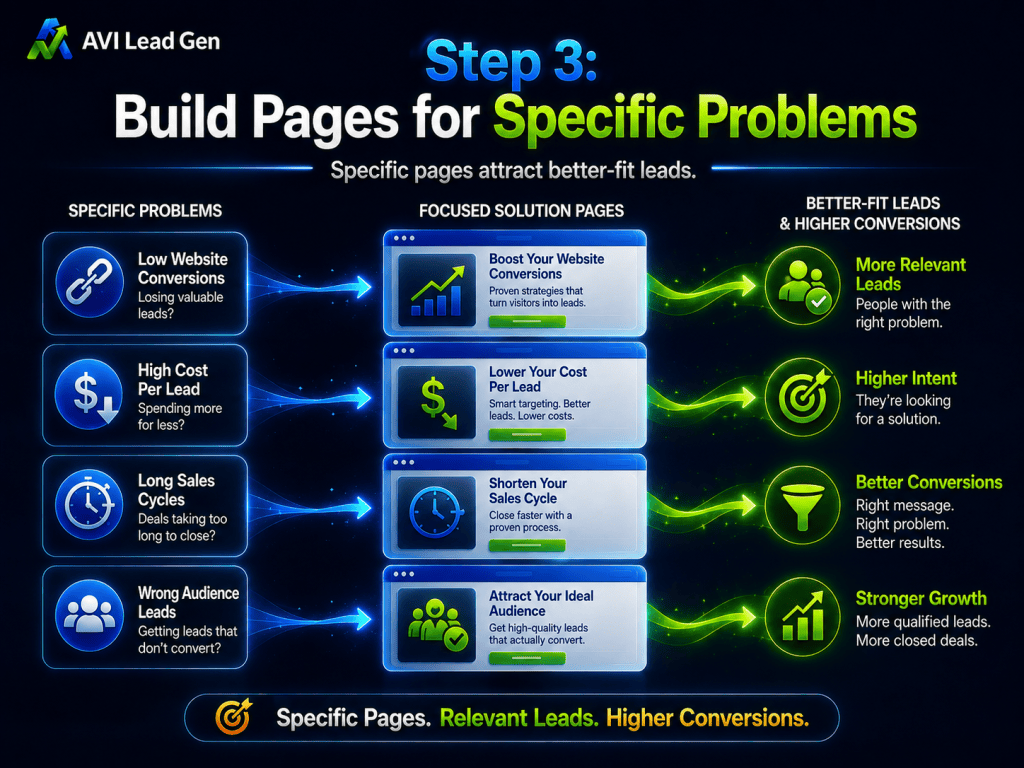
Qualified traffic needs somewhere useful to land.
If every visitor gets sent to the homepage, you may be wasting intent.
The homepage has a role. It should explain who you help, what you do, and how the system works.
But many visitors need something more specific.
A person searching for lead follow-up automation shouldn’t have to dig through a generic homepage to figure out whether you can help.
A person searching for appointment booking systems should land on a page that talks about booking, reminders, confirmation, follow-up, and CRM connection.
A person searching for lead generation websites should land on a page that explains how the website captures and converts visitors.
Specific pages help match the visitor’s intent.
That improves the experience and gives the business a better chance to turn traffic into action.
Examples of focused pages include:
Service pages
Landing pages
Lead magnet pages
Comparison pages
Problem-specific blog posts
Local service pages, when relevant
Booking or consultation pages
Each page should answer a simple question:
“What does this visitor need to understand before taking the next step?”
A high-converting website does that well, giving traffic a better chance of turning into a lead.
Step 4: Use SEO to Capture Existing Demand
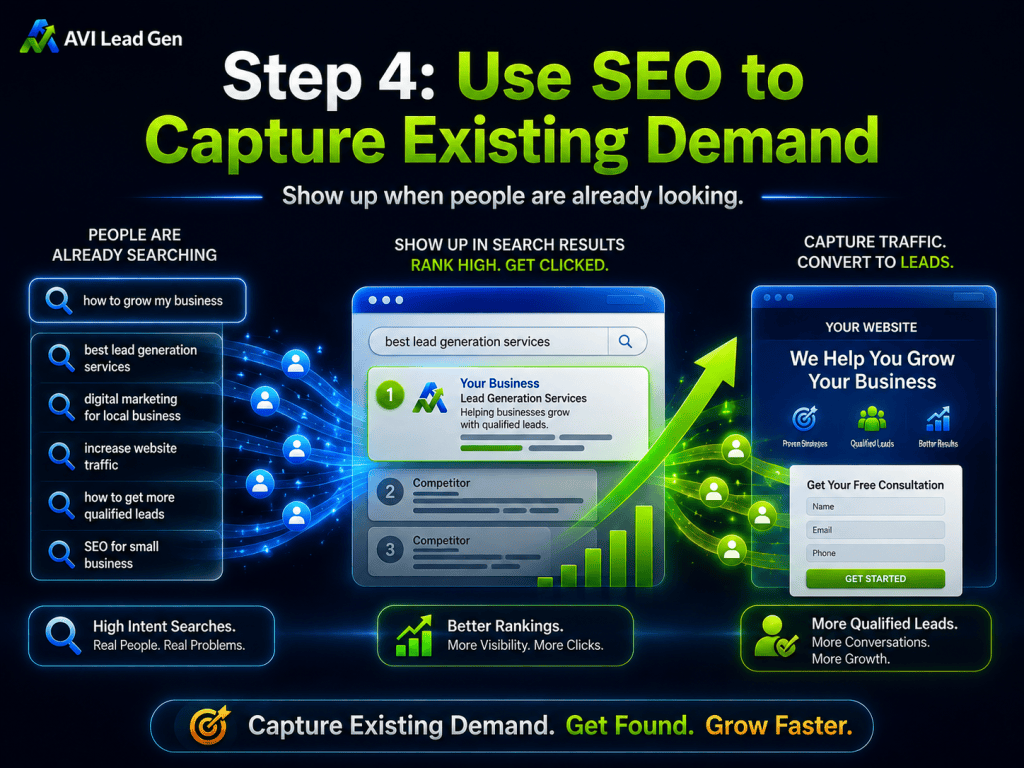
SEO is useful because it helps your business get found by people already searching for answers.
That’s why SEO can be one of the best sources of qualified traffic over the SEO timeline.
But SEO works best when it’s built around intent, not just keywords.
A keyword isn’t valuable only because it has search volume.
It’s valuable when the person searching it is likely to care about your offer.
For example, a small business lead generation company shouldn’t chase every marketing keyword. It should focus on topics that connect back to the problems it solves.
That might include:
Lead generation websites
Website conversion
Lead capture
CRM automation
Lead follow-up
Appointment booking
Lead qualification
Sales conversion
Tracking and funnel improvement
Those topics support the system AVI sells.
They also help build topical authority around the same message.
The goal isn’t to rank for random traffic.
The goal is to build a content library that attracts the right business owners and guides them toward the next step.
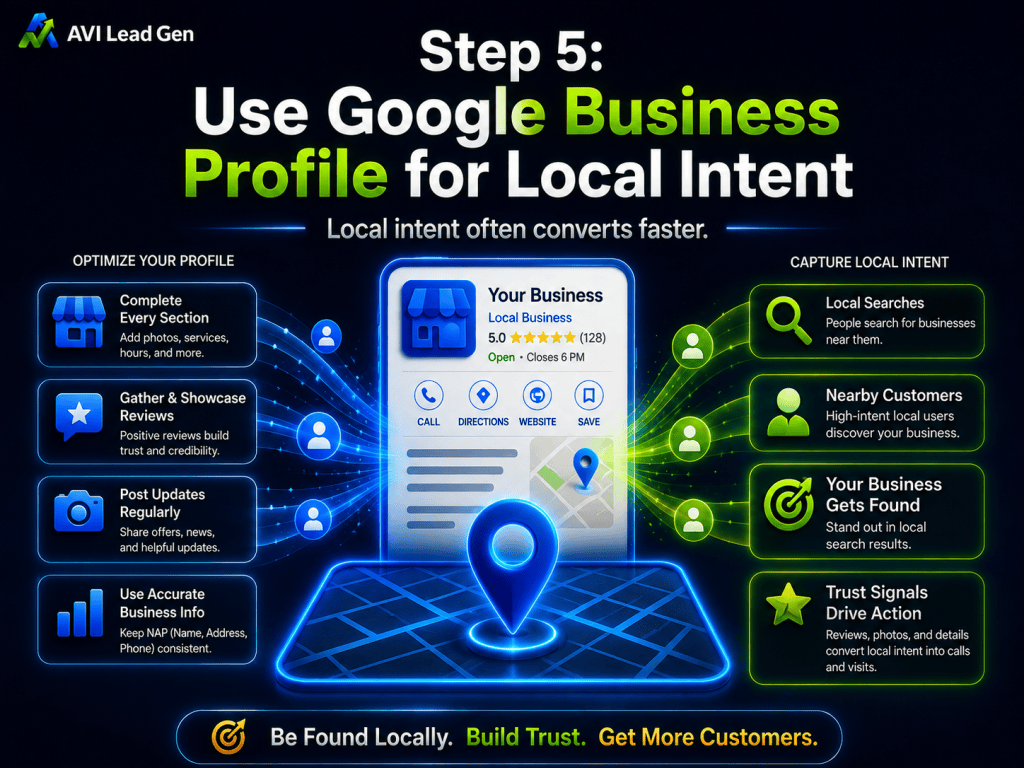
Step 5: Use Google Business Profile for Local Intent
For local and regional businesses, Google Business Profile can help capture people who are looking for a real provider, not just general information.
This matters because local intent can be strong.
People searching near them may be comparing options, checking reviews, looking at photos, reading updates, or deciding who to contact.
A Google Business Profile can support qualified traffic by helping people understand:
What the business does
Where it serves
How to contact it
Whether it looks active
What customers say
What services are offered
Where to go next
The profile shouldn’t operate separately from the website.
It should support the same lead generation path.
When someone clicks from the profile to the website, they should land somewhere useful. That might be the homepage, a service page, a consultation page, or a specific offer page depending on the business.
The profile builds confidence.
The website captures and converts the opportunity.
That connection matters.
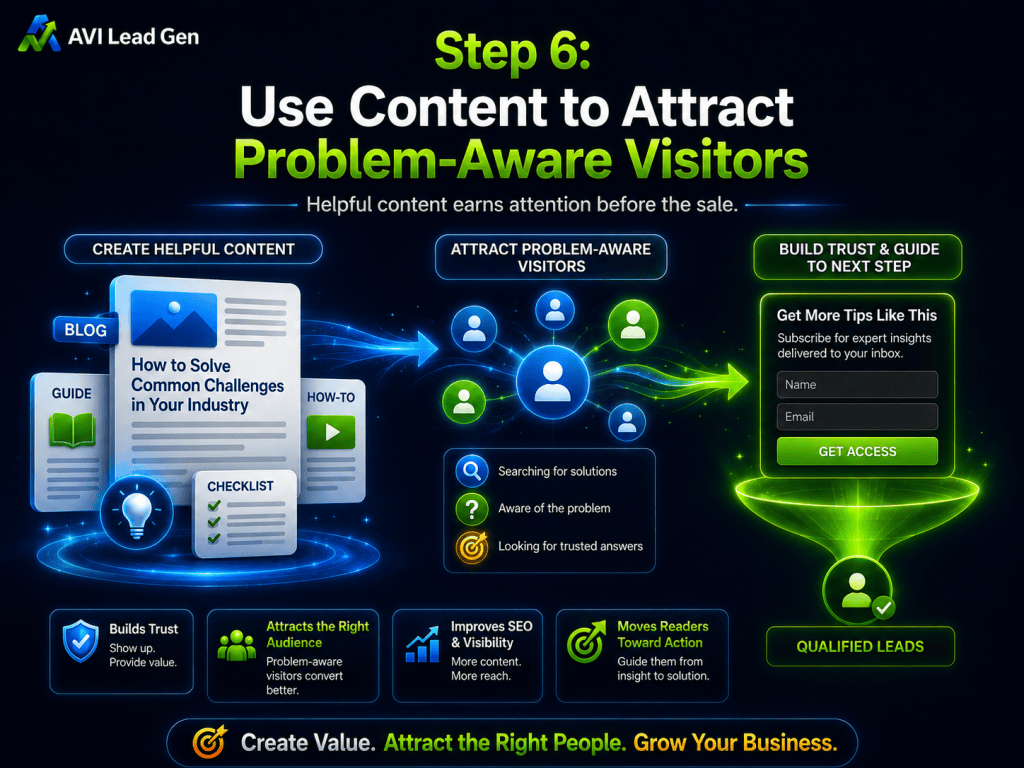
Step 6: Use Content to Attract Problem-Aware Visitors
Blog content isn’t just for “posting something.”
It should attract people who are problem-aware.
A problem-aware visitor may not be ready to buy today, but they know something is wrong.
They may be asking:
Why am I getting traffic but no leads?
Why are my leads not booking calls?
Why are my booked appointments not turning into customers?
How do I follow up with leads faster?
How do I qualify leads before they book?
How do I know which part of my lead generation system is broken?
These are valuable questions because they connect directly to business pain.
The right blog content can help lead qualification by letting visitors understand the problem and see the need for a better system.
That’s where AVI’s content should stay focused.
Every article should help readers move closer to understanding one of these ideas:
Traffic needs the right destination.
Websites need lead capture.
Leads need follow-up.
Appointments need structure.
Prospects need qualification.
Sales need clear next steps.
Growth needs tracking.
That’s how content becomes part of a lead generation system instead of a disconnected publishing habit.

Step 7: Use Paid Ads Carefully
Paid ads can help get traffic faster, but they can also waste money quickly.
The issue isn’t whether paid ads are good or bad.
The issue is whether the system behind the ad is ready.
If you pay for clicks before the message, page, form, follow-up, booking path, and tracking are clear, you may just pay to expose the weak spots faster.
Before running ads, make sure you know:
Who the ad is for
What problem the ad speaks to
Which page the person will land on
What action you want them to take
How the lead will be captured
What follow-up happens next
How you’ll track quality, not just clicks
This is especially important for small businesses with limited ad budgets.
Paid traffic should be treated like fuel.
If the engine isn’t ready, more fuel doesn’t solve the problem.
A better approach is to make sure the landing page and follow-up system are strong first. Then paid ads can be tested with clearer expectations.
If the traffic converts, you can scale carefully.
If it doesn’t, you can see where the system is breaking.
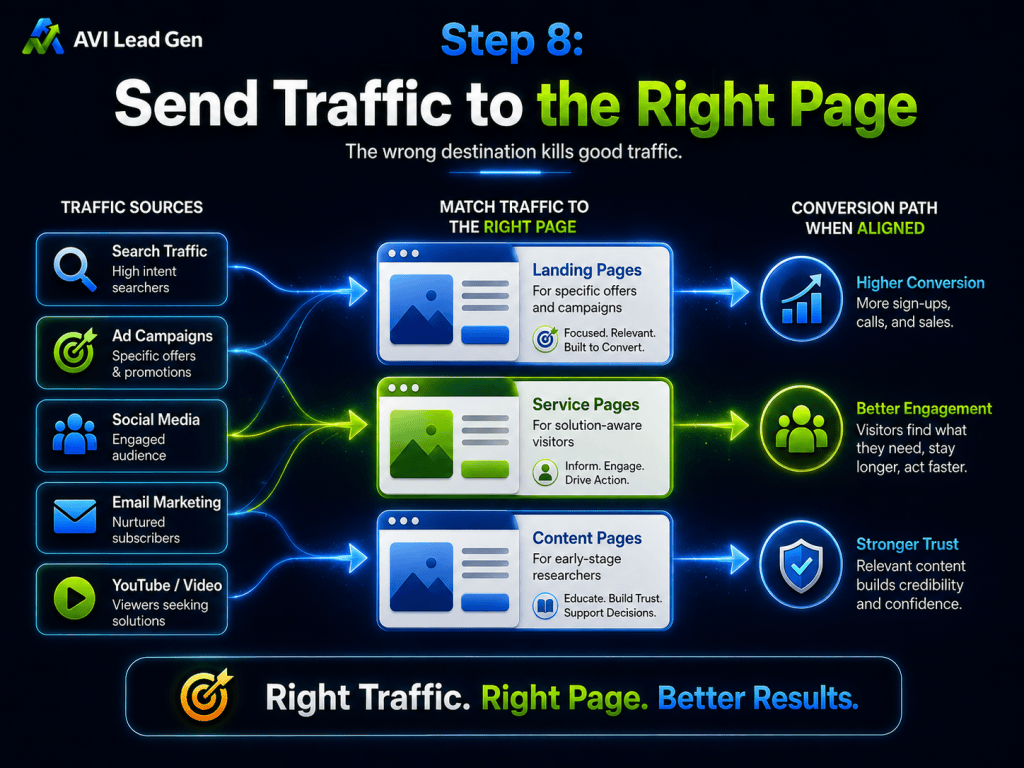
Step 8: Send Traffic to the Right Page
One of the fastest ways to waste traffic is to send everyone to the same place.
The right landing page depends on intent.
Someone searching for a specific service should usually land on a page about that service.
Someone clicking a lead magnet should land on a focused opt-in page.
Someone coming from a social post may need a clear article or offer page that continues the message they clicked.
Someone comparing providers may need a page that explains your process, offer, proof, and next step.
This is where many businesses lose people.
The visitor clicks because something seemed relevant, then lands on a page that feels too broad, confusing, or disconnected.
The page has to continue the conversation.
A good traffic path looks like this:
Source → message → landing page → lead capture → follow-up → booking → sale
Each step should make sense based on the step before it.
If the ad, search result, social post, or referral promise doesn’t match the landing page, the visitor may leave.
If the landing page doesn’t offer a clear next step, the visitor may leave.
If the form works but follow-up is slow, the opportunity may go cold before a booked appointment can be set.
Qualified traffic only becomes valuable when the path after the click is built correctly.
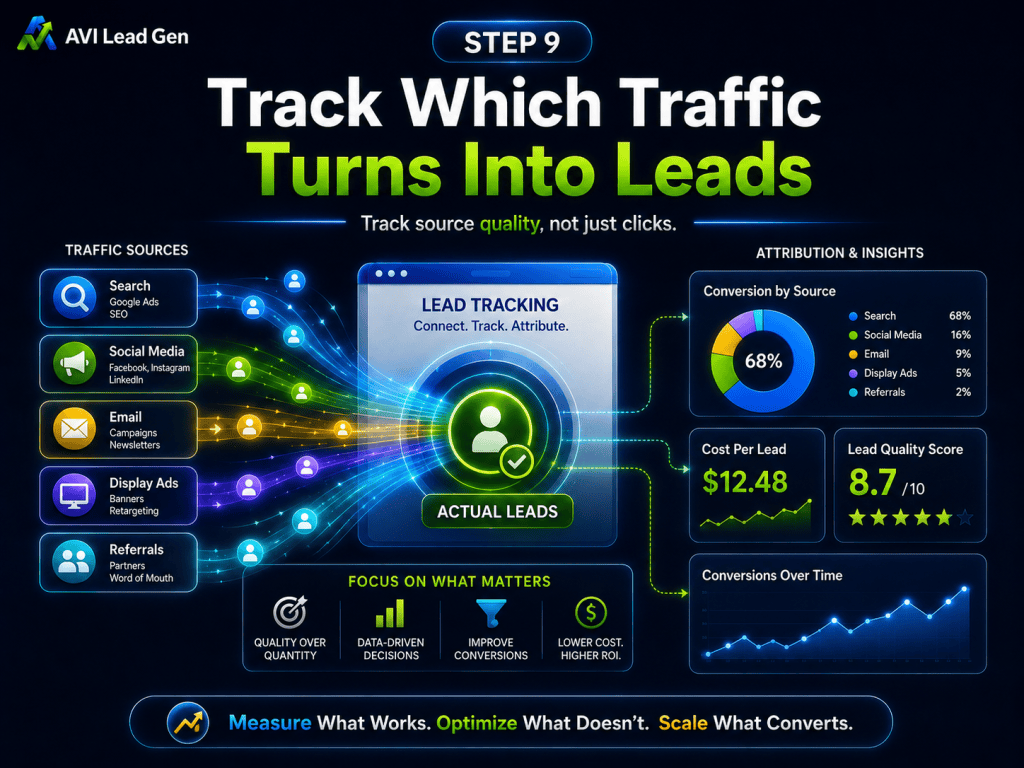
Step 9: Track Traffic to Leads Conversions
Traffic data by itself isn’t enough.
You need to know which traffic sources actually create leads, appointments, and customers.
That means tracking more than visits.
Useful numbers include:
Traffic source
Landing page
Form submissions
Lead quality
Booking clicks
Calls booked
Calls completed
Qualified opportunities
Customers won
Revenue, when available
Without fully tracking traffic to leads, it’s easy to overvalue the wrong source.
A channel may send a lot of traffic but few qualified leads.
Another channel may send fewer visitors but better opportunities.
That difference matters, particularly in a lead generation audit.
Tracking helps you decide where to spend more time, where to improve the page, where to adjust the offer, and where to stop wasting effort.
This is also why traffic strategy should connect to CRM and conversion tracking.
The website shouldn’t only tell you how many people arrived.
It should help show what happened after they arrived.
With relevant data, tracking and improving your lead generation funnel becomes possible
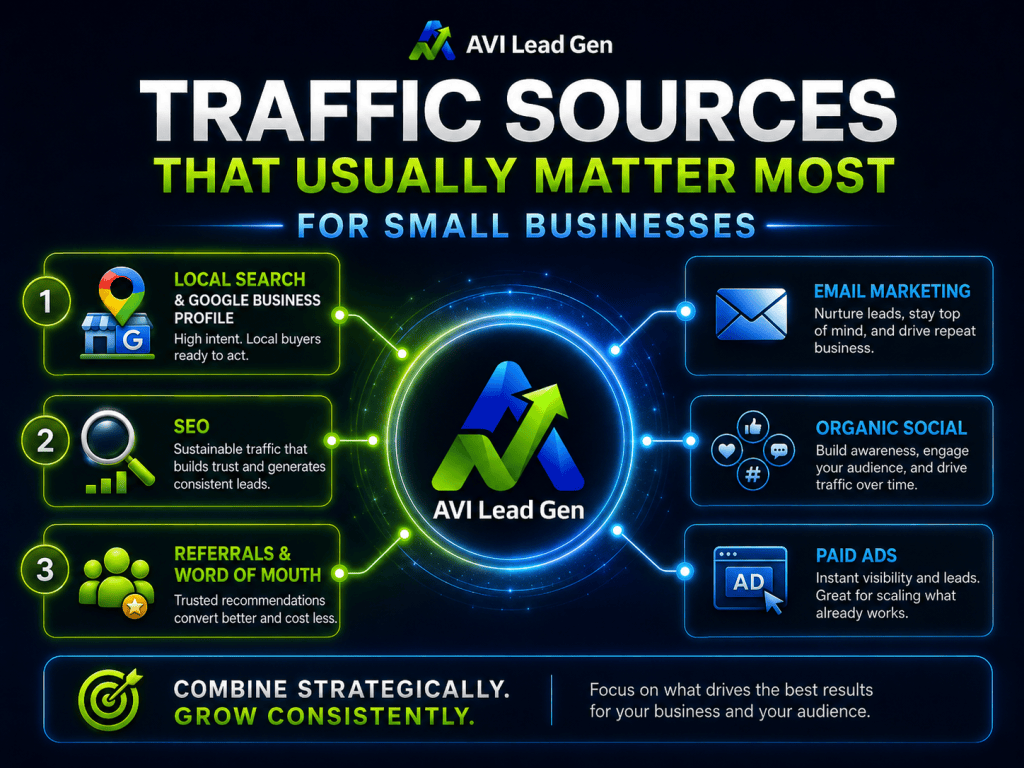
Traffic Sources That Usually Matter Most for Small Businesses
There are many ways to get website traffic that converts, but most small businesses don’t need to chase every channel at once.
A better approach is to focus on the channels most likely to attract qualified visitors.
Google Search
Google Search is valuable because it captures people who are already looking for something.
They may be searching for a service, asking a question, comparing options, or trying to solve a problem.
That makes search traffic useful for lead generation, especially when the content or page matches the intent.
SEO is slower than paid ads, but it can compound over time when the content library is focused and useful.
For AVI-style systems, search traffic works best when it connects to problem-specific pages and clear calls to action.
Google Business Profile
Google Business Profile can support local trust and discovery.
For small businesses serving a defined area, the profile may be one of the first places a prospect checks before visiting the website or making contact.
A profile that looks active, accurate, and connected to the website can help move people from local discovery to real inquiry.
The key is consistency.
The business name, services, website, phone number, description, and updates should match the broader brand.
Referral Traffic
Referral traffic can be very valuable because it often comes with borrowed trust.
Someone may click from a partner site, directory, client recommendation, social profile, podcast, newsletter, or another trusted source.
These visitors may already have context before they arrive.
That means the landing page should reinforce the recommendation and make the next step easy.
Referral traffic shouldn’t be ignored just because it may be smaller in volume.
It can be higher quality than broad traffic when the source is relevant.
Direct Traffic
Direct traffic often includes people who already know your business name or have interacted with the brand before.
They may have seen a social post, received an email, heard about you from someone else, or returned after a previous visit.
Direct traffic can be harder to interpret, but it still matters.
It’s often a sign that people are remembering the brand or coming back with stronger intent.
The website should be ready when they return.
Social Media Traffic
Social traffic can build awareness and trust, but it usually works differently from search traffic.
People on social platforms aren’t always actively looking for a solution at that moment.
That means the message needs to be practical, clear, and easy to connect back to a real business problem.
For AVI, social posts should support the content library and reinforce the system message.
The goal isn’t just likes.
The goal is to help the right people recognize a problem and move toward the website when they’re ready.
Paid Search
Paid search can produce qualified traffic when it targets high-intent keywords and sends people to the right landing page.
It can also waste money if the offer is unclear, the targeting is too broad, or the landing page is weak.
Paid search is best used when the business has a clear offer, a focused page, a follow-up process, and tracking.
Otherwise, it may create clicks without opportunities.

Traffic Mistakes That Waste Time and Money
Qualified traffic isn’t only about what you do.
It’s also about what you avoid.
Here are some of the biggest mistakes.
Mistake 1: Chasing Volume Instead of Intent
More traffic isn’t always better.
A smaller number of high-intent visitors can be more valuable than a large number of poor-fit visitors.
If the traffic doesn’t match your offer, the numbers may look good while the pipeline stays weak.
Mistake 2: Sending Everyone to the Homepage
The homepage is important, but it shouldn’t carry every traffic source.
Specific searches, ads, social campaigns, and lead magnets often need specific landing pages.
When the page matches the visitor’s intent, the path to action becomes clearer.
Mistake 3: Using Vague Calls to Action
A vague CTA like “Contact Us” may not be enough.
The visitor should understand what happens next and why they should take that step.
Better CTAs are tied to the offer and the stage of the visitor.
Examples include:
Book a Strategy Call
See How the Full System Works
Get the Checklist
Request a Consultation
Start With a Lead Generation Audit
The CTA should make the next step feel obvious.
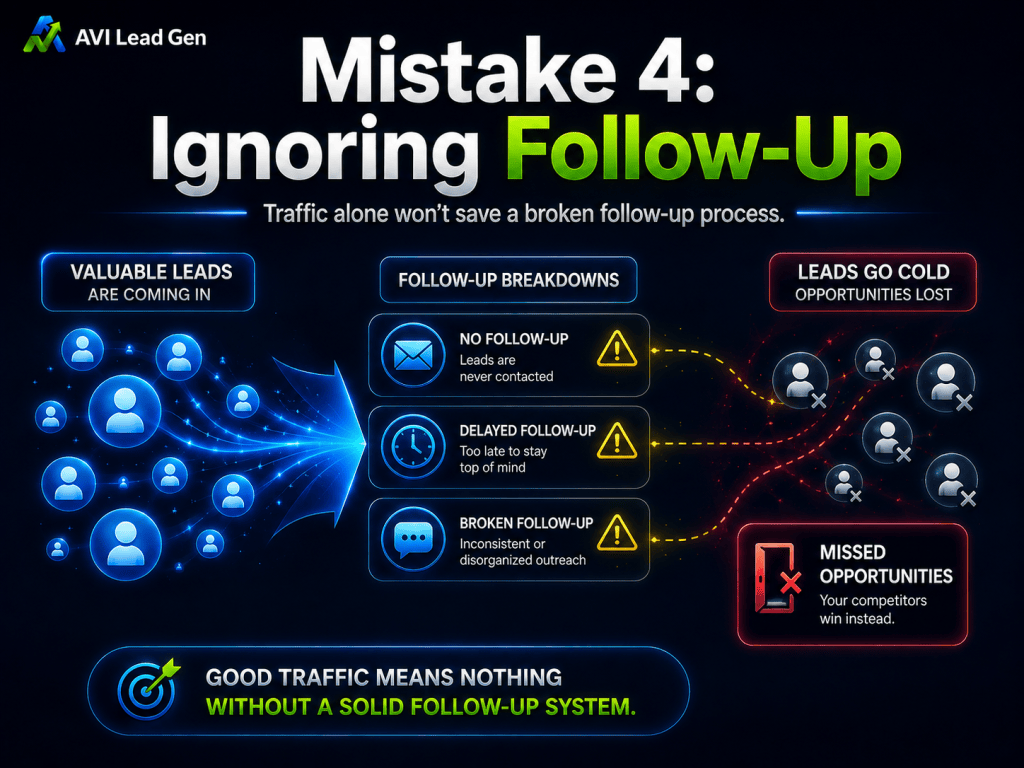
Mistake 4: Ignoring Follow-Up
Traffic can create interest, but follow-up turns interest into movement.
If someone fills out a form and nothing useful happens afterward, the business may lose the opportunity.
Follow-up should be fast, relevant, and connected to the action the person took.
A lead who requests a consultation shouldn’t receive the same follow-up as someone who downloads a basic guide.
The system should respond based on intent.
Using resources like lead follow-up automation can ensure immediate follow-up.
Mistake 5: Not Tracking Lead Quality
A traffic source isn’t automatically valuable because it sends visitors.
It’s valuable when it sends people who become leads, appointments, opportunities, or customers.
If you only track visits, you may keep investing in the wrong things.
Lead quality has to be part of the measurement.

Where Conversion Fits Into the Traffic Strategy
Traffic and conversion shouldn’t be treated as separate projects.
They’re connected.
Qualified traffic gives you a better chance of attracting the right people.
Conversion systems give those people a path to take action.
If either side is weak, results suffer.
Good traffic with a weak website may not convert.
A strong website with poor-fit traffic may still struggle.
A good lead capture form with no follow-up may lose momentum.
A strong booking path with unqualified traffic may fill the calendar with poor-fit calls.
That’s why AVI’s approach is system-based.
The question isn’t just:
“How do we get more visitors?”
The better question is:
“How do we attract the right visitors and move them through a clear path from interest to opportunity?”
That path includes:
Traffic source
Landing page
Message match
Lead capture
CRM organization
Follow-up
Booking
Qualification
Sales conversion
Tracking
When those pieces work together, traffic becomes more useful.

The Bottom Line for Website Traffic that Converts
More traffic isn’t the same thing as more growth.
If the wrong people are visiting the wrong pages, more clicks won’t fix the problem.
Qualified website traffic works differently.
It starts with knowing who you want to attract. It uses content, SEO, local visibility, referrals, and paid traffic carefully. It sends visitors to pages that match their intent. It gives them a clear next step. It tracks what happens after the click.
That’s how traffic becomes part of a lead generation system.
The goal isn’t to get attention from everyone.
It’s how to attract high-intent website visitors and give them a clear path to become leads, appointments, and customers.
Ready to Turn Better Traffic Into Real Leads?
If you’re getting website traffic but not enough real opportunities, the issue may not be traffic alone.
It may be the system behind the traffic.
Ready to stop guessing and build a lead generation system that works around the clock?
AVI Lead Gen helps small businesses capture leads, automate follow-up, and turn more website visitors into real opportunities.
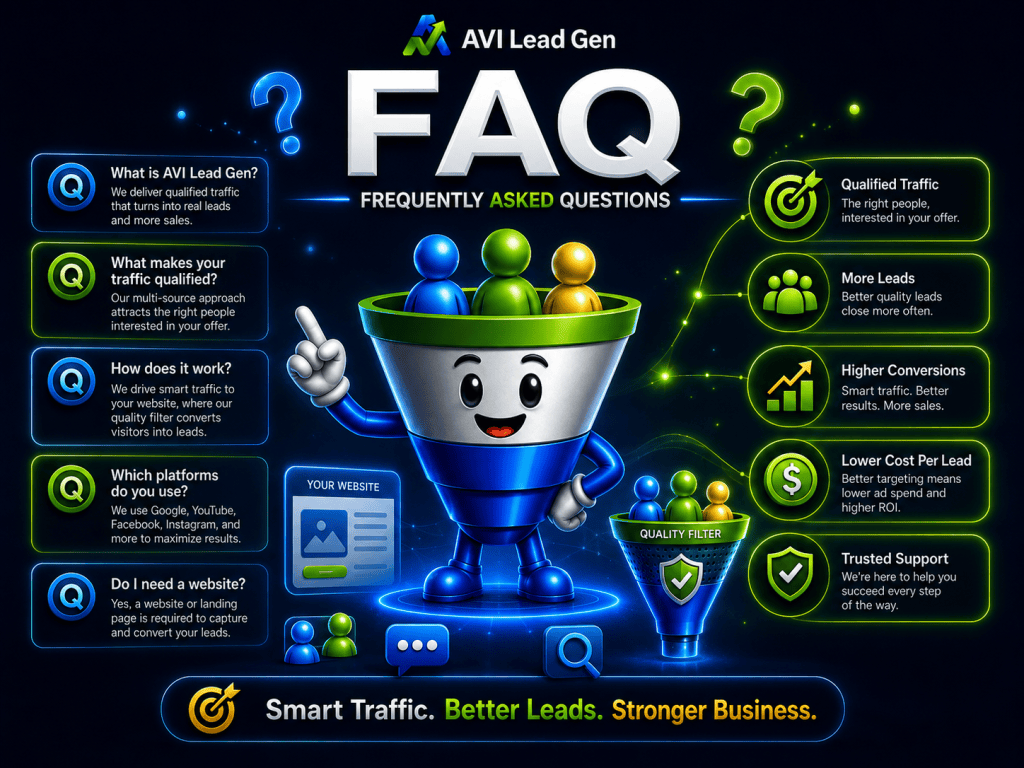
FAQ
What is qualified website traffic?
Qualified website traffic is made up of visitors who match your target audience, have a relevant problem, and are more likely to take a useful next step. They may not be ready to buy immediately, but they have enough fit or intent to be worth attracting, capturing, and following up with.
How do you get more qualified traffic to your website?
You get more qualified traffic to your website by defining your ideal customer, creating pages around specific problems, targeting keywords with real buyer intent, using Google Business Profile for local discovery, publishing helpful content, building referral paths, and sending visitors to pages that match what they need.
Why am I getting website traffic but no leads?
You may be getting traffic but no leads because the visitors aren’t qualified, the page doesn’t match their intent, the offer is unclear, the call to action is weak, the form isn’t useful, or there’s no follow-up system after someone shows interest.
Is SEO or paid ads better for qualified traffic?
SEO is often better for long-term qualified traffic because it captures people searching for useful information over time. Paid ads can work faster, but they need a clear offer, strong landing page, good targeting, and tracking. The better option depends on your goals, budget, timeline, and whether your conversion system is ready.
Should I send all traffic to my homepage?
No. Your homepage is important, but not every visitor should land there. Specific traffic sources often need specific pages. A service keyword should point to a service page. A lead magnet should point to an opt-in page. A paid ad should point to a focused landing page. The page should match the visitor’s intent.
What traffic sources work best for small businesses?
The strongest traffic sources for many small businesses are Google Search, Google Business Profile, referral traffic, direct traffic, useful content, social media, and carefully targeted paid search. The best source depends on the business, audience, offer, and how well the website converts visitors into leads.
What matters more: traffic or conversion?
Both matter, but conversion usually needs to be fixed before scaling traffic. More traffic won’t help much if the website doesn’t capture leads, follow up quickly, guide people toward booking, or track results. Qualified traffic and strong conversion systems work best together.
How do I know which traffic source is working?
Track more than pageviews. Look at which sources create form submissions, booking clicks, calls booked, qualified opportunities, customers, and revenue. A source with fewer visitors may be more valuable if it sends better leads.


