
Most business owners know when something feels off.
The phone is not ringing enough. Form submissions are slow. Leads come in, but they don’t turn into customers. Website traffic looks decent, but revenue still feels inconsistent.
The frustrating part is not always the lack of activity.
It is not knowing where the problem actually is.
That’s why a lead generation audit matters.
A good audit does not start by assuming you need more traffic, a new website, more ads, or another marketing tool. It starts by looking at the full system and asking a better question:
Where are opportunities getting stuck?
At AVI Lead Gen, we believe small business growth gets easier to improve when the system becomes visible. Traffic, website conversion, lead capture, follow-up, qualification, booking, sales, and retention all work together.
If one stage breaks down, the entire system can underperform.
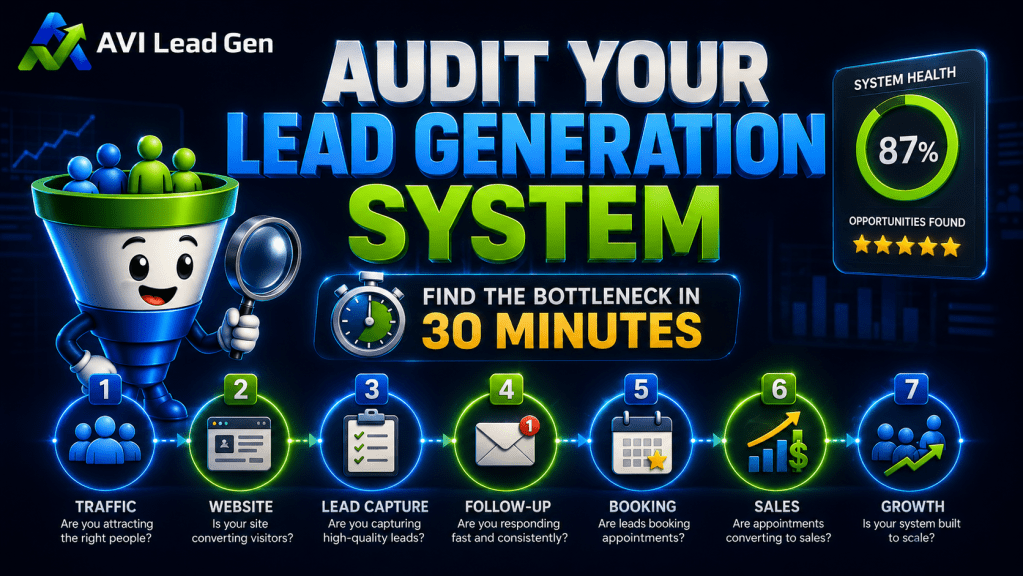
This article walks through a simple 30-minute lead generation audit you can use to find the first bottleneck worth fixing.
What Is a Lead Generation Audit?
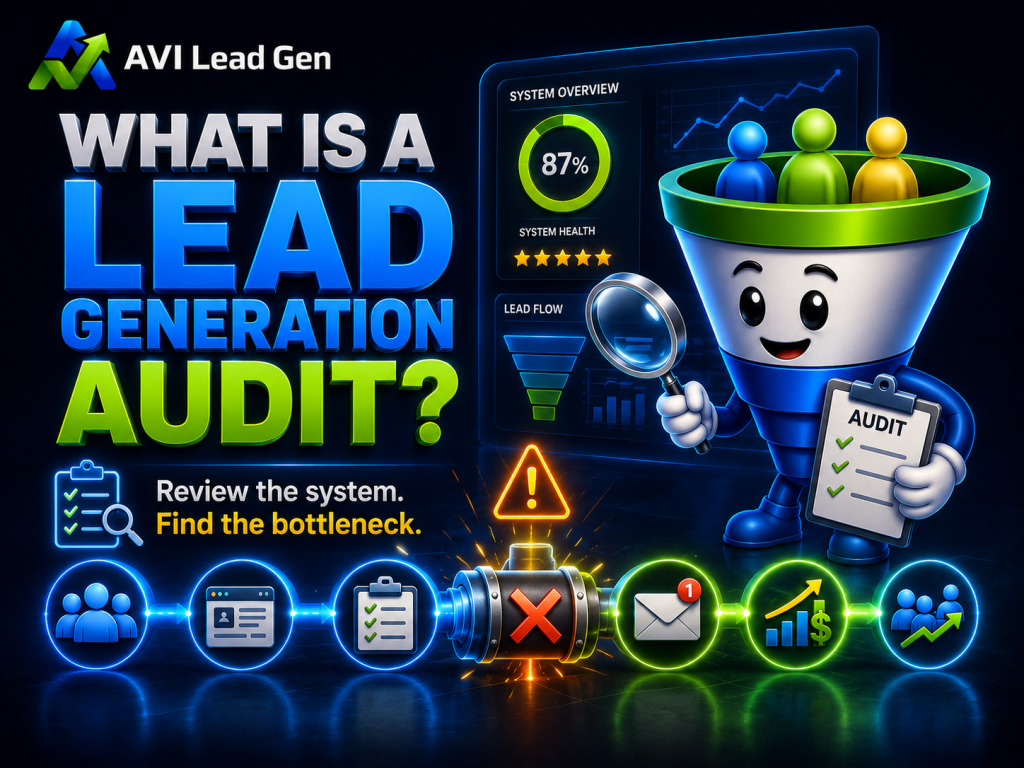
A lead generation audit is a simple review of how people move from first discovering your business to becoming a customer.
It looks at the full path:
Traffic to website.
Website to lead.
Lead to follow-up.
Follow-up to appointment.
Appointment to customer.
Customer to repeat business or referral.
The goal is not to judge every part of your marketing at once. The goal is to find the stage where the biggest drop-off is happening.
For some businesses, the problem is visibility. Not enough qualified people are finding the website.
For others, traffic exists, but visitors are not taking action.
Some businesses get leads, but follow-up is too slow. Others book plenty of calls, but too few turn into customers.
A lead generation audit helps you stop guessing.
Instead of asking, “What else should we add?”
You start asking, “What is preventing the current system from working better?”
That question usually leads to better decisions.
Why Most Businesses Skip the Audit
Most small businesses do not skip audits because they are careless.
They skip them because they are busy.
When leads slow down, the natural reaction is to look for the fastest fix. Run ads. Post more. Rewrite the homepage. Change the offer. Add another tool. Try a new campaign.
Sometimes those things help.
But when the real issue is hidden deeper in the system, new tactics can create more activity without improving growth.
More traffic will not fix a website that does not convert.
More leads will not fix slow follow-up.
More booked calls will not fix poor qualification.
More customers will not fix weak onboarding or retention.
That is why the audit comes first.
Before adding more pressure to the system, you need to know where the system is leaking.
A Simple 30-Minute Lead Generation Audit
You do not need a complicated dashboard to start.
You need a clear view of the major stages and enough information to spot where progress slows down.
Set a timer for 30 minutes and walk through these eight areas:
- Traffic quality
- Website conversion
- Lead capture paths
- Follow-up speed
- Lead qualification
- Appointment booking
- Sales conversion
- Retention and referrals
You are not trying to solve everything in one sitting.
You are trying to identify the first constraint.
That matters because fixing the right bottleneck often creates more improvement than changing five random things at once.
Step 1: Check Your Traffic Quality
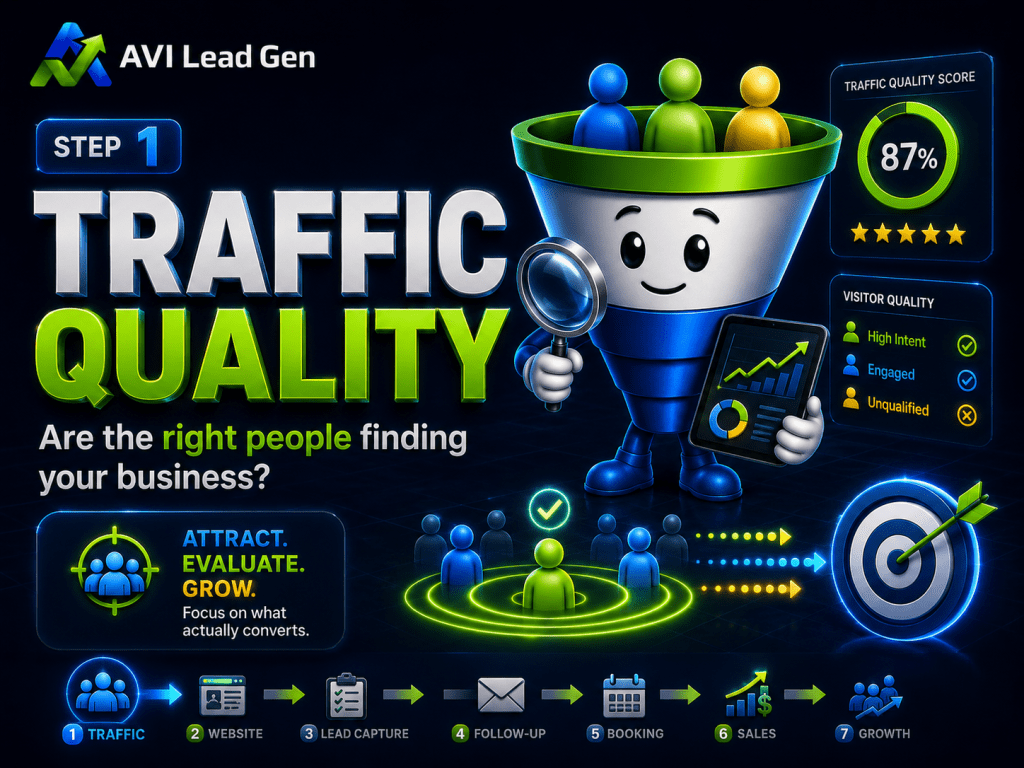
Start with the top of the system.
Are the right people finding your business?
Traffic volume matters, but traffic quality matters more. A website can get visitors and still generate very few opportunities if those visitors are not a good fit.
Look at where visitors are coming from. Search engines, social media, referrals, paid ads, directory listings, local map results, and email can all bring different types of traffic.
Then ask:
Are these visitors likely to need what we sell?
Are they local or serviceable?
Are they looking for help now, or only browsing?
Are they landing on pages that match their intent?
Are we attracting decision-makers, or just low-intent clicks?
If your website traffic is low, your bottleneck may be visibility.
If your traffic is steady but leads are weak, the issue may not be traffic at all. It may be what happens after visitors arrive.
This is where many businesses make the wrong move. They assume more traffic is the answer before checking whether the current traffic is converting.
If you’re not attracting enough of the right visitors, review how your content, local SEO, service pages, and offers are aligned with the people you actually want to reach.
Step 2: Check Website Conversion

Next, look at what happens when someone lands on your website.
A good website should help visitors understand three things quickly:
What you do.
Who you help.
What they should do next.
If those answers are unclear, visitors may leave even if they are interested.
Website conversion problems often show up in simple ways. People visit the site but do not call. They read the homepage but don’t click deeper. They reach a service page but don’t submit a form. They seem interested, but they never take the next step.
This doesn’t always mean the website looks bad.
A website can look professional and still fail to convert.
The issue may be unclear messaging, weak calls-to-action, buried forms, too many choices, generic service descriptions, slow pages, or a poor mobile experience.
During your audit, review your most important pages and ask:
Is the main offer clear within the first few seconds?
Does the page speak to the visitor’s problem?
Is there a clear next step?
Are calls-to-action easy to see?
Does the page build enough trust?
Does the mobile version make action easy?
If people are visiting your website but not becoming leads, this is likely one of the first bottlenecks to fix.
Step 3: Check Your Lead Capture Paths
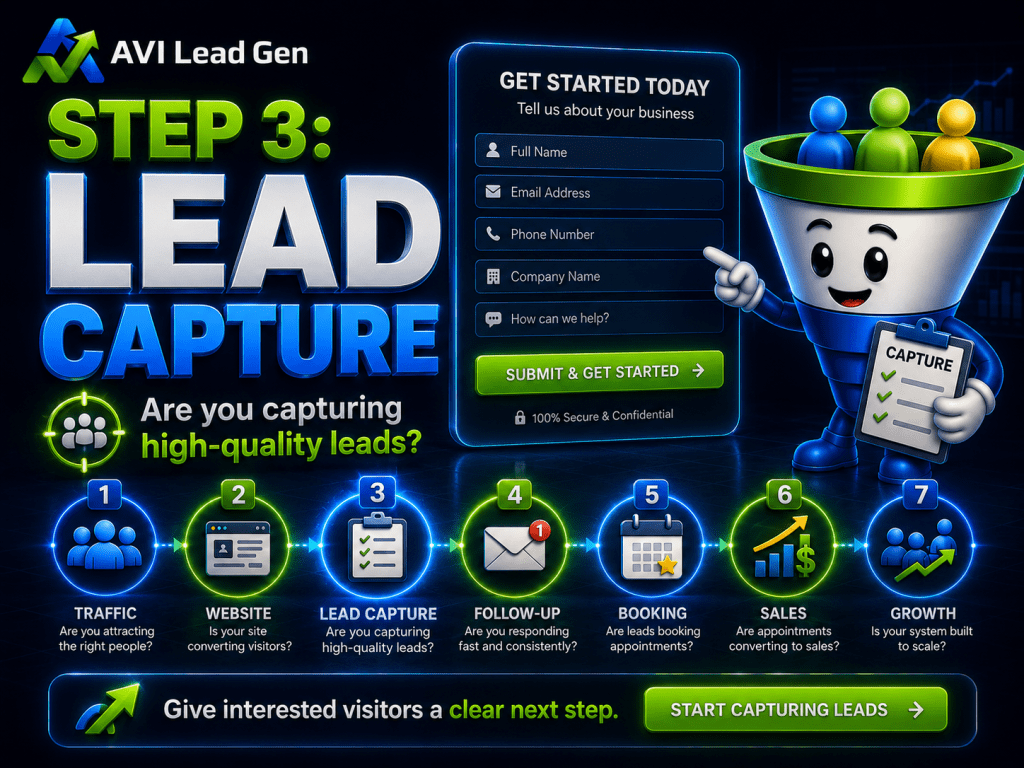
Once your website creates interest, it needs to make action easy.
That’s where lead capture comes in.
Lead capture includes the forms, booking calendars, phone buttons, quote requests, lead magnets, popups, and contact options that help visitors become leads.
The problem is that many websites give visitors only one vague option: “Contact Us.”
That may work for some people, but not everyone is ready for the same next step.
Some visitors are ready to book a call. Some want to request a quote. Some need a few questions answered. Some want to download a resource before talking to anyone.
A stronger lead capture system gives people a clear path based on their level of intent.
During your audit, ask:
Can visitors easily find a form or booking option?
Is the form short enough to complete quickly?
Does the call-to-action match the visitor’s intent?
Is there a clear option for high-intent visitors?
Is there a softer option for visitors who are not ready to book?
Do forms work properly on mobile?
Does every important page have a next step?
Lead capture should reduce friction.
If interested visitors have to search for the next step, the system is leaking opportunities.
This is also where the handoff matters. A form submission isn’t the finish line. It’s the start of the follow-up process.
Step 4: Check Follow-Up Speed

Follow-up is one of the easiest stages to underestimate.
A lead reaches out because they have some level of interest right now. If they wait too long for a response, that interest can fade quickly.
They may contact another company. They may get distracted. They may assume your business is too busy. They may forget why they filled out the form in the first place.
During your audit, review what actually happens when a new lead comes in.
Ask:
Who gets notified?
How fast does someone respond?
Does the lead receive an immediate confirmation?
Is there an internal reminder if no one follows up?
Are missed calls or form submissions tracked?
Does the CRM capture the lead correctly?
Is there an automated sequence if the lead doesn’t respond?
This stage is often where good leads quietly disappear.
A business may think it needs more leads when the real problem is that leads aren’t being handled quickly or consistently enough.
Fast follow-up doesn’t guarantee a sale, but slow follow-up can lose one.
If you’re generating inquiries but not turning enough of them into conversations, follow-up speed should be one of the first areas to review.
Step 5: Check Lead Qualification

Not every lead is worth the same amount of time.
That doesn’t mean low-fit leads should be ignored or treated poorly. It means your system needs a way to identify which leads are ready, qualified, and worth prioritizing.
Without qualification, your calendar can fill with people who aren’t a good fit.
They may not have the right budget. They may need a service you don’t provide. They may be outside your service area. They may not be ready to move forward. They may be shopping only for the lowest price.
This creates a different kind of bottleneck.
The business looks busy, but the pipeline is weak.
During your audit, ask:
Do our forms ask enough qualifying questions?
Do we know which leads are high intent?
Can we identify poor-fit leads before they book time?
Are leads tagged or segmented in the CRM?
Do different types of leads receive different follow-up?
Are we spending too much time with people who are unlikely to buy?
Qualification doesn’t need to make the process complicated.
It should make the next step smarter.
A few well-placed questions can help route leads more effectively, protect your calendar, and improve the quality of sales conversations.
Step 6: Check Appointment Booking
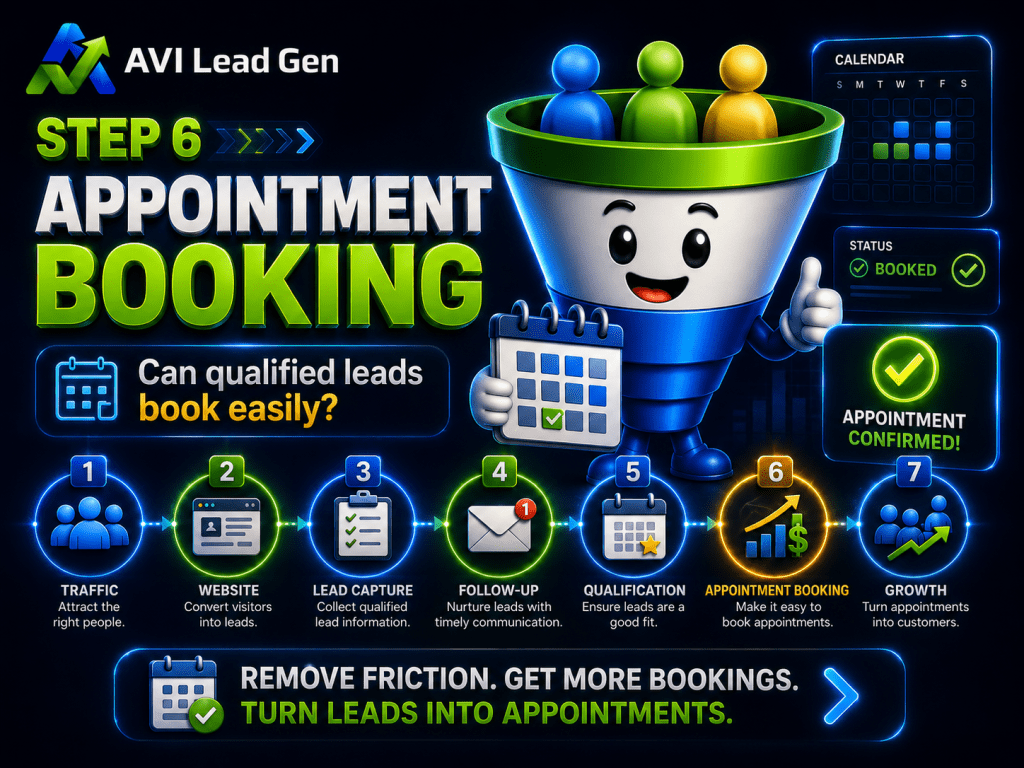
For many service businesses, the appointment is the bridge between interest and revenue.
If leads are interested but not booking, something is slowing them down.
This may happen because the booking process is confusing, the calendar is hard to find, the form asks for too much, available times are too limited, or the prospect does not understand the value of the call.
During your audit, ask:
Is booking easy from the website?
Can someone book from a mobile device without friction?
Does the booking page explain what happens on the call?
Are confirmation emails clear?
Are reminders sent before the appointment?
Is there a process for no-shows?
Are unbooked leads followed up with?
A booking system shouldn’t simply place an event on the calendar.
It should help the prospect feel confident about the next step.
If leads are coming in but appointments aren’t happening, the issue may be the transition between interest and scheduling.
That transition deserves attention because every extra step can lower momentum.
Step 7: Check Sales Conversion
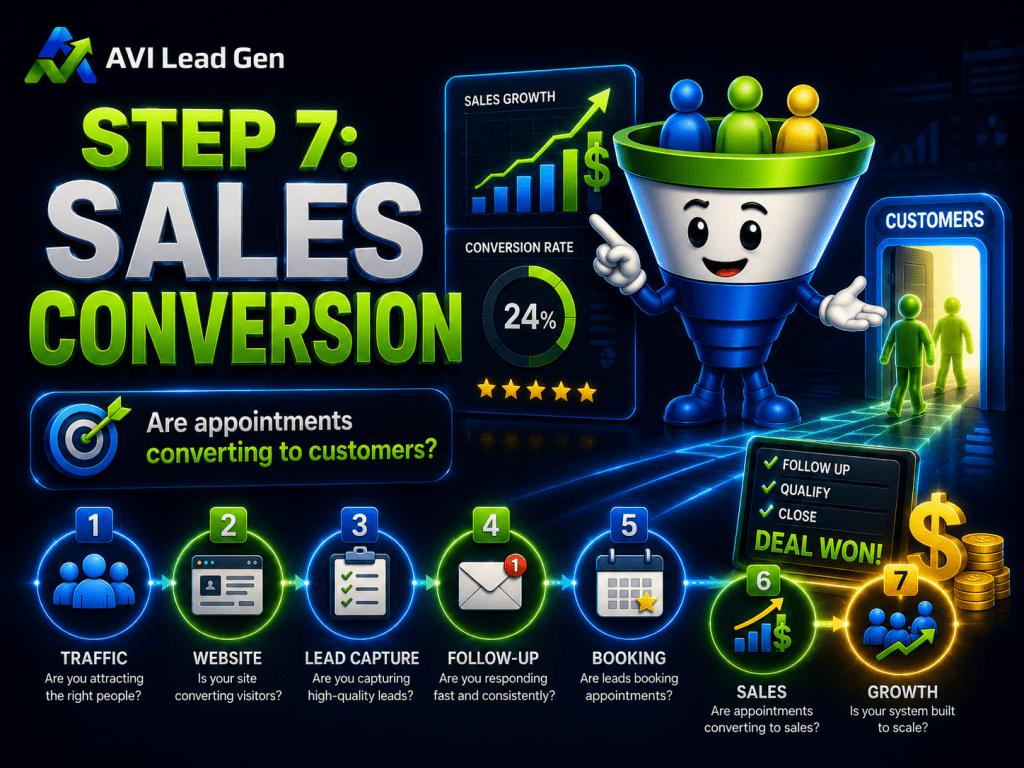
Some businesses generate leads and book appointments, but still struggle to turn those appointments into customers.
This is a sales conversion bottleneck.
It’s one of the most frustrating bottlenecks because everything looks close to working. The traffic’s there. The leads are there. Calls are happening. But the revenue doesn’t match the activity.
During your audit, review what happens during and after the sales conversation.
Ask:
Are prospects clear on the value before the call?
Is there a consistent discovery process?
Are the right questions being asked?
Is pricing connected to the problem being solved?
Are objections being addressed clearly?
Is there a defined next step after the call?
Are proposals followed up with consistently?
Are closed lost reasons being tracked?
A better sales process does not need to feel scripted or aggressive.
It simply needs structure.
The goal is to understand the prospect’s problem, confirm fit, explain the solution clearly, and guide them toward the next decision.
If appointments are happening but deals are not closing, more traffic may not be the answer. The bottleneck may be the sales process itself.
Step 8: Check Retention and Referrals

Lead generation doesn’t stop when someone becomes a customer.
If customers leave quickly, have a poor onboarding experience, or never refer others, the business has to work harder to replace lost momentum.
Retention and referrals are often ignored in lead generation conversations, but they matter.
A business that keeps customers longer and earns more referrals does not need to rely only on new traffic to grow.
During your sales funnel audit, ask:
What happens immediately after someone becomes a customer?
Is onboarding clear and organized?
Are expectations set properly?
Do customers receive communication after the sale?
Are reviews requested at the right time?
Is there a referral process?
Do happy customers know how to introduce someone else?
Poor onboarding creates friction. Weak communication lowers trust. No referral process leaves future opportunities to chance.
If your business wins customers but growth still feels inconsistent, the bottleneck may be after the sale.
A complete lead generation system should connect marketing, sales, and customer experience. Otherwise, you may keep filling the top of the funnel while losing momentum at the bottom.
A Realistic Example
Imagine a local accounting firm that wants more bookkeeping clients.
The owner assumes the problem is traffic because the website is not producing enough new business. So they consider running ads.
But before spending money, they complete a simple marketing bottleneck audit.
Here is what they find:
Website traffic is not huge, but it is steady.
The service page gets visitors every week.
The contact form is buried near the bottom of the page.
The call-to-action only says “Contact Us.”
Leads who do submit the form receive no immediate confirmation.
Follow-up usually happens the next day.
There is no booking option.
There is no lead qualification process.
The issue is not only traffic.
The bigger problem is that interested visitors don’t have a clear path forward.
In this case, ads might increase traffic, but they would send more people into the same weak system.
A better first move would be improving the service page, adding a clearer call-to-action, creating a simple booking path, sending immediate confirmation emails, and setting up faster follow-up.
That’s the difference between guessing and auditing.
The lead generation audit shows what to fix first.
How to Score Your Lead Generation Audit
After reviewing each stage, give yourself a simple score from 1 to 5.
1 means the stage is weak or unclear.
3 means it exists but needs improvement.
5 means it is clear, consistent, and working well.
Score these areas:
Traffic quality
Website conversion
Lead capture
Follow-up speed
Lead qualification
Appointment booking
Sales conversion
Retention and referrals
Then look for the lowest score closest to revenue.
That phrase matters: closest to revenue.
If your website has low traffic, but you’re already getting leads that don’t receive follow-up, fix follow-up first.
If you’re booking appointments but not closing, fix sales conversion before chasing more traffic.
If customers are buying but leaving quickly, fix onboarding and retention before adding more acquisition pressure.
You don’t always need to fix the earliest stage first.
You need to fix the constraint that’s most limiting growth right now.
What to Do After the Audit
Once you find the bottleneck, don’t try to fix everything at once.
Choose one area and improve it intentionally.
If traffic quality is the issue, improve content, local SEO, service pages, and targeting.
If website conversion is the issue, clarify the message, strengthen calls-to-action, improve page structure, and reduce friction.
If lead capture’s the issue, simplify forms, add booking options, and create stronger next steps.
If it’s follow-up, set up CRM alerts, automated confirmations, reminders, and follow-up sequences.
If qualification is the issue, add better form questions, lead scoring, tags, and routing.
If sales conversion issues are the culprit, improve discovery, proposal follow-up, objection handling, and next-step clarity.
If retention is the problem, improve onboarding, communication, review requests, and referral systems.
The goal isn’t perfection.
The goal is progress in the right place.
A system improves faster when the real bottleneck is clear.
Why This Audit Matters
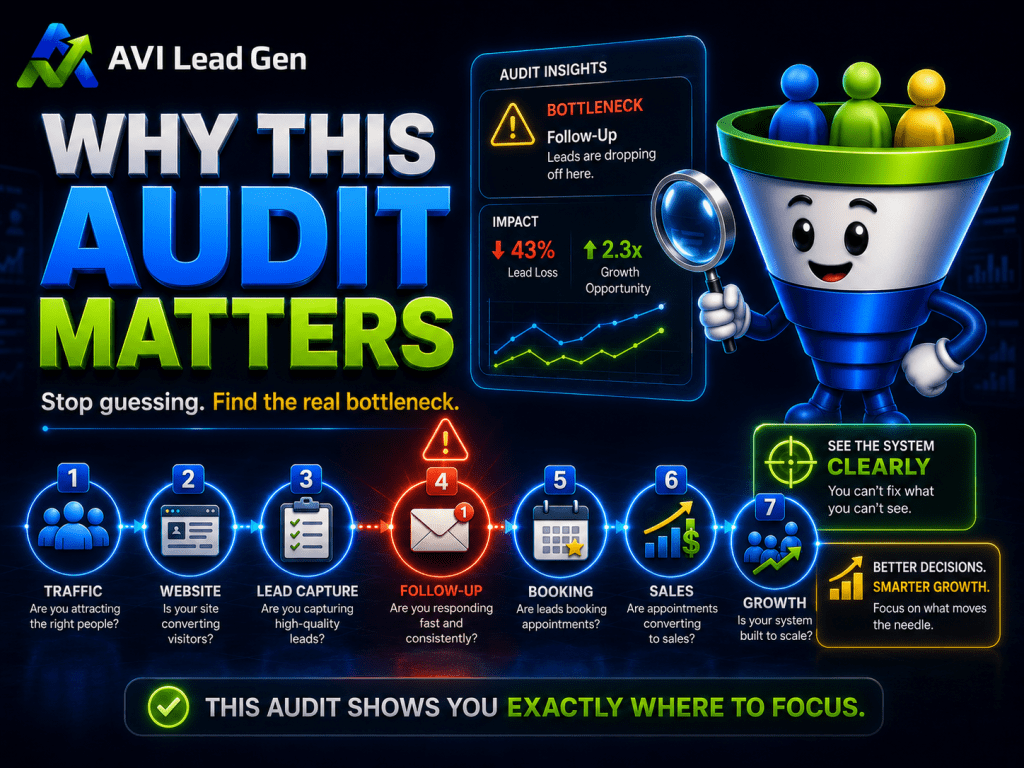
Without an audit, marketing decisions are often based on feelings.
The business feels slow, so you assume you need more leads.
The website feels outdated, so you assume you need a redesign.
The calendar feels empty, so you assume you need ads.
Those assumptions may be right, but they may also be expensive distractions.
A lead generation audit gives you a clearer view of the actual system.
It helps you see whether the problem is visibility, conversion, capture, follow-up, qualification, booking, sales, retention, or referrals.
That clarity matters because every stage affects the next one.
Better traffic helps only if the website converts.
Better conversion helps only if leads are captured.
Better lead capture helps only if follow-up happens.
Better follow-up helps only if prospects are qualified.
Better appointments help only if the sales process converts.
Better sales help only if customers stay, review, and refer.
Lead generation is not one tactic.
It’s a connected system.
The Bottom Line
If your business isn’t generating enough leads, don’t start by guessing.
Audit the system first.
Look at the full path from traffic to customer. Find where opportunities slow down. Identify the first bottleneck worth fixing.
Sometimes the answer is more traffic.
Sometimes it’s a better website.
Sometimes it’s faster follow-up, stronger qualification, clearer booking, better sales structure, or a more consistent post-sale experience.
The important thing is knowing which problem you are solving.
At AVI Lead Gen, we help small businesses build lead generation systems that connect website strategy, lead capture, CRM automation, booking, follow-up, and performance tracking.
Because growth gets easier when you can see the system clearly.
Ready to Find What’s Holding Back Your Lead Generation System?
Ready to stop guessing and build a lead generation system that works around the clock?
AVI Lead Gen helps small businesses capture leads, automate follow-up, and turn more website visitors into real opportunities.
Frequently Asked Questions
What is a lead generation audit?
A lead generation audit is a review of how prospects move through your marketing and sales system. It helps identify where people are dropping off between traffic, leads, appointments, customers, retention, and referrals.
How often should a small business audit its lead generation system?
A small business should review its lead generation system at least quarterly. If leads suddenly slow down, close rates drop, or traffic changes, it is worth auditing sooner.
What should I check first in a lead generation audit?
Start by checking where the biggest drop-off happens. If traffic is low, review visibility. If traffic is steady but leads are low, review website conversion. If leads are coming in but not booking, review follow-up and lead capture.
Can a lead generation audit help before running ads?
Yes. A lead generation audit can help you avoid sending paid traffic into a weak system. Before investing in ads, make sure your website, forms, follow-up, booking process, and sales process are ready to convert new opportunities.
What is the biggest lead generation problem for small businesses?
The biggest problem is usually not one single tactic. It is often a bottleneck somewhere in the system, such as weak website conversion, slow follow-up, poor qualification, or an unclear sales process.