Most business owners think they need more leads.
Sometimes they do.
But often, more leads are not the real solution. More traffic will not fix a website that does not convert. More form submissions will not fix slow follow-up. More booked appointments will not fix a weak sales process.
Every lead generation system has a constraint.
The businesses that grow fastest are usually not the ones chasing the next tactic. They are the ones that find the bottleneck, fix it, and make the system easier to move through.
That is where many small businesses get stuck.
They may already have a website, forms, SEO, ads, CRM software, email automation, or a booking calendar. On paper, the pieces are there. But if one part of the system is weak, the entire process can underperform.
At AVI Lead Gen, we believe lead generation should be diagnosed like a system. The goal is not just to create more activity. The goal is to understand where opportunities are getting stuck, then remove the friction that keeps leads from becoming customers.
What Is a Lead Generation Bottleneck?
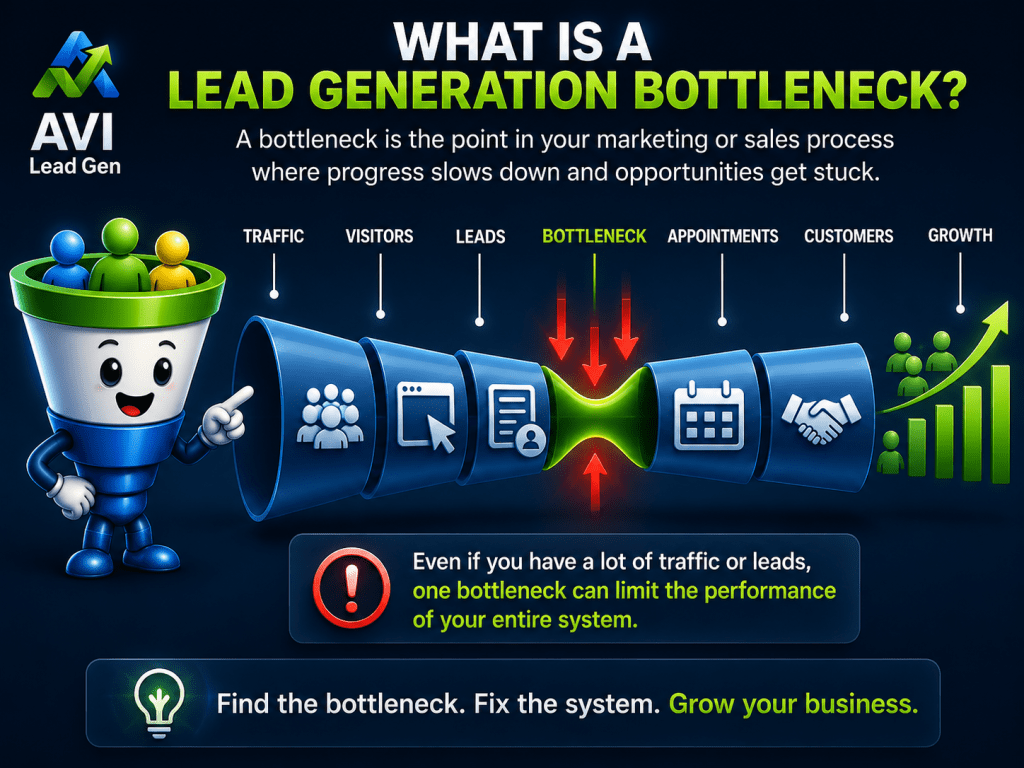
Lead generation bottlenecks are the point in your marketing or sales process where progress slows down.
It’s the place where attention stops turning into action.
For one business, the bottleneck may be traffic. Not enough of the right people are finding the website.
For another, the website may get traffic, but visitors are not filling out forms or booking calls.
For another, leads may come in consistently, but follow-up happens too slowly.
The important thing to understand is that bottlenecks are not always obvious.
A business owner may assume the problem is SEO because revenue feels slow. But after looking closer, the real issue may be poor website conversion. Another business may assume they need more leads, when the actual problem is that too many poor-fit prospects are filling the calendar.
That is why guessing is expensive.
A stronger approach is to look at the full path:
Traffic to website.
Website to lead.
Lead to appointment.
Appointment to customer.
Customer to retention and referral.
The stage with the biggest drop-off is usually where the bottleneck lives.
A Realistic Example
Imagine a home service business getting 50 leads per month.
The owner feels frustrated because revenue is still inconsistent. At first, the problem seems obvious: they need more leads.
But after reviewing the system, the real issue becomes clearer.
The website is generating inquiries, but only a small percentage of leads are receiving a response within the first hour. Some leads wait until the next day. Some get a missed call but no follow-up message. Some never get entered into the CRM properly.
In this case, more traffic would not solve the main problem.
More leads would simply create more missed opportunities.
The bottleneck is follow-up speed and lead handling. Once that constraint improves, the same number of leads may produce better results.
That is the power of finding the bottleneck. You stop guessing and start fixing the part of the system that is actually holding growth back.
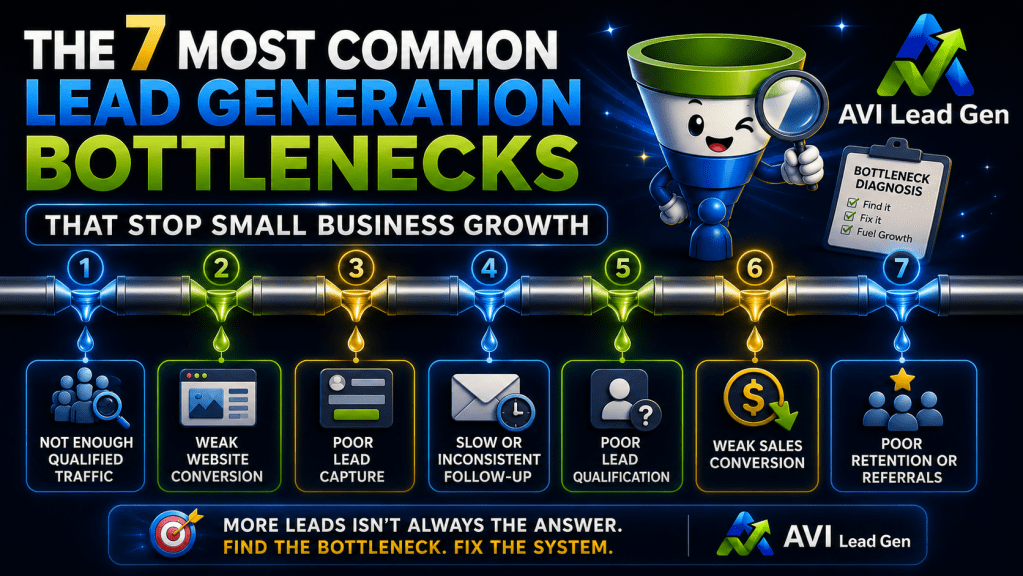
Bottleneck #1: Not Enough Qualified Traffic

Traffic is not the same as opportunity.
A website can get visitors and still fail to generate meaningful leads if the wrong people are arriving.
This happens when a business attracts low-intent visitors, broad search traffic, poor-fit social clicks, or people who are only looking for free information. The site may show activity in analytics, but that activity does not turn into conversations.
The fix is not always more traffic. Often, the better move is improving traffic quality.
That means targeting search terms, content topics, local visibility, and offers that match the problems your best prospects are actually trying to solve.
If your website is not getting enough of the right visitors, it may be worth reviewing how to get more qualified traffic to your website. More visitors only help when those visitors are aligned with your offer and ready to take action.
Bottleneck #2: Weak Website Conversion

The next bottleneck happens when people visit the website but do not take action.
This is one of the most common lead generation problems in small business.
The site may look professional. It may be mobile-friendly. It may explain the services clearly enough. But if visitors are not calling, filling out forms, booking consultations, or requesting quotes, something in the conversion path is not working.
Weak website conversion often comes from unclear messaging, vague calls-to-action, buried forms, too many distractions, or service pages that describe what the business does without explaining why it matters.
A lead generation website should help visitors quickly understand three things:
You understand their problem.
You have a clear solution.
There is an obvious next step.
If those pieces are missing, traffic can keep coming in without producing enough leads.
This is why it helps to understand why your lead generation website is not generating leads before assuming the only solution is more traffic.
Bottleneck #3: Poor Lead Capture
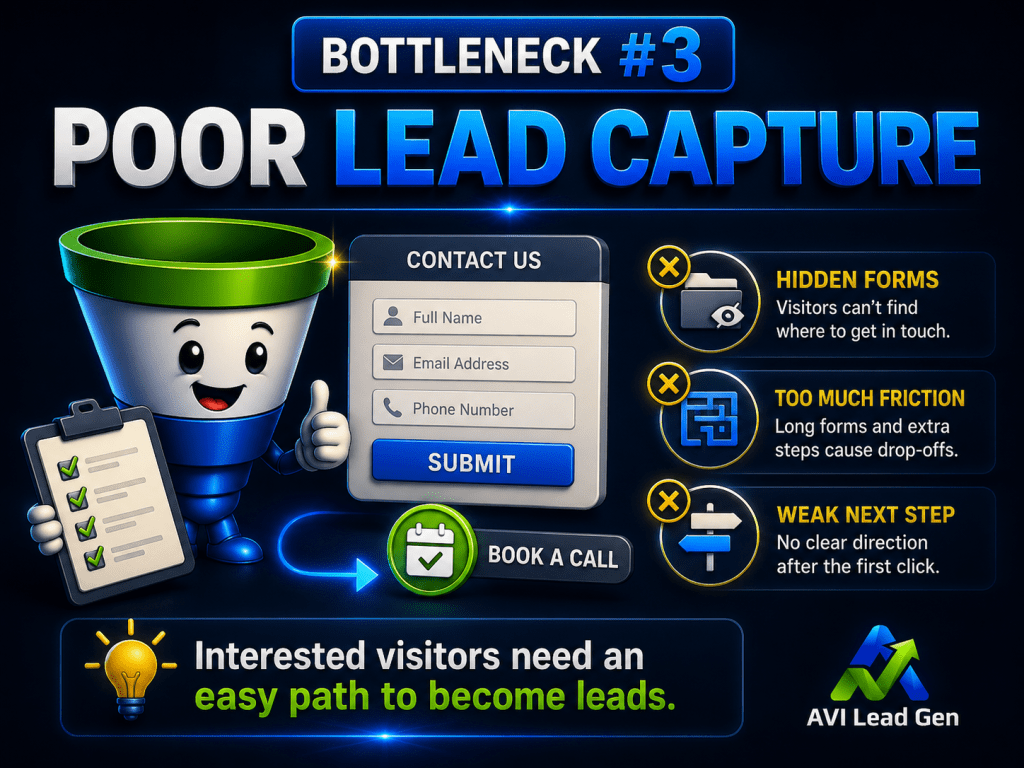
Some websites get qualified visitors, but still make it too hard, and they fail to understand why leads aren’t converting.
That is a lead capture problem.
Maybe the contact form is buried on one page. Maybe the form asks for too much information. Maybe the call-to-action is too passive. Maybe the website only gives visitors one option: “Contact Us.”
Not every visitor is ready to make the same move.
Some people want to book a call. Some want to request a quote. Some want to ask a question. Some want to download a guide before speaking with anyone.
A stronger lead capture system gives qualified visitors clear, simple ways to take the next step based on their level of intent.
For high-intent visitors, that may mean a booking calendar or quote request form. For earlier-stage visitors, it may mean a helpful guide, checklist, or email sequence.
A good small business growth strategy is not to collect as many names as possible. The goal is to capture the right interest and move it into a system where it can be followed up with.
That is also why what happens after a lead fills out your website form matters. The form is not the finish line. It is the start of the conversion process.
Bottleneck #4: Slow or Inconsistent Follow-Up

Follow-up is where many good leads quietly disappear.
A prospect reaches out because they are interested right now. They may be comparing options, trying to solve a problem, or looking for someone who can help soon.
If the response is slow, that interest can fade quickly.
The lead may contact another company. They may lose urgency. They may forget why they reached out. They may assume the business is too busy or unorganized.
This is why speed to contact matters.
Fast follow-up does not guarantee a sale, but slow follow-up can easily lose one.
A strong follow-up system should not depend only on memory or manual effort. At minimum, new leads should receive a clear confirmation, the business should be notified quickly, and the next step should be obvious.
For many businesses, CRM automation can help by triggering confirmation emails, internal alerts, reminders, lead tags, and follow-up sequences.
If leads are coming in but not turning into conversations, one of the first areas to review is how fast you should respond to a new lead. Improving response time can often improve conversions before you ever increase traffic.
Bottleneck #5: Poor Lead Qualification
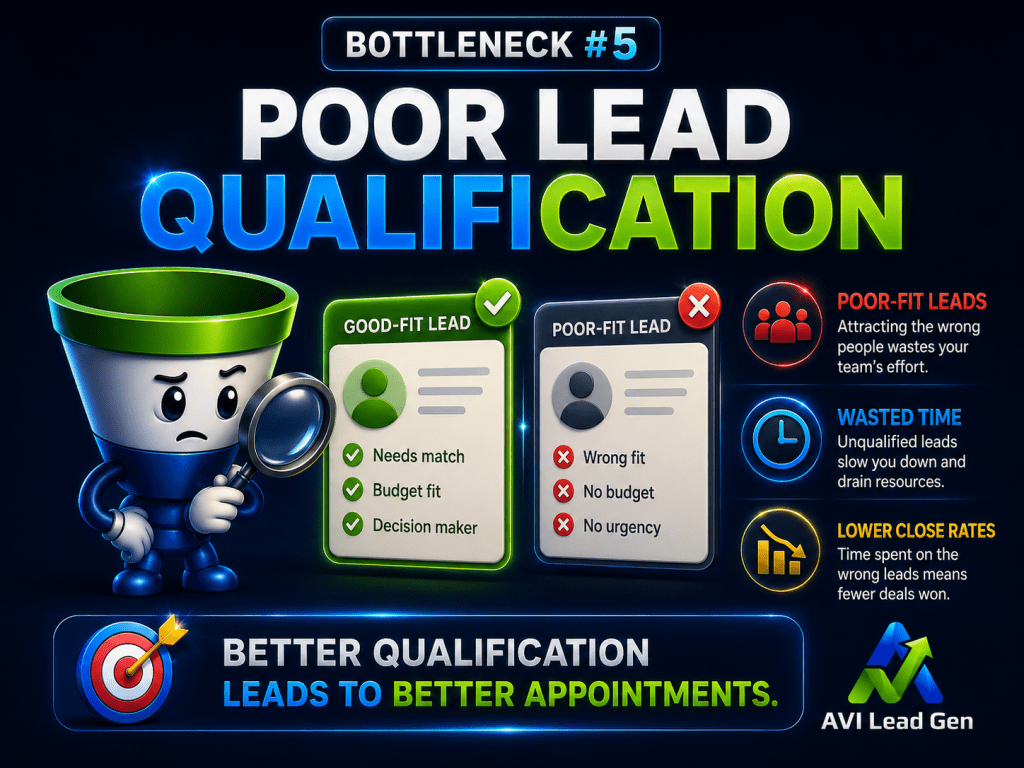
Not every lead should become an appointment.
That may sound strange, especially when a business is trying to grow. But filling the calendar with poor-fit prospects creates its own problem.
Poor qualification leads to wasted calls, lower close rates, frustrated staff, and less time for serious opportunities.
Some prospects are not ready. Some are not a fit. Some cannot afford the service. Some are looking for something the business does not provide. Some are only shopping based on the lowest price.
Without qualification, those leads can still consume time and attention.
A strong lead generation system should help separate higher-intent, better-fit prospects from people who are unlikely to become good customers.
That does not mean making the process difficult. It means asking the right questions at the right time.
For example, a form may ask about the service needed, timeline, budget range, business type, location, or urgency. A booking workflow may route different leads based on their answers. A CRM may tag leads by interest level or fit.
When qualification improves, sales conversations usually improve too.
That’s why learning how to qualify leads before they book a call is so important. The goal is not just more appointments. The goal is better appointments.
Bottleneck #6: Weak Sales Conversion
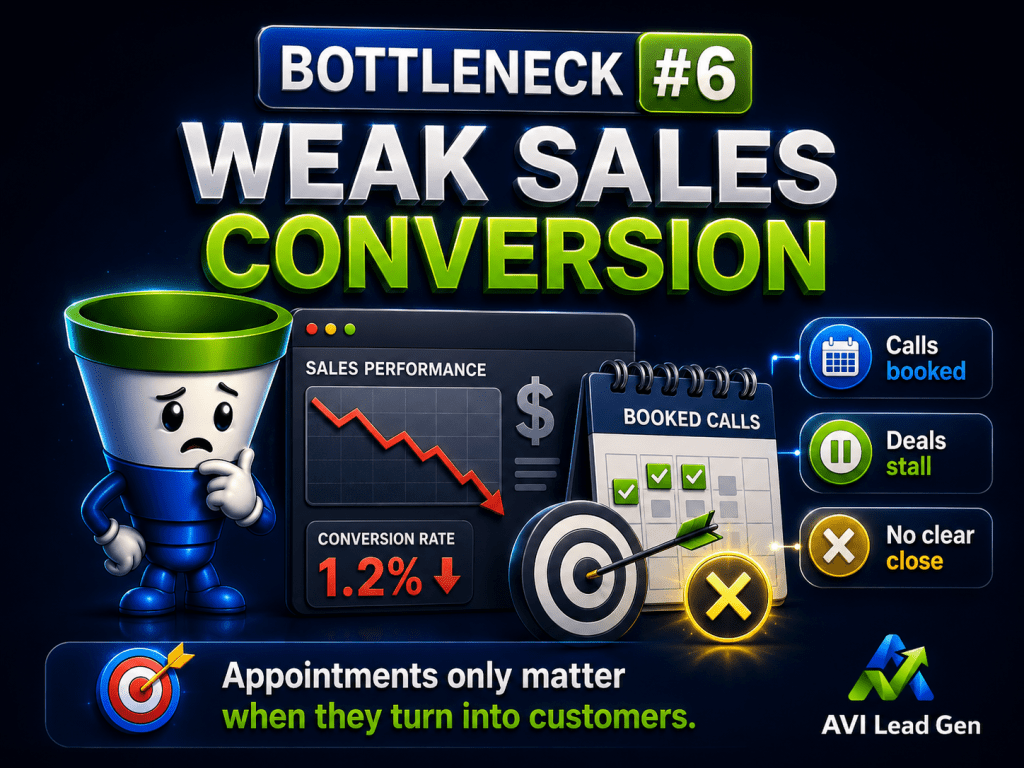
Some businesses do not have a lead problem.
They have a sales conversion problem.
The website generates leads. Follow-up happens. Calls get booked. But too few appointments turn into customers.
This bottleneck is especially frustrating because the business feels close to growth. Opportunities are entering the pipeline, but the revenue is not following.
Weak sales conversion can happen when calls are too casual, discovery is shallow, pricing is presented without enough context, objections are not handled well, or the conversation ends without a clear next step.
A strong sales process does not need to feel scripted or pushy. It simply needs structure.
The business should understand what problem the prospect is trying to solve, why it matters now, what they have already tried, what success looks like, and whether the offer is actually a good fit.
If appointments are happening but deals are not closing, the next bottleneck is likely the sales conversation itself. That is where a clear process for turning booked appointments into paying customers becomes critical.
Bottleneck #7: Poor Onboarding, Retention, or Referral Process
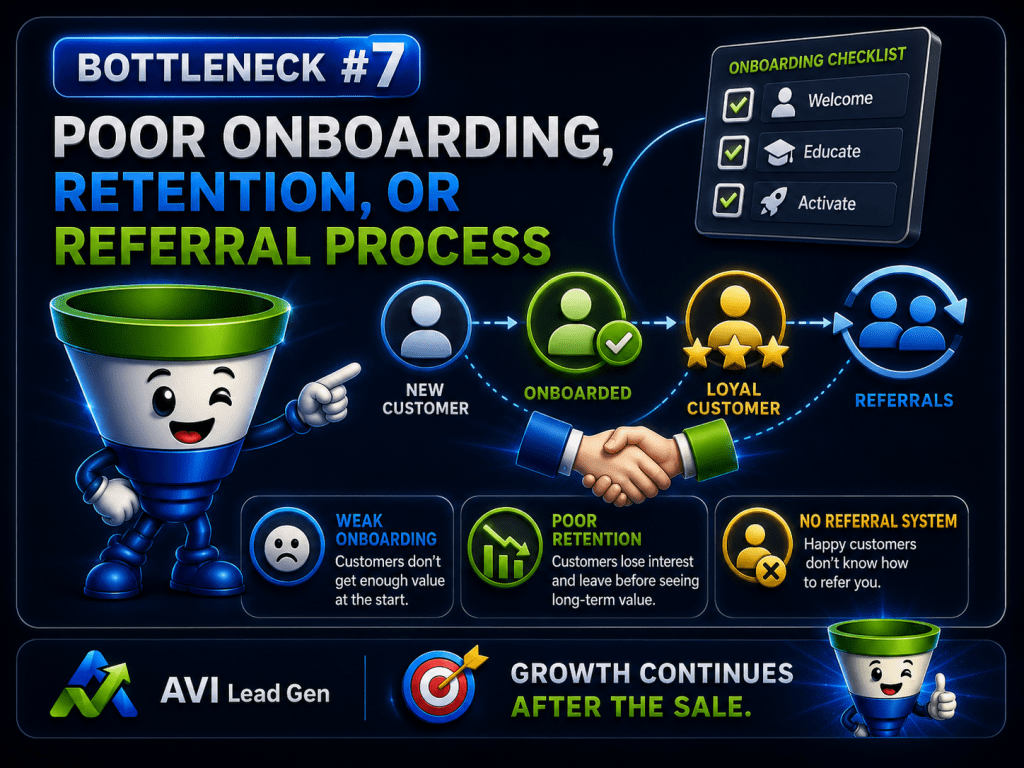
Growth does not stop when someone becomes a customer.
If the experience after the sale is confusing, slow, or inconsistent, the business may lose momentum before the relationship has a chance to grow.
Poor onboarding can create buyer’s remorse. Weak communication can lower trust. Unclear expectations can lead to frustration. And even happy customers may never refer anyone if there is no process for encouraging referrals.
This matters because long-term growth is not only about getting new leads.
It is also about keeping customers, creating better experiences, earning repeat business, and making referrals easier.
A strong lead generation system should eventually connect to the customer experience. That includes onboarding, delivery, communication, retention, reviews, and referrals.
If your business closes new customers but struggles to keep them engaged, it may be time to review what happens after you close a client. The sale is not the end of the system. It is the start of the customer experience.
How to Identify the Biggest Lead Generation Problems
The best way to find a bottleneck is to stop looking at lead generation as one big number.
Instead, break the system into stages.
How many people visit the website?
How many become leads?
How many leads receive fast follow-up?
How many book appointments?
How many appointments become customers?
How many customers stay, repeat, review, or refer?
The stage with the largest drop-off usually deserves attention first.
If traffic is low, the bottleneck may be visibility.
If traffic is strong but leads are low, the bottleneck may be website conversion or lead capture.
If leads are strong but bookings are low, the bottleneck may be follow-up.
If bookings are strong but sales are low, the bottleneck may be qualification or sales process.
If sales happen but growth still feels inconsistent, the bottleneck may be retention, onboarding, or referrals.
This is why tracking matters. Without visibility, every fix is a guess. With tracking, you can improve the part of the system that is actually limiting results.
If you do not know where people are dropping off, start by learning how to track and improve your lead generation funnel. Better data makes better decisions possible.
Why Fixing Bottlenecks Beats Chasing More Tactics
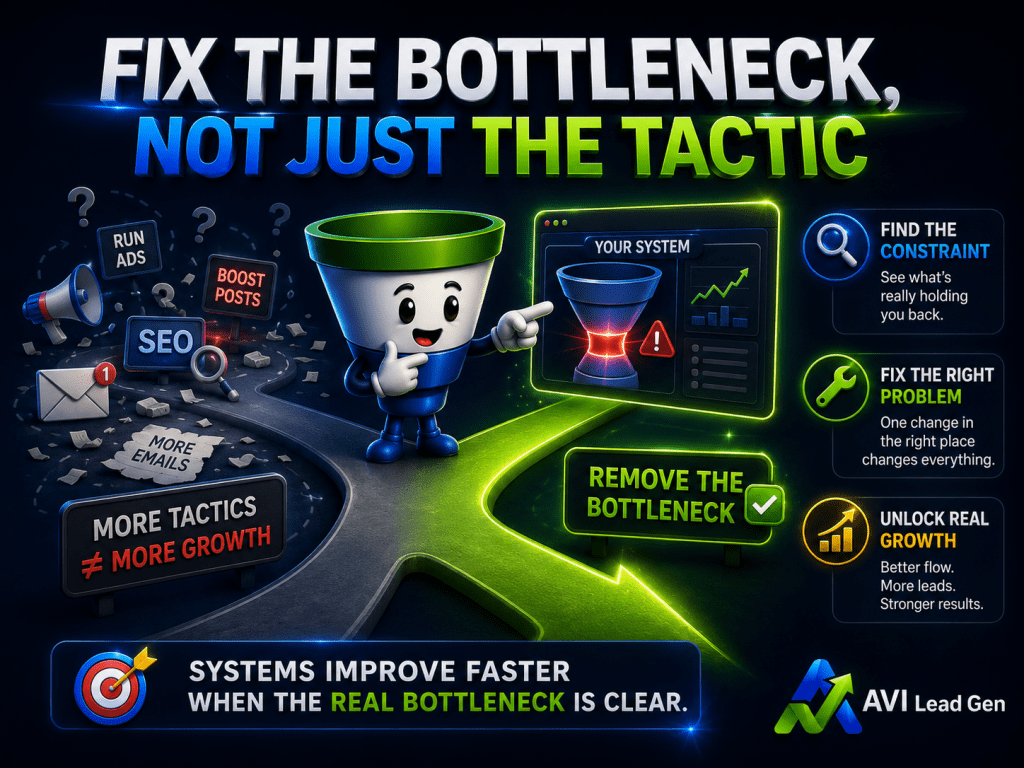
It’s tempting to chase the next marketing tactic when growth feels slow.
More SEO. More ads. More social posts. More emails. More automation.
Those things can help, but only if they support the right part of the system.
If the real issue is slow follow-up, more traffic may create more lost leads. If the real issue is poor qualification, more booked calls may create more wasted time. If the real issue is weak sales conversion, more appointments may create more frustration.
This is why bottleneck thinking is so valuable.
It helps you stop asking, “What else should we add?”
Instead, you start asking, “What is preventing the current system from working better?”
That question usually leads to smarter decisions.
The Bottom Line
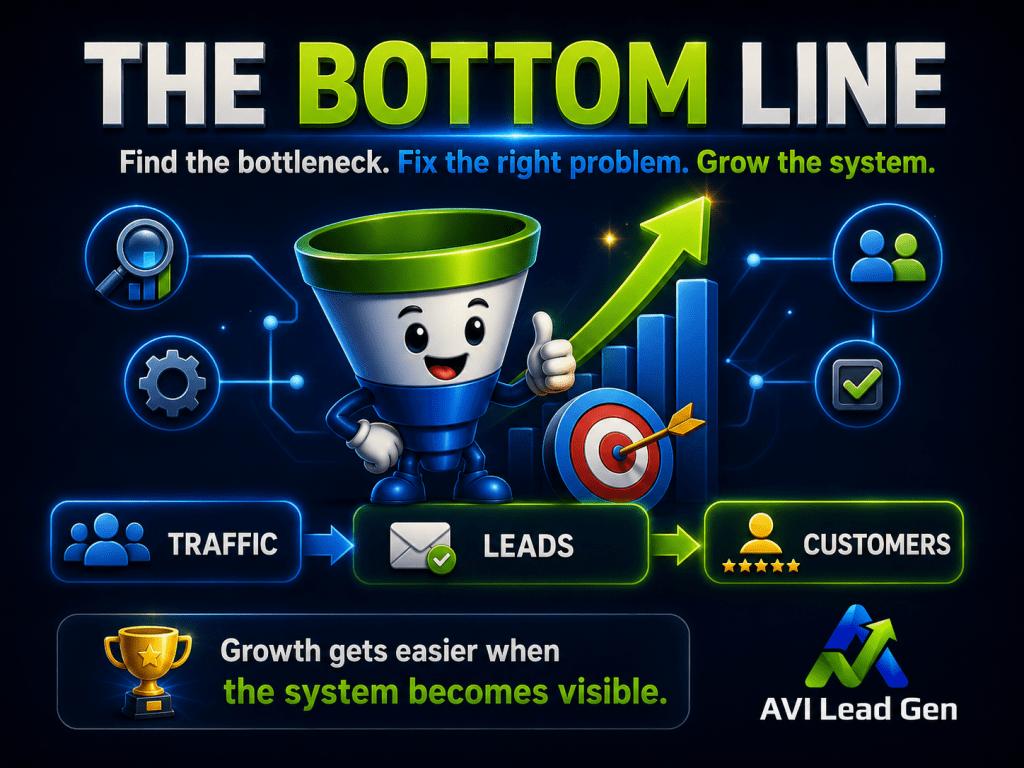
Most businesses don’t need random marketing activity.
They need a clearer system.
More traffic can help, but not if the website does not convert. More leads can help, but not if follow-up is slow. More appointments can help, but not if the wrong people are booking. More customers can help, but not if onboarding and retention are weak.
The goal is not just to generate more leads.
The goal is to remove the bottlenecks that keep good opportunities from becoming customers.
At AVI Lead Gen, we believe small business growth becomes easier to improve when the full system is visible: traffic, website conversion, lead capture, follow-up, qualification, booking, sales, retention, and referrals.
When you can see the bottleneck, you can fix the right problem.
Ready to Find and Fix the Bottlenecks in Your Lead Generation System?
AVI Lead Gen helps small businesses build lead generation systems that connect website strategy, lead capture, CRM automation, follow-up, booking, and performance tracking.
Ready to stop guessing and build a lead generation system that works around the clock?
AVI Lead Gen helps small businesses capture leads, automate follow-up, and turn more website visitors into real opportunities.
Frequently Asked Questions

What are lead generation bottlenecks?
Lead generation bottlenecks are the points in your marketing or sales process where prospects stop moving forward. Common bottlenecks include poor traffic quality, weak website conversion, slow follow-up, poor qualification, weak sales conversion, and poor retention.
How do I know where my lead generation problems exist?
Start by tracking each stage of the funnel: traffic, leads, follow-up, booked appointments, customers, retention, and referrals. The stage with the biggest drop-off usually shows where the bottleneck is.
Can more traffic fix a lead generation problem?
Sometimes, but not always. If the website does not convert, follow-up is slow, or leads are not qualified, more traffic may only create more missed opportunities. Fix the bottleneck before adding more volume.
Why are my leads not converting into customers?
Leads may not convert because they are poor fit, follow-up is too slow, the offer is unclear, the sales process lacks structure, or there is no clear next step after the first conversation.
What is the first bottleneck a small business should fix?
Start with the bottleneck closest to revenue. If leads are coming in but not booking, fix follow-up. If appointments are happening but not closing, fix qualification or sales conversion. If traffic is low, work on visibility and qualified traffic.