
Getting leads feels good.
Until you realize you don’t actually know where they’re coming from, which ones are worth chasing, why some book calls, why others disappear, or which marketing efforts are turning into customers.
Until you learn how to track your lead generation system those answers remain elusive. That’s where a lot of small businesses get stuck.
They’re doing the work. They’re publishing content. They’re updating the website. They’re trying SEO. They’re testing social posts. Some are running ads. Some are getting referrals.
But when it comes time to answer the most important question, things get fuzzy.
“What’s actually working?”
That’s the problem.
A lead generation system shouldn’t leave you guessing.
It should help you see where traffic is coming from, which pages are converting, how many people are filling out forms, how fast leads are being followed up with, how many calls are being booked, which leads are qualified, and which opportunities turn into paying customers.
At AVI Lead Gen, we don’t look at tracking as a separate analytics task.
We look at it as part of the system.
Because if you can’t see where the system is leaking, you can’t fix the right thing.
And if you can’t fix the right thing, you may end up spending more time and money on marketing activity that never turns into real growth.
You Can’t Improve What You Don’t Track
Random marketing activity isn’t what businesses should be prescribed.
They need better visibility.
They need to know what happens between the first click and the final sale.
That sounds simple, but it’s where a lot of lead generation breaks down.
A business may know how many people visited the website, how many submitted a form, and how many calls were booked.
But those numbers don’t always connect.
The owner may not know which traffic source created the best leads. Which page convinced someone to fill out the form?
They may be clueless as to whether follow-up happened fast enough.
Why some leads booked and others didn’t, and whether any of the booked calls were actually qualified leads.
Finally, they’ll want to know which opportunities converted into paying customers.
That creates guesswork.
And guesswork is expensive.
It makes businesses fix the wrong problems.
They think they need more traffic when the website isn’t converting.
They think they need a new website when follow-up is too slow.
They think they need better leads when the sales process is unclear.
They think they need more ads when the landing page is weak.
They think they need a new CRM when the current process isn’t being used consistently.
Tracking helps slow that down.
It gives the business a clearer picture of where the system is working and where it’s breaking.
The goal isn’t to drown in reports. The goal is to see the few numbers that actually help you make better decisions.
Why Lead Generation Tracking Breaks Down
Lead generation tracking usually breaks down because each part of the system gets treated separately.
The website is over here.
The contact form is over there.
The CRM is somewhere else.
The booking calendar is disconnected.
The sales notes live in someone’s inbox, spreadsheet, sticky note, or memory.
The analytics show traffic, but not lead quality.
The CRM shows leads, but not where they came from.
The booking tool shows appointments, but not which source created them.
The business owner can see pieces of the puzzle, but not the full path.
That’s when tracking becomes frustrating.
It’s not that the business has no data.
It’s that the data doesn’t tell a clear story.
A stronger system connects the stages.
Traffic should connect to landing pages.
Landing pages should connect to lead capture.
Lead capture should connect to the CRM.
The CRM should connect to follow-up.
Follow-up should connect to booking.
Booking should connect to qualification.
Sales outcomes should connect back to the original source.
That’s how you move from “we got some leads” to “we know which parts of the system are creating real opportunities.”
Tracking works best when it follows the customer journey.
Not in theory.
In the actual path someone takes from visitor to lead to appointment to customer.
That’s also why understanding lead generation bottlenecks matters. If one stage is weak, the rest of the system feels weaker than it really is.

A Realistic Example
Imagine a small business gets 1,200 website visitors in a month.
That sounds like progress.
The owner also gets 32 form submissions.
That sounds even better.
But only 7 people book a call.
Only 4 show up.
Only 1 becomes a customer.
Without tracking, the owner may jump to the wrong conclusion.
Maybe they think the website traffic isn’t good enough.
Maybe they think the offer is bad.
Maybe they think the sales process is weak.
Maybe they think ads aren’t working.
Maybe they blame SEO.
But once the system is tracked properly, the picture gets clearer.
Most traffic came from one blog article with broad informational intent.
The service page had fewer visitors, but a much higher form conversion rate.
The form did not capture service need or urgency.
Leads received a basic confirmation email, but no useful follow-up sequence.
The booking link was buried in the second email.
No one was notified when high-intent leads came in.
The strongest lead source was actually referral traffic, even though it sent fewer visitors.
Now the fix is different.
The business doesn’t need to panic and change everything.
It needs to improve specific parts of the system.
Add stronger lead source tracking.
Improve the form questions.
Segment leads by interest and urgency.
Move the booking path closer to high-intent leads.
Set up fast internal notifications.
Strengthen the service page.
Create more content around the topics that produced qualified visitors.
That’s the value of tracking.
It turns vague frustration into specific fixes.
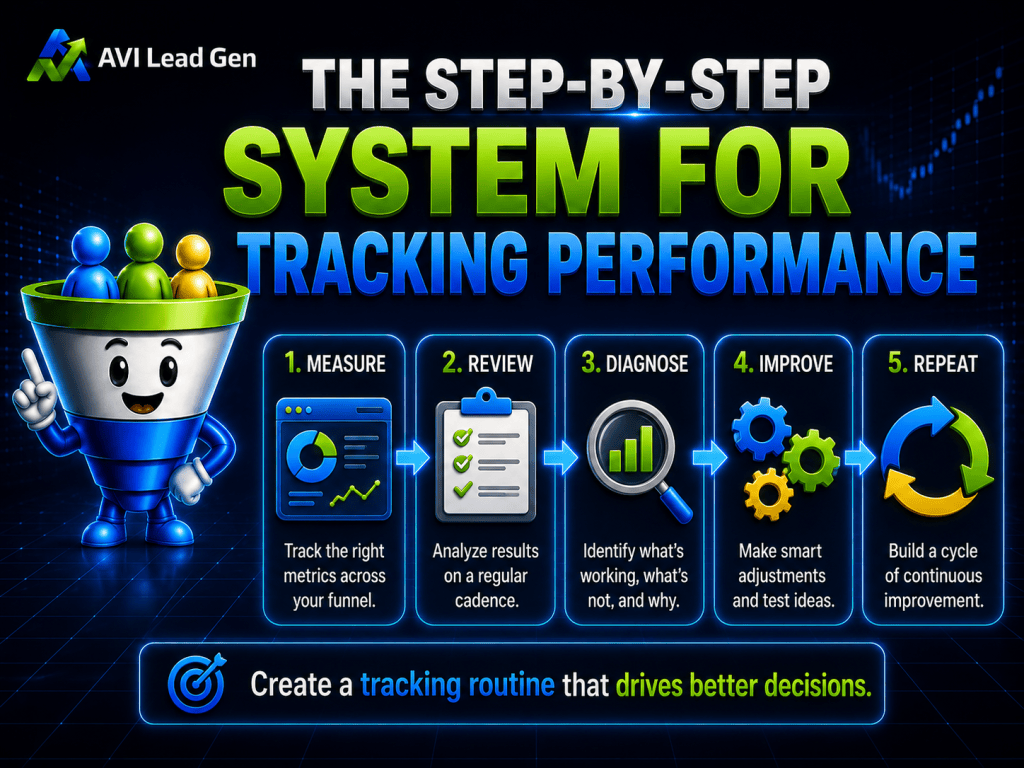
The Step-by-Step System for Tracking Your Lead Generation Funnel
A lead generation funnel doesn’t have to be complicated.
But it does need to be visible.
You should be able to look at the system and understand how people are moving from attention to action.
Here’s the path to track.
Step 1: Track Traffic Sources
Start with the first question:
Where are visitors coming from?
Common traffic sources include:
Google Search
Google Business Profile
Paid ads
Social media
Email
Referral partners
Directories
Direct visits
Blog content
Local search
LinkedIn
Facebook
YouTube
Industry websites
Traffic source tracking matters because not all visitors have the same intent.
Someone who searches for your exact service may be closer to action than someone who clicks a general social post.
Someone who comes from a trusted referral may be more qualified than someone who clicks a broad ad.
Someone who lands on an article may need more education before booking.
That’s why you shouldn’t judge traffic sources by visitor count alone.
A source that sends 500 visitors and 2 weak leads may be less valuable than a source that sends 40 visitors and 5 strong opportunities.
Track qualified website traffic, not just website traffic.
The real question is not:
“Which channel sends the most traffic?”
The better question is:
“Which channel sends visitors who become leads, appointments, and customers?”
Step 2: Track Landing Page Performance
Once you know where traffic comes from, look at where it lands.
This matters because the page has to match the visitor’s intent.
If someone clicks because they’re interested in appointment booking, they shouldn’t have to dig through a generic homepage to figure out whether you can help.
If someone searches for lead follow-up automation, the landing page should speak directly to follow-up, speed, CRM, reminders, and next steps.
If someone reads a blog article about qualified traffic, the next internal link should guide them toward conversion, lead capture, or the full lead generation system.
Landing page tracking helps you understand which pages are doing their job.
Look at:
Page visits
Time on page
Scroll behavior, when available
CTA clicks
Form submissions
Booking clicks
Lead magnet downloads
Exit rate
Conversion rate by page
Lead quality by page
A page with a lot of traffic but few leads may need stronger messaging, clearer calls to action, better proof, better page structure, or a better offer.
A page with low traffic but strong conversion may need more internal links, SEO work, or promotion.
The page is where traffic either starts becoming a lead or quietly disappears.
Track it accordingly.
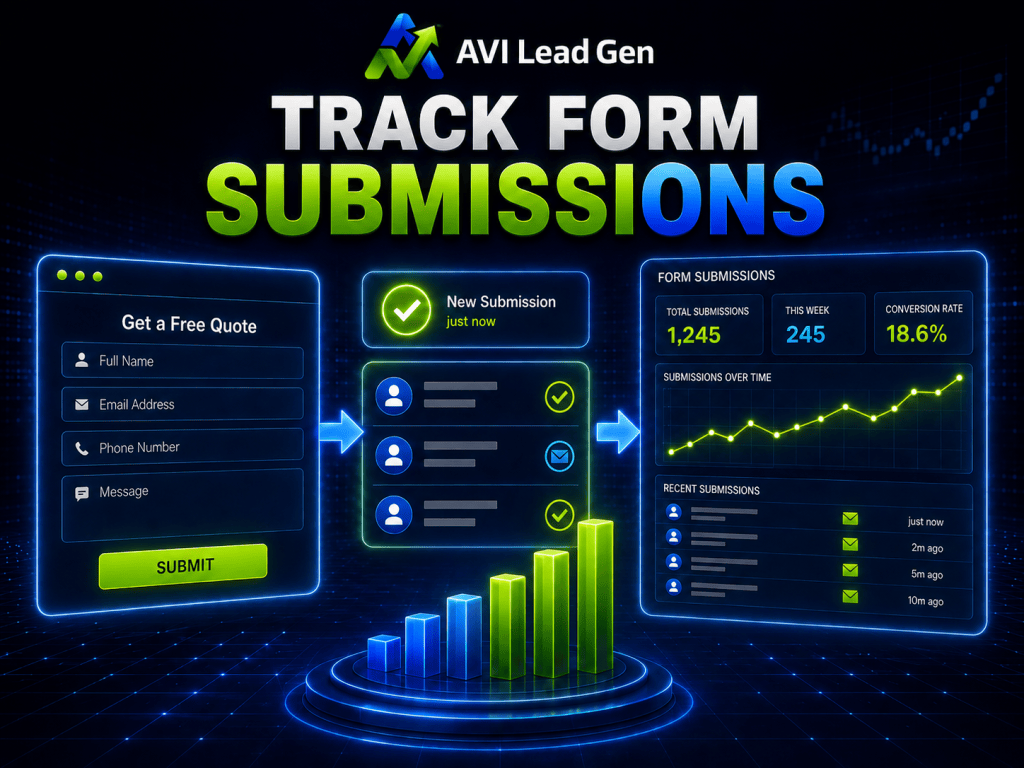
Step 3: Track Form Submissions
A form submission is not the finish line.
It’s the handoff from website visitor to lead.
That handoff needs to be tracked clearly.
You should know:
Which form was submitted
Which page the form was submitted from
What source brought the visitor there
What the person asked for
What service they’re interested in
How urgent their need is
Whether they’re a strong fit
Whether they booked a call
Whether follow-up happened
Many businesses treat every form submission the same.
That’s a mistake.
A person requesting a strategy call is not the same as someone downloading a checklist.
A person asking for help this month is not the same as someone casually researching.
A person with a clear service need is not the same as someone who submits a vague message with no context.
The form should help the system understand the lead.
That means asking useful questions without creating too much friction.
It also means passing the right information into the CRM so the business can follow up intelligently.
Good lead capture starts at the form.

Step 4: Track Lead Source Inside the CRM
A CRM shouldn’t just be a contact list.
It should help you understand where leads came from, what they wanted, what happened next, and whether they became real opportunities.
At minimum, each lead should include:
Name
Email
Phone, when collected
Lead source
Landing page
Form submitted
Service interest
Lead magnet or offer requested
Tags
Status
Booking status
Follow-up status
Notes
Outcome
This is where CRM automation starts becoming useful.
Instead of wondering where good leads came from, you can see it.
Instead of guessing whether a campaign worked, you can check.
Instead of asking whether people who download a resource eventually book calls, you can track it.
CRM tracking also helps with segmentation.
A lead interested in booking shouldn’t get the same lead follow-up as someone who only downloaded a basic guide.
A lead that is high urgency shouldn’t sit unnoticed.
A lead who isn’t ready may still need nurturing.
The CRM should help organize those paths.
Without that structure, leads tend to blur together.
And when leads blur together, follow-up gets weaker.
Step 5: Track Follow-Up Speed
Speed matters.
A lot.
When someone shows interest, the clock starts.
If the business waits too long, that interest can fade. The prospect may keep searching, contact someone else, or forget why they reached out in the first place.
Tracking follow-up speed helps you answer:
How long does it take to respond to a new lead?
Does the lead get an instant confirmation?
Does the business get notified?
Does the lead receive a useful next step?
Are high-intent leads followed up with faster?
Are leads being left in an inbox?
Are follow-up tasks being completed?
This is one of the easiest places for a lead generation system to improve results.
A business doesn’t always need more leads.
Sometimes it needs to respond better to the leads it already has.
Automation can help here.
It can send instant confirmations.
It can notify the business.
It can assign tags.
It can trigger follow-up emails.
It can route people toward booking.
It can keep nurture leads warm.
But automation should not replace human judgment.
It should protect the opportunity long enough for the right human follow-up to happen.

Step 6: Track Booked Appointments
Booked calls are an important milestone.
But they aren’t the same thing as revenue.
You need to know how many leads actually move from inquiry to booked appointment.
Track:
Booking page visits
Booking link clicks
Appointments scheduled
No-shows
Canceled appointments
Rescheduled appointments
Completed appointments
Appointment source
Appointment type
Lead quality
Notes from the call
Next step after the call
This helps you see whether your lead-to-booking path is working.
If many people submit forms but few book calls, the booking path may be weak.
If many people click the booking page but don’t schedule, the page may be unclear, the calendar may look inconvenient, or the offer may not feel compelling enough.
If many people book but don’t show up, reminders and confirmation messaging may need work.
If many booked calls are poor fit, the qualification process may need to happen earlier.
Booked appointments are useful only when they create real sales opportunities.
Tracking helps you separate calendar activity from actual progress.
Step 7: Track Lead Quality
Not all leads are equal.
That’s why tracking lead quality matters.
A lead can fill out a form and still be a poor fit.
A lead can book a call and still not be ready.
A lead can seem interested and still lack budget, urgency, service fit, location fit, or decision-making authority.
If you only count leads, you may make the wrong decisions.
You need to know which leads are worth pursuing.
Track quality signals like:
Service fit
Budget fit
Urgency
Problem clarity
Timeline
Location or service area
Business type
Decision-maker status
Engagement with follow-up
Answers from the form
Conversation quality
Sales readiness
This doesn’t need to be overly complicated.
Even simple labels can help.
High fit
Medium fit
Low fit
Not ready
Poor fit
Booked
No-show
Proposal sent
Closed won
Closed lost
Nurture
These labels give the system more meaning.
They help you avoid treating every inquiry like the same opportunity.
They also help you improve marketing.
If one traffic source sends fewer leads but better-fit opportunities, that source may deserve more attention.
If another source sends lots of low-quality leads, it may need better targeting or a different offer.
That’s why qualifying leads before they book can protect your calendar and improve the quality of your sales conversations.
Lead quality tracking protects you from chasing volume at the expense of results.
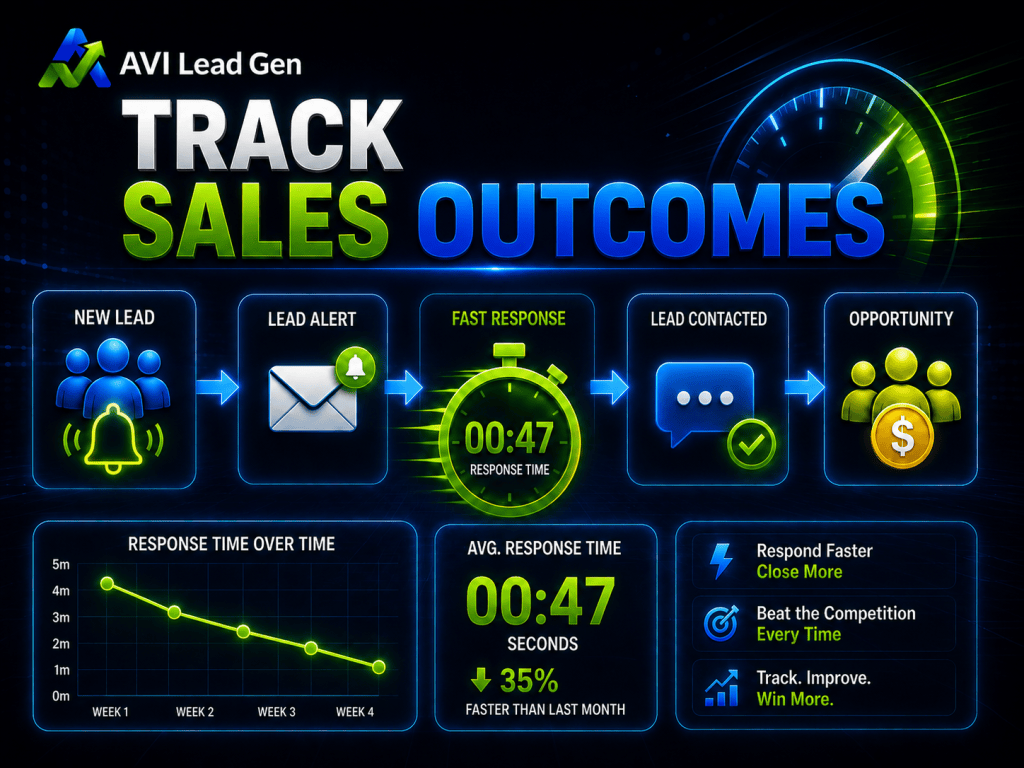
Step 8: Track Sales Outcomes
The lead generation system shouldn’t stop at the booked call.
It should track what happened after the conversation.
Otherwise, you may know how many leads you generated, but not whether they became business.
Track:
Calls completed
Qualified opportunities
Proposals sent
Proposals accepted
Proposals declined
Customers won
Customers lost
Reasons deals were lost
Revenue generated
Follow-up completed
Future follow-up dates
Referral potential
This is where the system becomes more powerful.
When you connect sales outcomes back to traffic sources, landing pages, forms, and follow-up paths, you start seeing what actually creates customers.
It’s possible that one blog article sends a steady stream of educated leads.
Maybe one service page creates the best booked calls.
There could be one lead magnet that attracts people who need more nurturing.
Maybe one ad campaign creates leads, but not customers.
Maybe referrals close at a much higher rate than search traffic.
That information changes your strategy.
It helps you invest in what produces real opportunities instead of what only looks good on the surface.
Step 9: Review the Numbers and Fix the Bottleneck
Tracking is only useful if you review it.
The goal isn’t to collect data for the sake of data. The goal is to find the bottleneck and fix it.
Look at the funnel in order:
Traffic
Landing page
Lead capture
CRM organization
Follow-up
Booking
Qualification
Sales conversion
Customer outcome
Then ask:
Where are people dropping off?
Where is interest slowing down?
Where are leads going cold?
Where are poor-fit leads entering the system?
Where are good leads getting stuck?
Which source creates the best opportunities?
Which page produces the strongest leads?
Which offer moves people forward?
Which follow-up path needs improvement?
Fix the biggest constraint first.
If you have traffic but no leads, fix the page and offer.
If you have leads but no bookings, fix follow-up and booking flow.
If you have bookings but no customers, fix qualification, sales process, and post-call follow-up.
If you have customers but no repeat business or referrals, fix onboarding, value delivery, and referral systems.
The point is to stop guessing.
Tracking tells you where to work next.
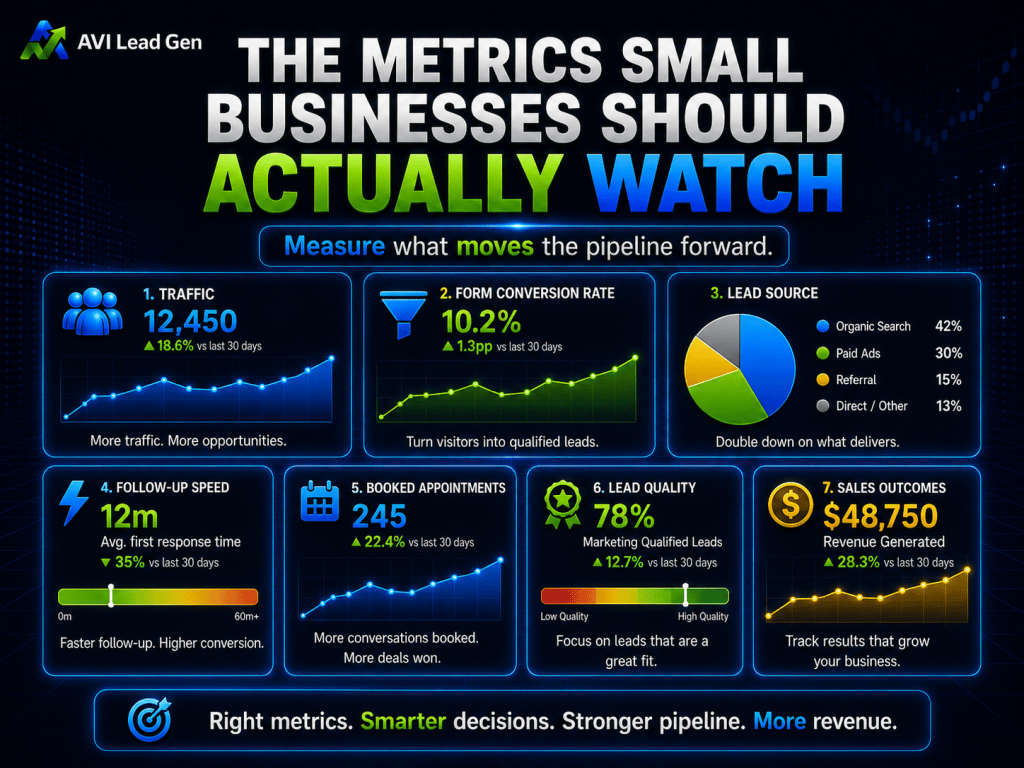
The Metrics Small Businesses Should Actually Watch
You don’t need a giant dashboard to improve a lead generation system.
You need a small number of useful numbers reviewed consistently.
Start with these.
Traffic Source
Where did the visitor come from?
This helps you understand which channels are creating awareness, interest, and opportunity.
Track sources like organic search, Google Business Profile, social, referral, direct, email, and paid ads.
Landing Page
Which page did the person land on before taking action?
This helps you understand which pages are doing the best job turning attention into leads.
Form Conversion Rate
How many visitors become leads?
This helps you see whether the page, offer, CTA, and form are working together.
Lead-to-Booking Rate
How many leads schedule a call?
This shows whether your follow-up and booking path are strong enough.
Booking-to-Customer Rate
How many booked appointments become customers?
This helps you understand sales conversion, lead quality, qualification, and offer fit.
Time to First Response
How quickly does the business follow up?
This is one of the most practical numbers to watch because slow response can waste otherwise good leads.

Lead Quality
How strong are the leads?
This keeps you from assuming all form submissions are equally valuable.
Cost Per Lead
How much did each lead cost?
This matters most when you are running ads, but it can also help compare time and effort across channels.
Cost Per Customer
How much did it cost to acquire a paying customer?
This is more useful than cost per lead because it accounts for lead quality and sales conversion.
Revenue by Source
Which channels are creating actual business?
This is the number most businesses eventually need, even if they start with simpler tracking.
What Not to Waste Time Tracking
Not every number deserves attention.
Some metrics are useful in context, but dangerous when they become the main goal.
Be careful with:
Pageviews without lead data
Impressions without clicks
Clicks without conversions
Social likes without website visits
Traffic volume without source quality
Form submissions without lead quality
Booked calls without close rate
Email opens without next-step action
Keyword rankings without business impact
These numbers are not useless.
They just should not be treated as the main measure of success.
For example, ranking for a keyword can matter, but only if the keyword attracts the right person.
A social post with engagement can matter, but only if it supports the larger content and trust strategy.
A high-traffic article can matter, but only if it guides people toward a useful next step.
The best tracking connects activity to outcomes.
Not every number needs to be on the scoreboard.
Where Automation Helps
Automation is useful because tracking and follow-up can break down when everything depends on memory.
A connected system can help by:
Capturing form data
Assigning tags
Recording lead source
Triggering confirmation emails
Notifying the business
Sending follow-up sequences
Routing leads by interest
Sending booking reminders
Updating lead status
Adding contacts to the CRM
Segmenting nurture leads
Tracking engagement
Triggering internal tasks
This makes the system more consistent.
It also keeps fewer leads from falling through the cracks.
But automation should have a purpose.
Don’t automate chaos.
A messy process becomes a faster messy process when automation is added too early.
First, define the path.
Then automate the repeatable pieces.
The goal isn’t to remove the human side of sales and service.
The goal is to make sure good opportunities are captured, organized, followed up with, and tracked.
Where Human Judgment Still Matters
Tracking can show you where the system is breaking.
Automation can help move leads through the process.
But human judgment still matters.
A CRM tag can show that someone is interested.
A human still needs to understand the conversation.
Analytics can show that one page converts better.
A human still needs to decide why.
A form can collect budget, urgency, and service interest.
A human still needs to decide whether the lead is a good fit.
A dashboard can show that close rates are low.
A human still needs to improve the offer, sales process, or follow-up conversation.
The system gives clarity.
The business still has to make decisions.
That’s why the strongest lead generation systems combine tracking, automation, and real judgment.

How Often Should You Review the Funnel?
You don’t need to obsess over numbers every day.
But you should review the system often enough to catch problems before they cost you too many opportunities.
For most small businesses, a simple rhythm works well.
Weekly:
Review new leads
Check booked appointments
Look at follow-up status
Review no-shows or missed opportunities
Confirm lead sources are being captured
Monthly:
Review traffic sources
Check landing page conversion
Review lead quality by source
Look at booking rates
Review customer wins and losses
Decide what to improve next
Quarterly:
Review the full funnel
Compare channel performance
Update content strategy
Improve major pages
Refine offers and CTAs
Clean up automations
Review sales process and close rate
The point is not to create more administrative work. The point is to create a habit of improvement.
A lead generation system should get better over time.
That only happens when someone reviews what the system is showing.
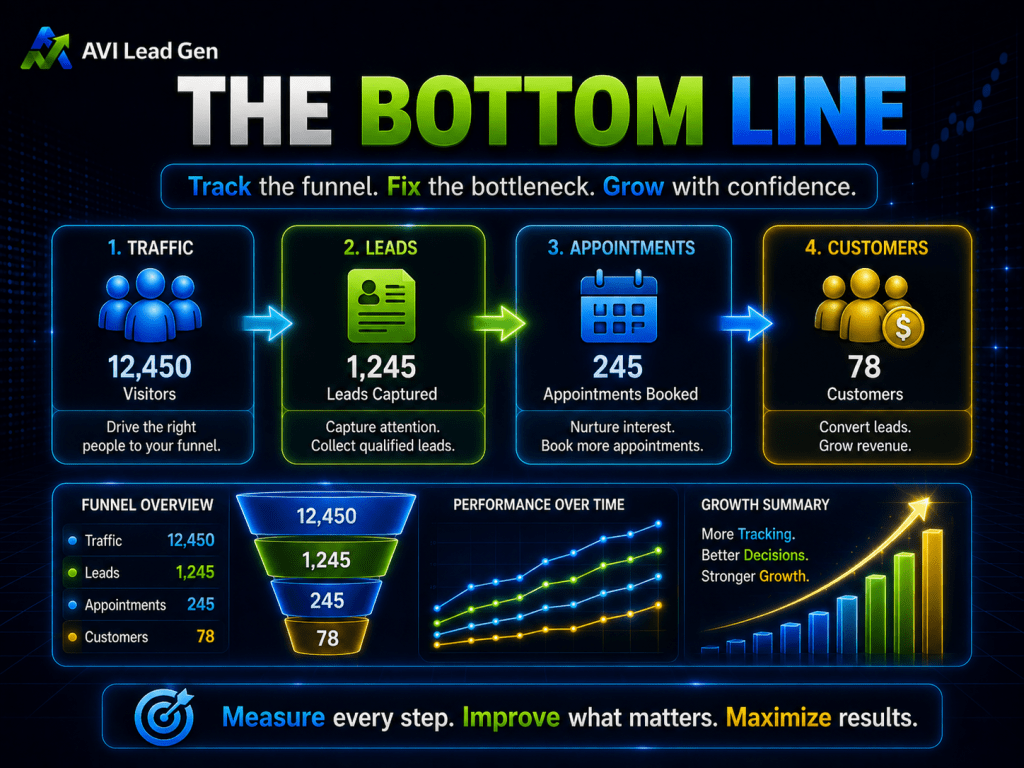
The Bottom Line
Lead generation shouldn’t be a guessing game.
If you don’t know where leads are coming from, which pages are converting, how quickly follow-up happens, which leads book, which calls close, or which sources create customers, it’s hard to improve the system.
You may work harder and still fix the wrong thing.
Tracking changes that.
It helps you see the path from traffic to customer.
It shows where people drop off.
It helps you identify weak pages, slow follow-up, poor-fit leads, booking problems, sales issues, and sources that aren’t producing real opportunities.
The goal isn’t to track everything.
The goal is to track what helps you make better decisions.
That’s how a lead generation system improves.
Not by guessing.
Not by chasing more activity.
By seeing where the system is leaking and fixing the right thing next.
Ready to Track What’s Actually Turning Into Customers?
AVI Lead Gen helps small businesses build lead generation systems that connect website traffic, landing pages, forms, CRM automation, lead follow-up, appointment booking, qualification, sales conversion, and tracking.
If you’re getting traffic, leads, or booked calls but still don’t know what’s actually working, the problem may not be effort.
It may be visibility.
Ready to stop guessing and build a lead generation system that works around the clock?
AVI Lead Gen helps small businesses capture leads, automate follow-up, and turn more website visitors into real opportunities.
FAQ – for Lead Tracking
What is a lead generation funnel?
A lead generation funnel is the path someone takes from first discovering your business to becoming a lead, booking a call, getting qualified, and eventually becoming a customer. For a small business, that path often includes traffic, landing pages, forms, CRM follow-up, appointment booking, sales conversations, and tracking.
How do you track a lead generation funnel?
You track a lead generation funnel by connecting each stage of the process. Track where traffic comes from, which page the person lands on, which form they submit, how they are tagged in the CRM, how fast follow-up happens, whether they book a call, whether they are qualified, and whether they become a customer.
What lead generation metrics matter most?
The most useful lead generation metrics are traffic source, landing page conversion rate, form submissions, lead-to-booking rate, booking-to-customer rate, response time, lead quality, cost per lead, cost per customer, and revenue by source.
Why am I getting leads but not customers?
You may be getting leads but not customers because the leads are poor fit, follow-up is too slow, the booking path is unclear, the sales conversation lacks structure, the offer is not clear enough, or the system is not qualifying leads before they reach the calendar.
How do I know where my lead generation system is breaking?
Look at the funnel in order. If traffic is high but leads are low, the page or offer may be weak. If leads come in but appointments are low, follow-up or booking may be the issue. If appointments happen but sales are low, lead quality, qualification, offer clarity, or the sales process may need work.
Can a CRM help with lead generation tracking?
Yes. A CRM can help track lead source, form submissions, tags, segmentation, follow-up status, booking status, engagement, and sales outcomes. It is especially useful when it connects to your website forms, email follow-up, and appointment booking system.
Do small businesses need complicated dashboards?
No. Most small businesses do not need complicated dashboards at first. They need a clear way to track the few numbers that matter: where leads came from, what action they took, whether follow-up happened, whether they booked, whether they were qualified, and whether they became customers.
How often should I review lead generation performance?
Most small businesses should review leads and follow-up weekly, review traffic and conversion monthly, and review the full funnel quarterly. The goal is to spot leaks, fix bottlenecks, and improve the system over time.