How to Build a High-Converting Lead Generation Website: 7 Must-Have Components
A good-looking website can still fail.
It can load quickly, use modern design, have polished images, and still leave visitors unsure about what to do next.
That’s the problem many small businesses run into.
They build a website to look professional, but the site never becomes a reliable source of leads, appointments, or sales opportunities. Traffic may arrive. People may browse. Some may even seem interested.
Then they leave.
No form submission. No booked call. No conversation. No clear next step.
A high-converting lead generation website is built differently.
It doesn’t simply present information. It guides the right visitors toward action, captures their interest, connects them to follow-up, and gives the business a clearer way to turn traffic into opportunities.
At AVI Lead Gen, we believe a website should work as part of a larger lead generation system. Design matters, but design alone isn’t enough. The website needs clear messaging, intentional calls-to-action, lead capture, follow-up automation, trust builders, tracking, and a path for continuous improvement.
The seven components discussed in this article are what help a website move from “online brochure” to lead generation asset.

What Makes a Website High-Converting?
What makes a website high-converting isn’t just design, speed, or a polished layout.
A high-converting website helps visitors move forward with clarity and confidence.
That sounds simple, but it requires structure.
The visitor has to understand the offer. They need to see why it matters. They need enough trust to continue. They need a clear next step. And once they take that step, the business needs a system that responds quickly and keeps the opportunity from going cold.
This is where many websites break down.
The issue isn’t always traffic. It’s not always design. It isn’t always SEO.
Sometimes the website gets visitors, but the message is unclear. Sometimes the message is clear, but the call-to-action is weak. Sometimes the form works, but the follow-up is too slow. Sometimes leads come in, but they’re not qualified. Sometimes appointments are booked, but no one tracks where the best opportunities came from.
A high-converting lead generation website doesn’t treat those issues separately.
It connects them.
If you want the broader picture of how traffic becomes leads, appointments, and customers, start with how to convert traffic with a lead generation website.
A Realistic Example
Imagine a local service business getting steady website traffic every month.
The owner assumes the website is working because people are visiting it. But the phone is quiet, form submissions are inconsistent, and booked appointments are rare.
After reviewing the site, the problem becomes clearer.
The homepage headline is vague. The service pages explain what the business does, but not why it matters to the customer. The main call-to-action says “Contact Us,” but doesn’t explain what happens next. The form is buried near the bottom of the page. There’s no confirmation email after someone submits it. New leads go to a general inbox. Follow-up happens whenever someone has time.
The website is live.
It’s not built to convert.
A stronger version of that same website would clarify the offer, place a clear call-to-action above the fold, make lead capture easy, connect forms to a CRM, trigger immediate follow-up, qualify leads before they book, and track which pages and channels produce real opportunities.
That’s the difference between a website that simply exists and a website that helps create growth.
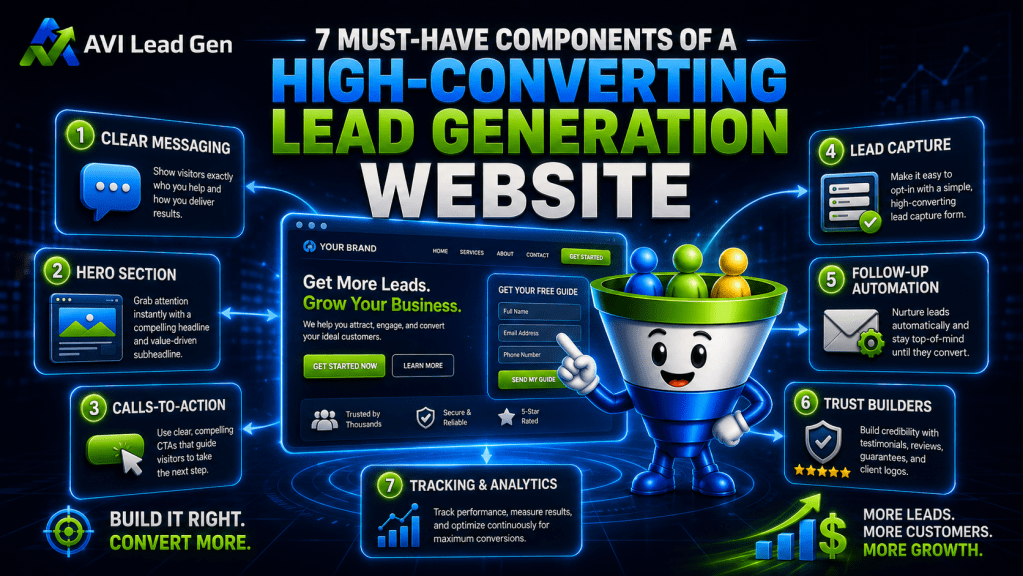
The 7 Must-Have Components of a High-Converting Lead Generation Website
A high-converting website isn’t built around one clever headline, one attractive design, or one form at the bottom of the page.
It works because several important pieces support each other.
The message helps visitors understand the offer. The hero section creates the first moment of clarity. Calls-to-action guide the next step. Lead capture turns interest into an inquiry. Follow-up automation protects the opportunity. Trust builders reduce hesitation. Tracking shows what needs to improve.
When these pieces are missing or disconnected, the website may still look professional, but it will struggle to turn traffic into real opportunities.
That’s why the goal isn’t just to build a better-looking website.
The goal is to build a website that helps the right visitors move forward with less confusion, less friction, and more confidence.
The seven components below are the foundation of how to build a lead generation website.
1. Clear Messaging and a Strong Value Proposition
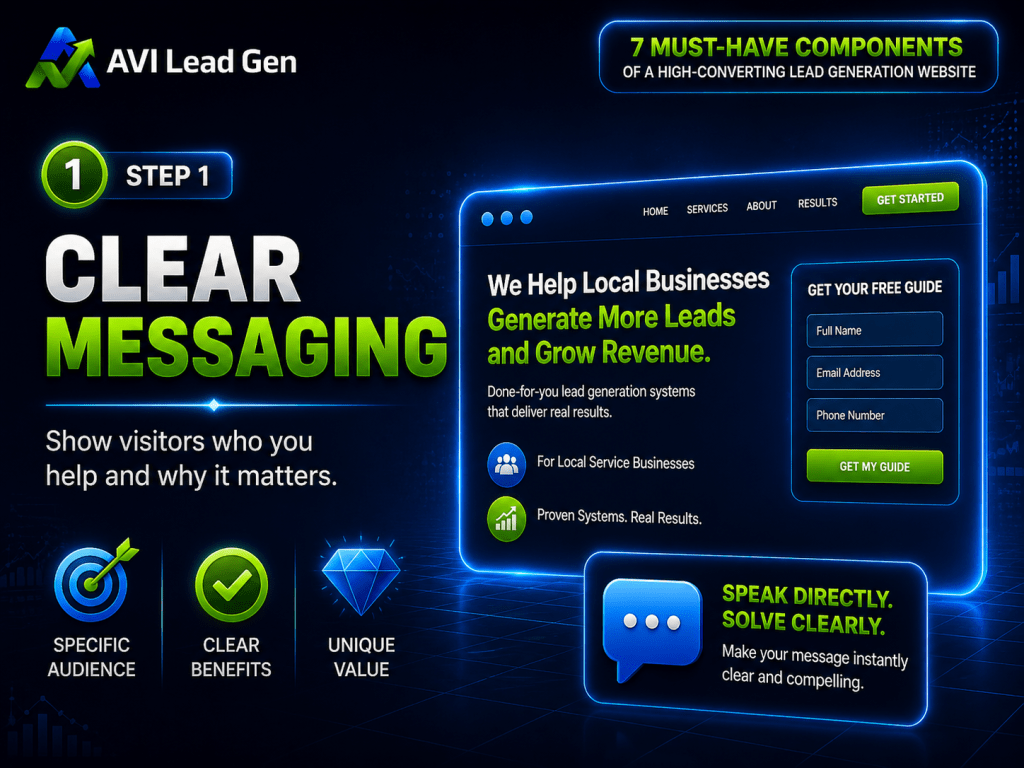
The first job of a lead generation website is clarity.
When someone lands on your website, they should be able to understand three things quickly:
Who you help.
What problem you solve.
What step they should take next.
If those answers are not obvious, the visitor has to work too hard.
Many small business websites lead with vague statements like:
Quality service you can trust.
Your local experts.
We care about our customers.
Solutions built for you.
Those lines may sound professional, but they don’t tell the visitor enough.
A stronger message is specific.
It speaks to the customer, the problem, and the outcome.
For example, “Lead Generation Websites for Local Service Businesses That Need More Qualified Calls and Booked Appointments” is much clearer than “Professional Website Design Services.” It tells the visitor who the service is for, what kind of help is being offered, and why it matters.
Clear messaging reduces confusion.
And confusion is one of the fastest ways to lose a visitor.
A high-converting website should make the visitor feel like they’re in the right place. The copy should focus less on what the business wants to say and more on what the visitor needs to understand before they’re willing to act.
This is one of the reasons many lead generation websites fail to produce leads. The design may be fine, but the message does not create enough confidence or urgency for visitors to move forward.

2. A Conversion-Focused Hero Section
The hero section is the first major decision point on the page.
It usually includes the headline, supporting text, primary call-to-action, and first visual impression. It sets the tone for everything that follows.
A weak hero section tries to sound impressive.
A strong hero section creates direction.
The visitor shouldn’t have to scroll halfway down the page to understand what the business does. They shouldn’t have to guess who the service is for. They shouldn’t have to search for the next step.
A conversion-focused hero section should include:
A clear headline.
A short supporting line.
One primary call-to-action.
A helpful visual that supports the message.
Enough trust or context to reduce hesitation.
The goal isn’t to cram every detail into the top of the page.
The goal is to create enough clarity for the visitor to keep moving.
For many service businesses, the hero section should answer:
What do you do?
Who is it for?
Why should I care?
What should I do next?
If the hero section cannot answer those questions, the rest of the page has to work much harder.
This is also where the difference between a traditional website and a lead generation website becomes obvious. A traditional website often introduces the business. A lead generation website introduces the problem, the solution, and the next step.
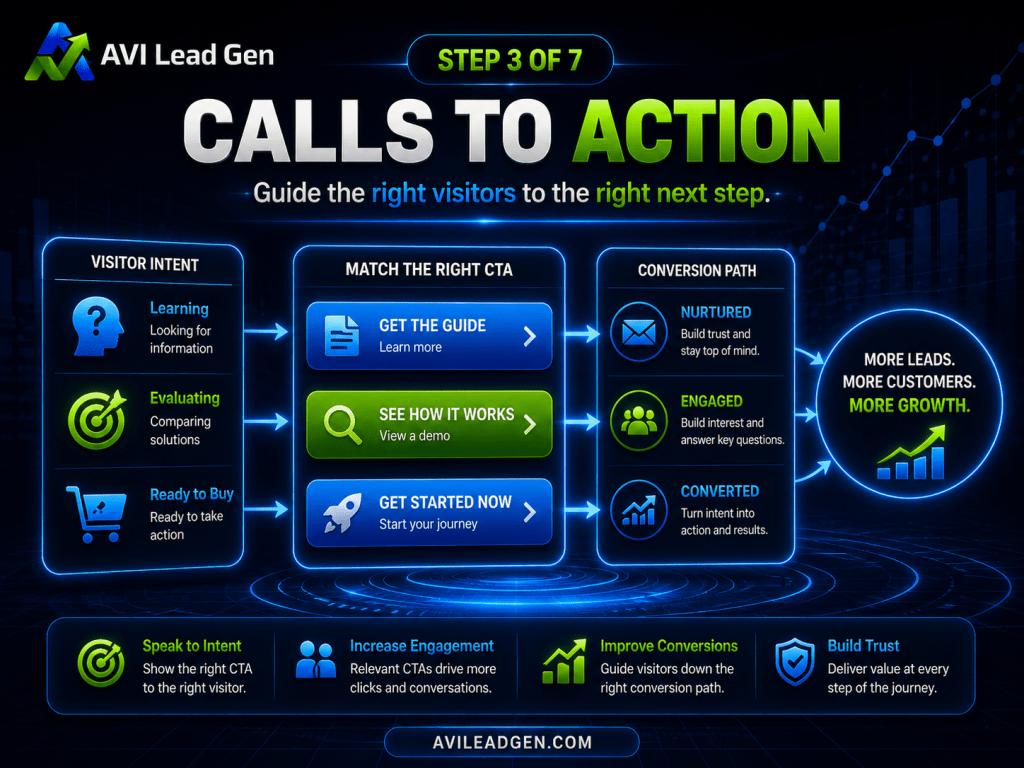
3. Calls-to-Action That Match Visitor Intent
A call-to-action isn’t just a button.
It’s the point where interest turns into movement.
The mistake many websites make is relying on one generic CTA everywhere.
Contact Us.
Submit.
Learn More.
Get Started.
Those can work in certain places, but they often leave too much uncertainty.
A stronger CTA tells the visitor what they are doing and what they can expect.
For example:
Book a Free Consultation.
Request a Website Audit.
Get the Conversion Checklist.
Schedule Your Strategy Call.
See How the Full System Works.
Request a Quote.
Download the Guide.
The best CTA depends on the visitor’s intent.
Someone on a service page may be ready to book or request a quote. Someone reading an educational blog article may not be ready for a call yet, but they may download a guide or read a related article. Someone comparing options may need a page that explains your process before they take action.
A high-converting website should use calls-to-action intentionally.
That doesn’t mean every page needs ten buttons.
It means every important page should have one clear primary action and, when appropriate, a softer secondary action for visitors who aren’t ready to book.
The CTA should reduce hesitation, not create more questions.
If someone clicks “Book a Strategy Call,” they should understand what the call is for. If someone clicks “Download the Guide,” they should know what they will receive. If someone clicks “See How the Full System Works,” they should land on a page that explains the larger process.
Every CTA should create a logical next step.
4. Simple Lead Capture and Booking Paths
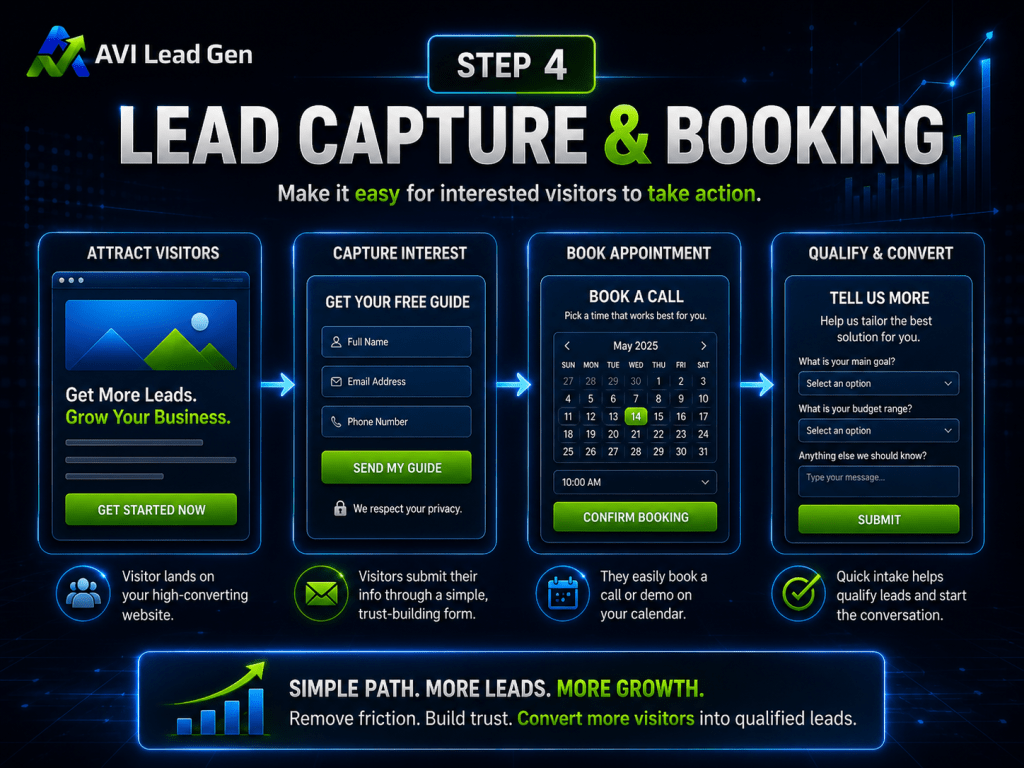
Traffic without lead capture is wasted opportunity.
If someone is interested, your website needs to make the next step easy.
That may sound obvious, but many websites create unnecessary friction. The form is hard to find. The booking link is buried. The mobile experience is clunky. The form asks for too much information. Visitors are sent to a general contact page with no clear reason to act.
A strong lead capture system gives people a simple way to raise their hand.
That might include:
A short contact form.
A quote request form.
A consultation booking page.
A lead magnet download.
A newsletter signup.
A click-to-call button.
A service-specific intake form.
The right option depends on the business and the page.
High-intent visitors should have a clear path to book, call, or request a quote. Earlier-stage visitors may need a softer conversion point, such as a checklist, guide, or email sequence.
Lead capture should balance ease and usefulness.
If the form is too long, visitors may stop. If the form is too short, the business may not have enough information to respond well. The goal is to ask for enough information to support the next step without making the process feel heavy.
This is where lead capture and booking systems become important. The website should not only collect information. It should move the visitor into a process that helps the business respond, qualify, and guide the lead forward.

5. Follow-Up Automation That Protects Every Opportunity
The form submission isn’t the finish line.
It’s the start of the follow-up process.
This is one of the biggest shifts in how small businesses should think about their websites. A high-converting lead generation website doesn’t simply send form submissions to an inbox and hope someone responds.
It starts a system.
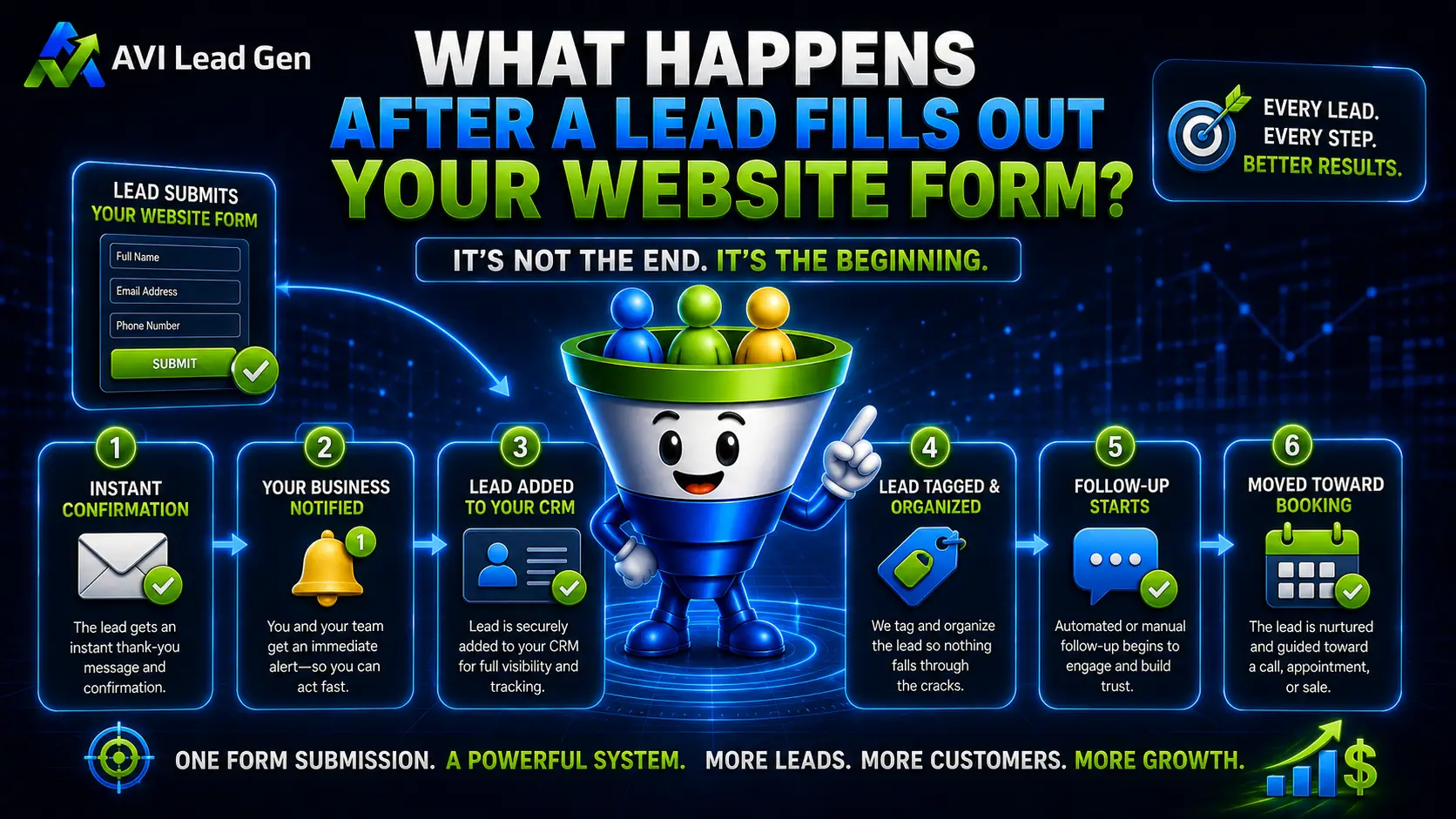
When someone fills out a form or books a call, several things should happen quickly:
The lead should receive confirmation.
The business should receive an alert.
The contact should enter the CRM.
The lead source should be tracked when possible.
The next step should be clear.
Follow-up should happen while interest is still high.
If that process is missing, good leads can go cold.
A visitor may be interested when they submit the form, but if they wait hours or days for a response, they may contact another business, lose urgency, or forget why they reached out.
Automation helps protect those opportunities.
It can send immediate confirmation emails, notify the business, create CRM tasks, trigger reminders, send booking links, tag contacts, and start nurture sequences for leads who aren’t ready to buy yet.
Automation doesn’t replace human relationships.
It makes sure opportunities don’t disappear before a human conversation can happen.
If leads are coming in but not turning into conversations, follow-up may be the bottleneck.
Fast follow-up matters because buyer intent fades quickly. When someone reaches out, they are usually trying to solve a problem now. A slow response gives that opportunity time to cool off.

6. Trust Builders That Reduce Hesitation
Visitors rarely take action based only on your claims.
They need evidence.
A lead generation website should help people feel safer about the next step. That doesn’t mean filling the page with hype. It means showing proof that supports the decision.
Trust builders may include:
Testimonials.
Google reviews.
Client stories.
Before-and-after examples.
Relevant certifications.
Industry experience.
Guarantees or clear expectations.
Photos of the team or work.
Process explanations.
Frequently asked questions.
The best trust builders are specific.
A generic testimonial like “Great company” is fine, but it doesn’t carry as much weight as a review that explains the problem, the experience, and the result.
Trust should also be placed strategically.
A review near a call-to-action can reduce hesitation. A process section before a booking button can help visitors understand what happens next. FAQs near the bottom of the page can address concerns before someone leaves.
Trust isn’t only about proving that your business is legitimate.
It’s about reducing the uncertainty that stops people from acting.
For service businesses, that uncertainty often sounds like:
Will this be worth my time?
Will they understand my problem?
Will I be pressured?
What happens after I submit the form?
How much will this cost?
Are they the right fit for me?
A strong website knows how to turn website visitors into leads because it answers those questions before they become objections.

7. Tracking and Analytics That Show What to Improve
A high-converting website isn’t built once and forgotten.
It should be measured, reviewed, and improved.
Without tracking, every decision becomes guesswork. You may know that traffic is up, but not whether the traffic is qualified. You may know that people visit a page, but not whether they click the call-to-action. You may receive leads, but not know which source produced them.
Tracking helps you understand the full path.
A strong lead generation website should help answer:
Where are visitors coming from?
Which pages generate leads?
Which CTAs get clicked?
Which forms convert?
Which traffic sources produce qualified leads?
How quickly are leads followed up with?
How many leads become appointments?
How many appointments become customers?
Those answers matter because they show where the system is working and where it’s leaking.
If traffic’s low, visibility may be the issue.
If traffic’s strong but leads are low, website conversion or lead capture may be the issue.
If leads are strong but appointments are low, follow-up or booking may be the issue.
If appointments happen but sales are weak, qualification or sales conversion may be the issue.
That’s why tracking should look beyond traffic.
Traffic is only one part of the system.
The real goal is to see how visitors move toward becoming leads, appointments, and customers.
How the 7 Components Work Together
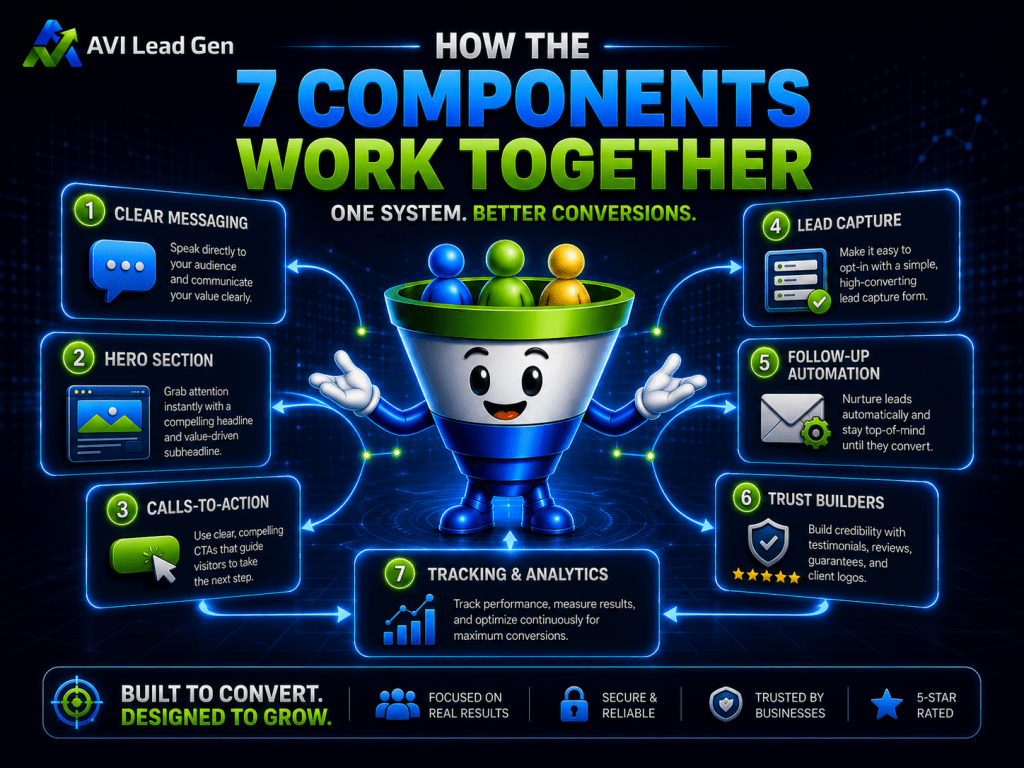
The seven components aren’t separate website features.
They work together as one conversion system.
Clear messaging helps visitors understand the offer.
A strong hero section creates the first moment of clarity.
Calls-to-action guide the next step.
Lead capture turns interest into an inquiry.
Follow-up automation protects the opportunity.
Trust builders reduce hesitation.
Tracking shows what needs improvement.
If one component is weak, the entire website can underperform.
For example, strong traffic won’t help much if the message is unclear. A great CTA won’t matter if the form is buried. A form submission won’t create growth if no one follows up quickly. A booking calendar won’t help if the wrong people are booking. Analytics won’t help if no one uses the data to improve the system.
This is why lead generation websites should be built as systems, not isolated pages.
When the pieces connect, the website becomes easier to improve.
Common Reasons Lead Generation Websites Underperform
Most websites don’t fail because of one obvious issue.
They usually underperform because several small gaps work against each other.
Common problems include:
The headline is too vague.
The offer is unclear.
The page has too many competing CTAs.
Forms are hard to find.
The mobile experience creates friction.
There’s no confirmation after form submission.
Leads go to an inbox instead of a CRM.
Follow-up is slow or inconsistent.
There’s no lead qualification process.
Trust builders are weak or missing.
No one tracks what happens after the visitor arrives.
These gaps can make a website feel like it should be working, even though the system is leaking opportunities.
This is why it helps to think in terms of bottlenecks. If the website has traffic but few leads, the bottleneck may be conversion. If leads come in but don’t book, the bottleneck may be follow-up. If appointments happen but don’t close, the bottleneck may be qualification or sales.

How to Know What to Fix First
Once you know the website has gaps, the next challenge is deciding what to fix first.
The mistake is trying to improve everything at once.
A better approach is to audit the system and find the first constraint.
Start by looking at the path:
Traffic to website.
Website to lead.
Lead to follow-up.
Follow-up to appointment.
Appointment to customer.
Customer to retention or referral.
Where is the biggest drop-off?
If few people visit the website, traffic may need attention.
If people visit but don’t take action, messaging, CTA, or lead capture may need attention.
If leads come in but don’t book, follow-up may need attention.
If appointments happen but don’t close, qualification or sales conversion may need attention.
A simple lead generation audit can help you identify where opportunities are getting stuck before you spend time or money on the wrong fix.
Once the weak point is clear, prioritize the fix that will unlock the next stage of growth.
How to Build a Lead Generation Website Bottom Line
A high-converting lead generation website isn’t just a nice design.
It’s a connected system built to turn visitors into leads, appointments, and customers.
That system needs clear messaging, a conversion-focused hero section, strategic calls-to-action, simple lead capture, follow-up automation, trust builders, and tracking.
When those pieces work together, the website becomes easier to measure and improve.
Traffic becomes more valuable. Leads are less likely to get missed. Visitors have a clearer path forward. The business has a better way to see what’s working and what needs to change.
That’s the real value of a lead generation website.
It gives your marketing a structure that can be improved over time.
Ready to Build a Website That Works as a Lead Generation System?
If your current website looks fine but doesn’t produce enough leads, or if leads are coming in without a clear system behind them, we can help you build a stronger path from visitor to customer.
Ready to stop guessing and build a lead generation system that works around the clock?
AVI Lead Gen helps small businesses capture leads, automate follow-up, and turn more website visitors into real opportunities.

Frequently Asked Questions
What is a high-converting lead generation website?
A high-converting lead generation website is a website designed to turn visitors into leads, appointments, or sales opportunities. It uses clear messaging, strong calls-to-action, simple lead capture, follow-up automation, trust builders, and tracking to guide visitors toward action.
What is the difference between a regular website and a lead generation website?
A regular website usually presents information about a business. A lead generation website is built to create movement. It guides visitors toward a clear next step, captures their interest, and connects them to a follow-up process.
What are the most important parts of a lead generation website?
The most important parts are clear messaging, a strong hero section, strategic calls-to-action, lead capture forms or booking paths, fast follow-up, trust builders, and tracking. These pieces work together to turn traffic into real opportunities.
Does a lead generation website need CRM automation?
It should have some form of follow-up system. CRM automation helps make sure leads are captured, organized, acknowledged, and followed up with consistently. It does not replace human response, but it helps prevent missed opportunities.
Why is my website getting traffic but not leads?
Your website may have unclear messaging, weak calls-to-action, buried forms, poor mobile usability, weak trust signals, or no clear lead capture path. The issue may also happen after the form if follow-up is slow or inconsistent.
How often should a lead generation website be improved?
A lead generation website should be reviewed regularly based on traffic, conversion rates, lead quality, follow-up performance, and booked appointments. Quarterly reviews are a good starting point, but active campaigns may require more frequent adjustments.
Can a small business benefit from a lead generation website?
Yes. Small businesses can benefit from a lead generation website because it creates a clearer system for turning visitors into leads and leads into conversations. The goal is not just to look professional, but to create a repeatable path for new opportunities.