After auditing your lead generation system, you may find several things that need work.
Your traffic may be inconsistent. Your website may not convert well. Your forms may be weak. Your follow-up may be slow. Your appointments may not be closing. Your customers may not be referring anyone.
That can feel overwhelming.
The mistake many businesses make is trying to fix everything at once.
They rewrite pages, post more content, run ads, change forms, add software, adjust offers, and test new tactics without knowing which problem is limiting growth the most.
That usually creates more activity.
It doesn’t always create more progress.
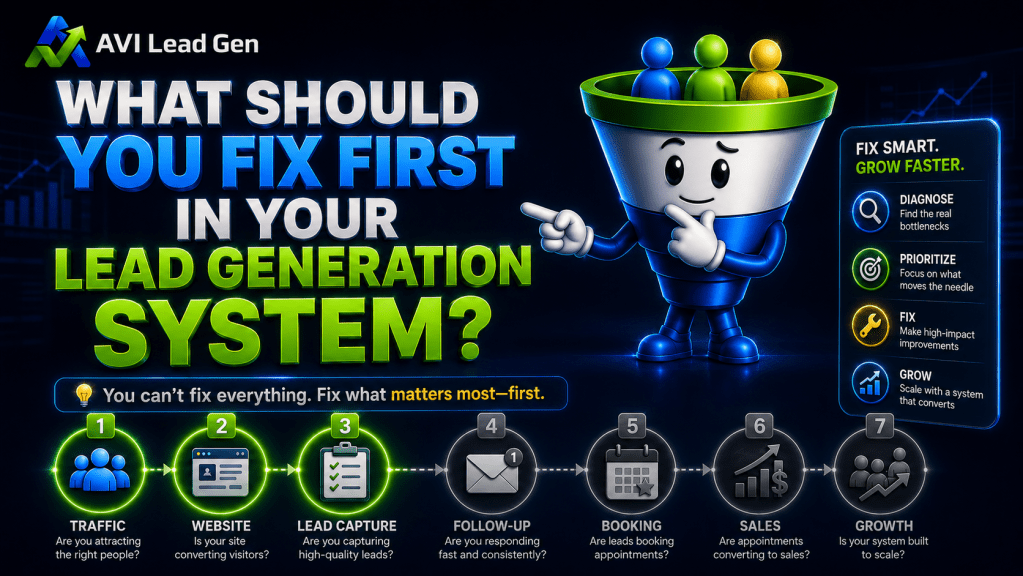
A smarter approach is to fix the constraint that’s holding the system back right now.
At AVI Lead Gen, we believe lead generation works best when it’s treated as a connected system. Traffic, website conversion, lead capture, follow-up, qualification, booking, sales, retention, and referrals all affect each other.
When one stage is weak, the whole system can slow down.
The goal isn’t to fix random marketing tasks. The goal is to fix the right problem in the right order, with proper sales funnel optimization.
Why Most Businesses Fix the Wrong Problem First
Most businesses don’t choose the wrong fix because they’re careless.
They choose it because the visible problem isn’t always the real problem.
A business may see low revenue and assume it needs more website traffic.
But if leads are already coming in and sitting unanswered for hours, traffic isn’t the first problem to fix.
Another business may decide it needs a new website because the current one feels outdated.
But if appointments are happening and deals aren’t closing, the website may not be the biggest constraint.
Another business may invest in ads because the calendar feels empty.
But if the landing page is unclear, the forms are buried, and follow-up is inconsistent, ads may only send more people into a weak system.
This is why guessing gets expensive.
When you fix the wrong problem first, you may improve something that looks important while leaving the real constraint untouched.
That’s how businesses end up doing more marketing without seeing better results.
Start by Finding the Constraint
A constraint is the part of your system that limits everything after it.
In lead generation, that constraint could be traffic, website conversion, lead capture, follow-up, qualification, booking, sales conversion, or retention.
The key question is:
Where are opportunities getting stuck?
If people are not finding you, the constraint may be visibility.
If people are visiting your website but not taking action, the constraint may be conversion.
If visitors are interested but not becoming leads, the constraint may be lead capture.
If leads are coming in but not turning into conversations, the constraint may be follow-up.
If conversations are happening but the wrong people are booking, the constraint may be qualification.
If appointments are happening but not closing, the constraint may be sales conversion.
If customers are buying but not staying, reviewing, or referring, the constraint may be retention or customer experience.
The right first fix depends on where the system is breaking down.
Fix the Problem Closest to Revenue First

One of the simplest ways to prioritize lead generation fixes is to start closest to revenue.
That doesn’t always mean ignoring traffic or website improvements. It means looking at the opportunities already closest to becoming customers.
For example, if you already have leads coming in but no one follows up quickly, fixing follow-up should usually come before investing in more traffic.
If you already have appointments booked but few of them close, improving the sales process should usually come before redesigning the homepage.
If you already have customers but they are not staying, reviewing, or referring, retention may deserve attention before launching a new campaign.
This matters because the closer a problem is to revenue, the faster a fix may affect results.
A traffic problem sits near the top of the funnel. It matters, but traffic takes time to build.
A follow-up problem sits closer to the sale. Fixing it may help you convert leads you are already receiving.
A sales conversion problem sits even closer. If booked appointments are not turning into customers, more leads may not be the most important move.
Start by asking:
What opportunities are already in motion, and where are we losing them?
That question often reveals the first fix.
Fix Leaks Before Adding More Traffic
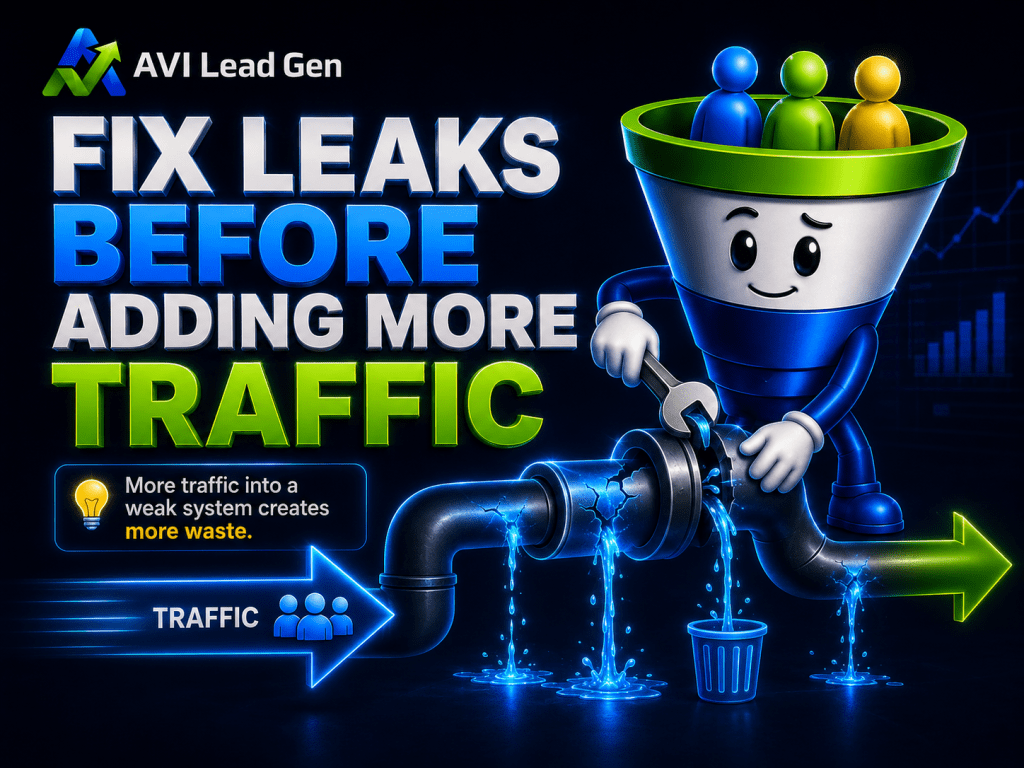
More traffic can help a strong system grow.
But more traffic can also expose a weak system.
If your website does not convert, more traffic may only increase bounce rates.
If your forms create friction, more traffic may only create more abandoned visits.
If your follow-up is slow, more traffic may only create more missed opportunities.
If your qualification is weak, more traffic may only fill your calendar with poor-fit prospects.
Before you invest heavily in traffic, make sure the rest of the system can handle the interest.
This doesn’t mean your system has to be perfect before you promote it. It means the basic path should be clear.
Visitors should understand what you do.
They should know what step to take next.
Leads should receive confirmation.
Your team should be notified.
Follow-up should happen quickly.
Qualified prospects should have a clear booking path.
Booked appointments should have a defined next step.
If those basics are missing, fix the leaks first.
Traffic is valuable only when the system is ready to turn attention into opportunity.
Prioritize the Biggest Drop-Off
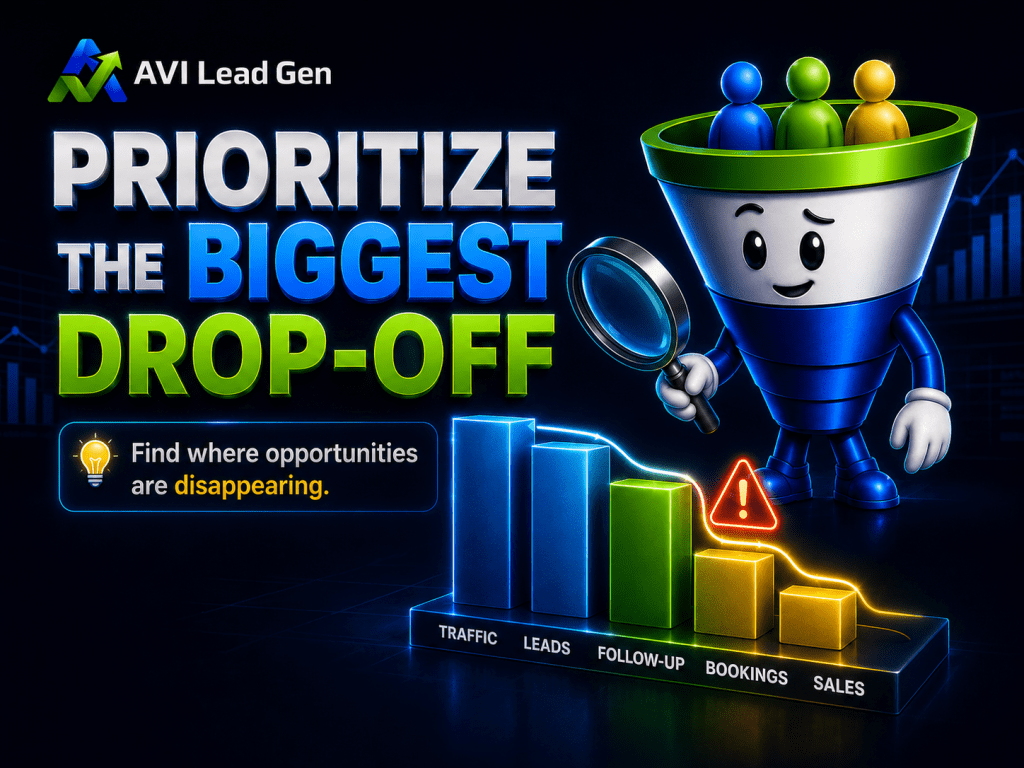
Another way to decide what to fix first is to look for the biggest drop-off.
This is where simple tracking becomes valuable.
Look at each stage:
How many people visit the website?
How many become leads?
How many leads get contacted?
How many leads book appointments?
How many appointments become customers?
How many customers stay, review, or refer?
The stage with the biggest drop-off usually deserves attention.
For example, if 1,000 people visit your website and only 3 become leads, website conversion or lead capture may be the first priority.
If 50 leads come in and only 5 book appointments, follow-up or booking may be the issue.
If 20 appointments happen and only 1 becomes a customer, qualification or sales conversion may be the constraint.
If customers buy once and disappear, retention or onboarding may be limiting long-term growth.
A drop-off doesn’t automatically tell you the full story, but it gives you a starting point.
Without this visibility, every fix is based on opinion.
With it, you can focus on the stage where improvement is most likely to have an impact.
Fix Low-Effort, High-Impact Problems Quickly
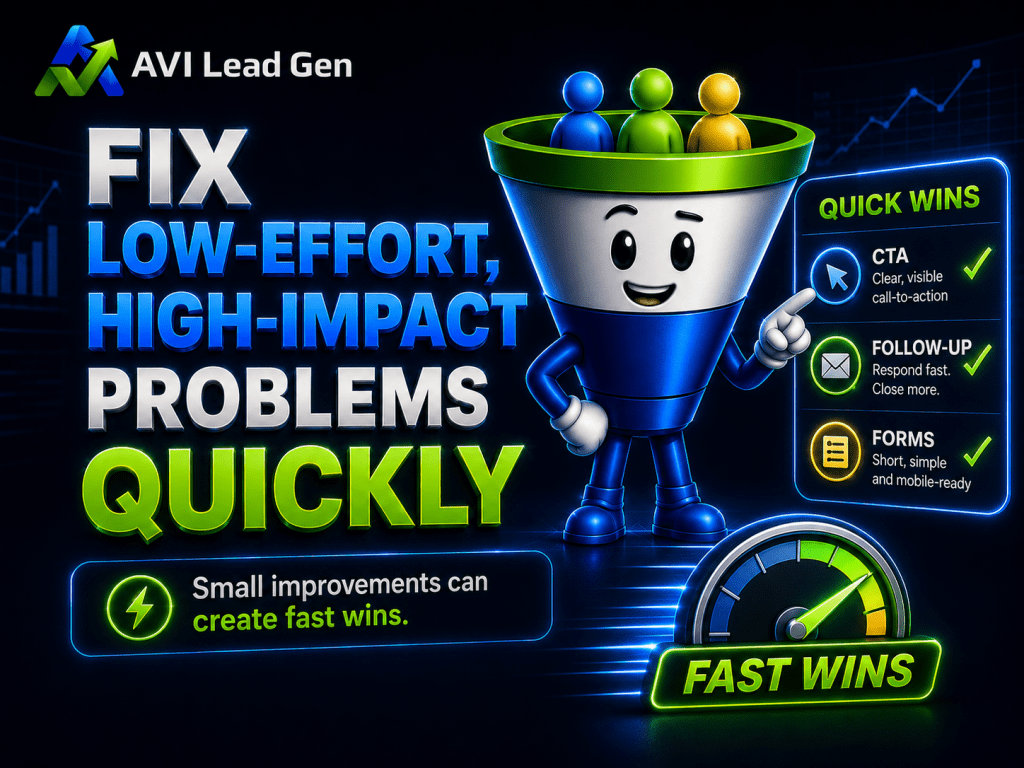
Not every fix requires a major rebuild.
Sometimes the best first move is a simple improvement that removes obvious friction.
For example:
A stronger call-to-action on a service page.
A shorter form.
A confirmation email after someone submits a form.
An internal notification when a new lead comes in.
A faster follow-up workflow.
A booking link in the first response.
A reminder before appointments.
A few qualification questions before a call.
A proposal follow-up sequence.
A review request after a customer has a good experience.
These changes may seem small, but they can improve the system quickly because they support leads that are already moving through the funnel.
The mistake is assuming every solution has to be big.
Sometimes the first fix is not a new website, new ad campaign, or new software platform.
Sometimes it’s making the next step clearer.
Sometimes it’s making sure no lead gets missed.
Sometimes it’s reducing one point of friction that causes people to stop.
Small fixes matter when they remove a real bottleneck.
Don’t Confuse Activity With Progress

Marketing activity can feel productive.
Posting more content feels productive. Running ads feels productive. Adding a tool feels productive. Rebuilding a page feels productive. Creating a new offer feels productive.
But activity isn’t the same as progress.
Progress means the system is moving more qualified people toward becoming customers.
That is the standard.
If a tactic doesn’t help the next stage of the system improve, it may not be the right priority yet.
For example, more blog posts may help long-term visibility, but they may not fix slow lead response.
A new CRM may help organization, but it may not fix unclear messaging.
A redesigned homepage may look better, but it may not fix weak sales conversations.
More ads may create more clicks, but they may not fix poor qualification.
Before you choose a fix, ask:
Will this improve the stage where we’re currently losing opportunities?
If the answer is unclear, the fix may not be the first priority.
A Simple Prioritization Framework
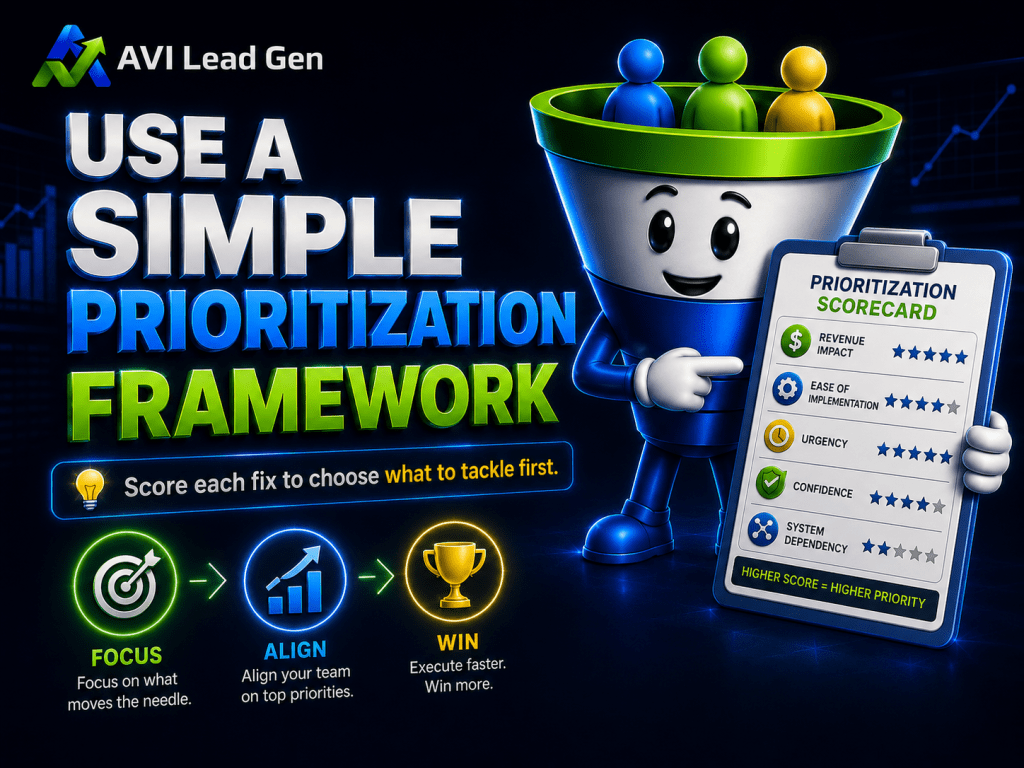
When several problems show up at once, use a simple scoring method.
Score each possible fix from 1 to 5 in five areas:
Revenue impact
Ease of implementation
Urgency
Confidence
System dependency
Revenue impact means how much the fix could affect leads, appointments, customers, or retention.
Ease of implementation means how quickly the fix can be made with the resources you have.
Urgency means how much the issue is hurting performance right now.
Confidence means how sure you are that this is a real problem, not just a guess.
System dependency means whether other improvements depend on this being fixed first.
For example, fast lead notifications may score high because they are easy to implement, close to revenue, urgent, and necessary for better follow-up.
A full website redesign may be important, but it may score lower if the immediate issue is that no one is responding to new leads quickly.
A content strategy may be valuable, but it may not be the first fix if the website is already getting qualified traffic that doesn’t convert.
This kind of scoring prevents emotional decision-making.
It gives you a practical way to decide what deserves attention first.
A Realistic Example
Imagine a local service business that wants more booked appointments.
The owner believes the problem is SEO because the website’s not generating enough customers.
After reviewing the system, they find several issues:
The website traffic is moderate but not terrible.
The main service page has a weak call-to-action.
The contact form works, but it is too long.
New leads do not receive an immediate confirmation.
The owner usually responds several hours later.
There is no booking link in the follow-up message.
Some leads are not a good fit.
Appointments that do happen often close well.
There are multiple problems here.
But the first fix should probably not be SEO.
The business already has some traffic. It already has some leads. It already closes appointments when the right people book.
The biggest constraint appears to be the middle of the system: lead capture, follow-up, and booking.
A smart first move would be to simplify the form, improve the call-to-action, send an immediate confirmation, alert the owner instantly, and include a clear booking link in the first response.
Those fixes help the opportunities already entering the system.
SEO may still matter later, but it’s not the first constraint.
This is how prioritization changes the decision.
Instead of chasing more visibility, the business fixes the path from interest to appointment first.
How to Decide Which Lead Generation Fixes Should Come First
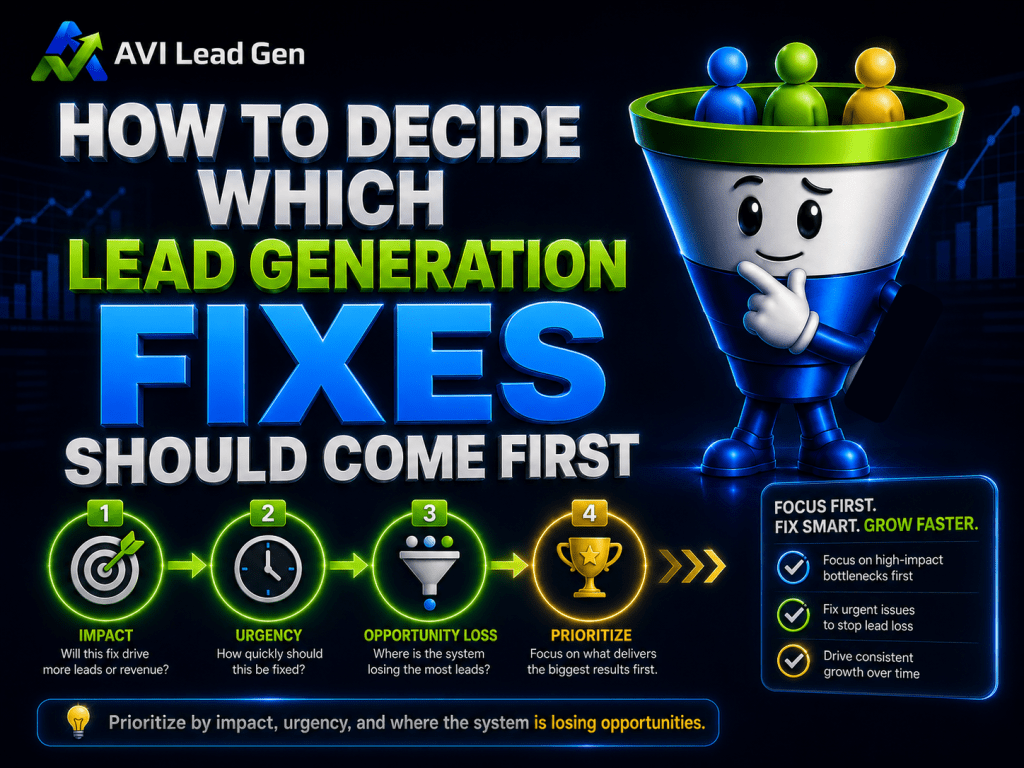
Once you know where the system is weak, usually by completing a simple lead generation audit, the next step is deciding what to fix first.
This is where many businesses get stuck. They find several problems at once, then try to solve all of them at the same time. That usually creates more work, but not always more growth.
The better approach is to prioritize your lead generation fixes based on impact, urgency, and where the problem sits in the funnel.
Start by asking one simple question:
Where is the system losing the best opportunities right now?
If qualified leads are already coming in but no one responds quickly, follow-up may need to come first. If people are visiting your website but not taking action, website conversion may be the priority. If appointments are happening but few prospects become customers, the sales process may be the constraint.
Not every issue deserves the same level of attention right away.
Some fixes are important but not urgent. Some are easy to make but may not move revenue. Others sit so close to the sale that improving them can create a faster impact than adding more traffic or launching another campaign.
A strong lead generation system is improved in order.
First, fix the gaps that cause qualified opportunities to stall. Then improve the parts of the system that help more of the right people enter the funnel.
When Traffic Should Be the First Fix

There are times when traffic really is the first problem.
If your website is clear, your forms work, your follow-up is fast, your sales process is solid, but very few qualified people are finding you, then visibility deserves attention.
This may mean improving local SEO, publishing better content, strengthening service pages, building referral channels, improving your Google Business Profile, running paid campaigns, or increasing promotion.
The key is making sure traffic is actually the constraint.
Traffic should usually be the first fix when:
Very few people are visiting the website.
The visitors you do get are not the right fit.
Your service pages are not visible for relevant searches.
Your local presence is weak.
You have a working conversion path but not enough qualified attention.
When that is true, visibility becomes the priority.
Just make sure the traffic you are chasing is aligned with the customers you want.
More visitors only help when the right people are finding the right pages for the right reasons.
When Website Conversion Should Be the First Fix
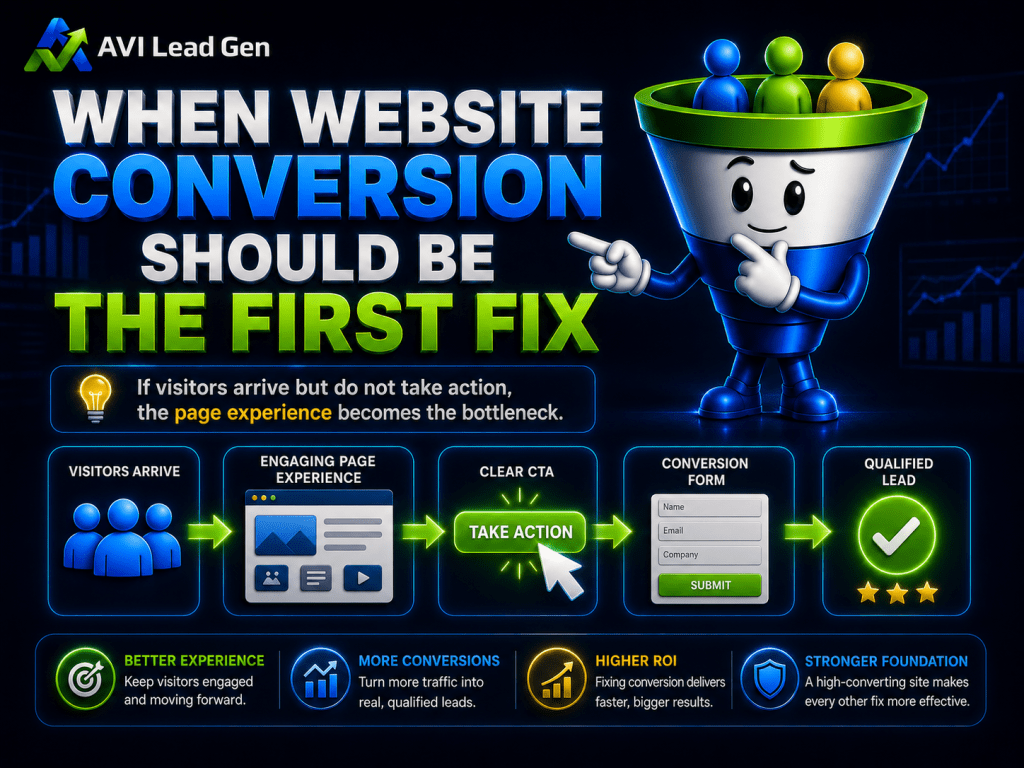
Website conversion should be the first priority when people are visiting your site but not taking action.
This is common.
A business may have decent traffic, but the homepage is vague. Service pages read like brochures. Calls-to-action are unclear. Forms are hidden. The site talks about the business but not enough about the customer’s problem.
When that happens, the website becomes the constraint.
You don’t necessarily need to rebuild everything.
Start with the most important pages.
Clarify the headline. Make the offer easier to understand. Add trust signals. Improve the call-to-action. Make the form easier to find. Make the mobile experience smoother. Remove distractions that compete with the next step.
Website conversion should be prioritized before traffic when the site’s already getting visitors but very few of them become leads.
When Follow-Up Should Be the First Fix
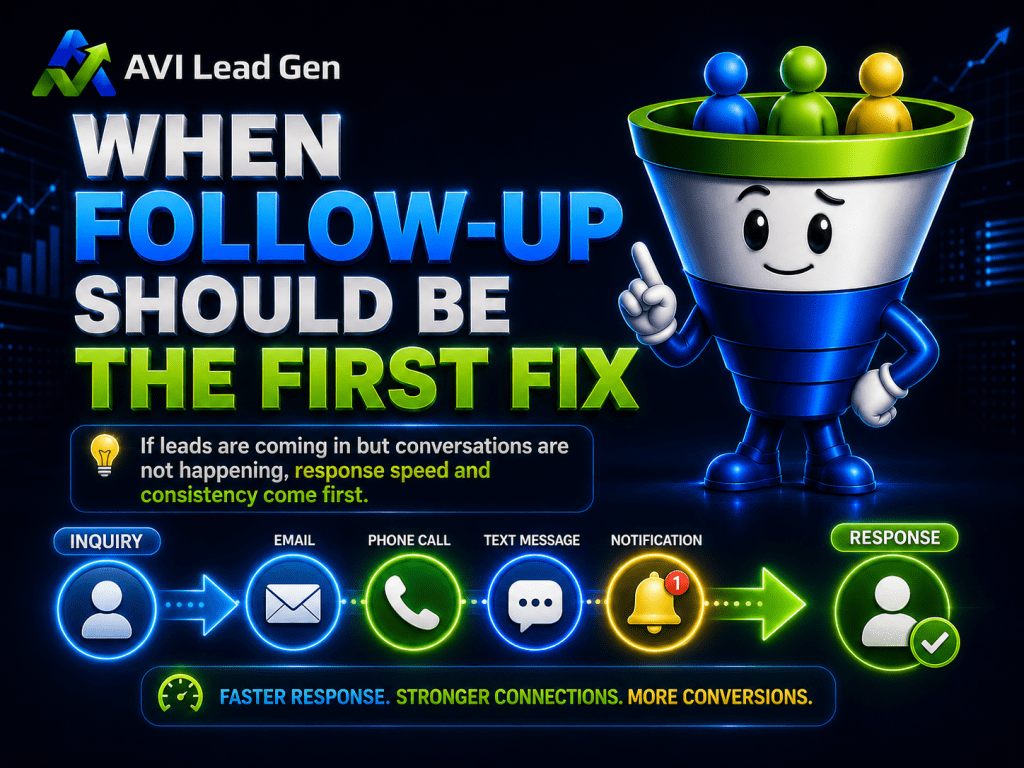
Follow-up should be the first fix when leads are coming in but not turning into conversations.
This is one of the fastest ways to waste good opportunities.
Someone fills out a form. They are interested. They are active. They are likely comparing options.
Then nothing happens for hours.
By the time the business responds, the lead may have moved on.
A stronger follow-up process should include immediate confirmation, internal notifications, reminders, quick response expectations, and a clear next step.
This is where CRM automation can help.
Automation does not replace real conversations. It helps make sure the lead doesn’t disappear before a real conversation happens.
If you’re already receiving inquiries, but response is slow or inconsistent, follow-up may be the best first fix.
When Qualification Should Be the First Fix
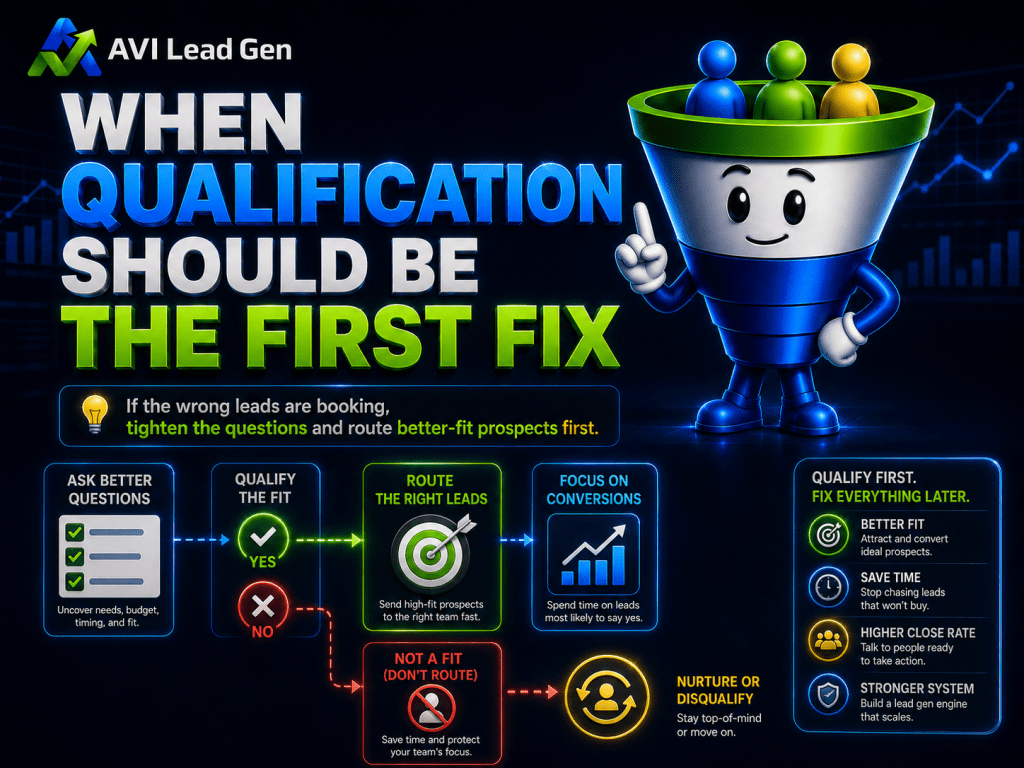
Qualification should be the first priority when the calendar is busy but the opportunities are weak.
This happens when a business gets leads, books calls, and spends time talking to people who aren’t a good fit.
The issue may not be lead volume.
It may be lead quality.
A few simple changes can help. Add better questions to forms. Segment leads by need, budget, location, timeline, or service fit. Use tags inside your CRM. Route high-intent prospects differently than low-intent inquiries. Give poor-fit leads a helpful alternative path instead of letting them consume the same amount of time.
Qualification isn’t about creating friction for serious buyers.
It’s about protecting time and improving the quality of conversations.
If too many appointments are a poor fit, qualification should move up the priority list.
When Sales Conversion Should Be the First Fix
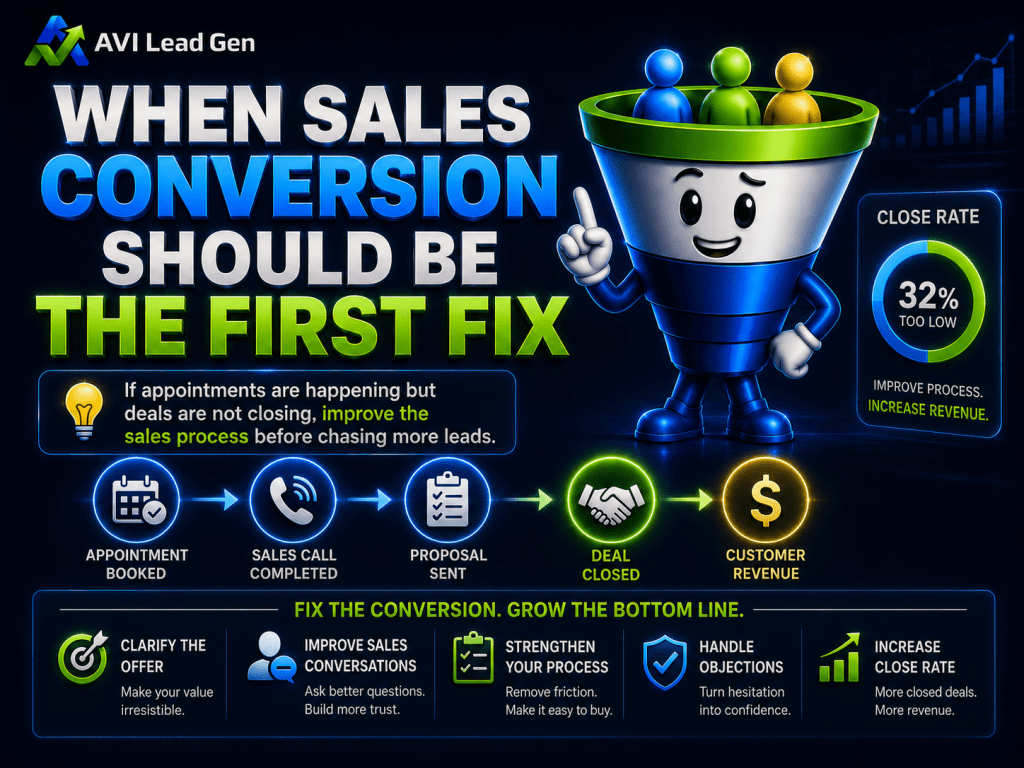
Sales conversion should be the first priority when appointments are happening but customers aren’t buying.
At that point, the business doesn’t have a top-of-funnel problem.
It has a conversion problem near the bottom of the funnel.
This may come from weak discovery, unclear offers, poor proposal follow-up, pricing presented without enough context, lack of urgency, or no defined next step after the call.
Improving sales conversion does not mean becoming pushy.
It means creating a clearer process.
Understand the prospect’s problem. Confirm fit. Explain the solution in terms of outcomes. Address concerns. Set expectations. Make the next step obvious.
If appointments are happening but deals aren’t closing, fix the sales process before adding more leads.
More appointments won’t solve a weak close process. They’ll only create more frustration.
The Right Order Depends on Your System
There is no universal order that works for every business.
One business may need traffic first.
Another may need website conversion.
Another may need faster follow-up.
Another may need better qualification.
Another may need a stronger sales process.
That’s why the audit matters.
The right order depends on your current system, your data, your goals, and the stage where opportunities are getting stuck.
However, the principle stays the same:
Fix the constraint that unlocks the next stage of growth.
That’s a very different mindset from trying to improve everything at once.
It gives you focus.
It helps you spend time and money more carefully.
It makes each improvement more connected to the result you actually want.
The Bottom Line
Your lead generation system may have several problems.
That doesn’t mean you should fix all of them at the same time.
Start by finding the constraint. Look for the biggest drop-off. Pay attention to the stage closest to revenue. Fix leaks before adding more traffic. Prioritize low-effort, high-impact improvements when they remove real friction.
The goal isn’t more activity.
The goal is better movement through the system.
More traffic is valuable when your website converts.
More leads are valuable when follow-up is fast.
More appointments are valuable when prospects are qualified.
More sales are valuable when customers stay, review, and refer.
Ready to Stop Guessing What to Fix First?
AVI Lead Gen helps small businesses identify the gaps in their lead generation system and build the right fixes in the right order.
If you’re not sure whether the problem is traffic, your website, follow-up, qualification, or sales conversion, we can help you create a clearer system.
Because growth gets easier when you know what to fix first.
Ready to stop guessing and build a lead generation system that works around the clock?
AVI Lead Gen helps small businesses capture leads, automate follow-up, and turn more website visitors into real opportunities.
Frequently Asked Questions
What should I fix first in my lead generation system?
Start with the constraint that is closest to revenue and limiting growth the most. If leads are coming in but not booking, fix follow-up. If appointments are happening but not closing, fix sales conversion. If traffic is low and the rest of the system works, fix visibility.
Should I focus on traffic or conversion first?
If your website has very little qualified traffic, focus on visibility. If your website already gets visitors but few become leads, focus on conversion first. More traffic won’t help much if the website doesn’t turn visitors into opportunities.
Why is follow-up often the best first fix?
Follow-up is close to revenue and often easier to improve quickly. If leads are already coming in, faster response times, confirmation messages, reminders, and clear booking links can help prevent good opportunities from going cold.
How do I know if my sales process is the problem?
Your sales process may be the problem if you’re booking appointments but few prospects become customers. Review your discovery questions, offer clarity, proposal follow-up, objection handling, and next-step process.
Can I fix more than one lead generation problem at a time?
You can, but it’s usually better to prioritize one primary constraint first. Trying to fix everything at once can spread your attention too thin and make it harder to know which improvement actually made a difference.