

Most business owners don’t mind investing in marketing.
They just want to know when it’s going to start working.
That’s the honest question behind almost every SEO, website, or lead generation conversation:
“How long until I see results?”
It’s a fair question. If you are paying for a new website, SEO, content, ads, CRM setup, or automation, you want to know when that investment starts turning into traffic, leads, appointments, and customers.
The problem is that marketing rarely works like a switch.
You don’t publish a website on Monday and suddenly have predictable lead flow by Friday. You do not post a few blogs and instantly outrank established competitors. You do not launch automation and immediately fix every weakness in the sales process.
Real lead generation takes time because it depends on more than visibility.
It depends on trust, traffic quality, website conversion, follow-up speed, qualification, tracking, and consistency.
At AVI Lead Gen, we believe small business marketing works best when it is treated like a system, not a one-time campaign. SEO can help bring the right people to your website, but the website still needs to convert. Leads can come in, but follow-up still needs to happen. Appointments can get booked, but the sales process still has to turn those conversations into revenue.
That is why SEO and lead generation timelines are not always simple.
The question is not only, “How long does SEO take?”
The better question is:
“How long does it take to build enough visibility, trust, and conversion systems to create consistent opportunities?”
Why Marketing Results Take Time
Many small business owners expect marketing to move faster than it does.
That expectation makes sense. If you launch something new, you want to see movement. You want proof that the effort is working.
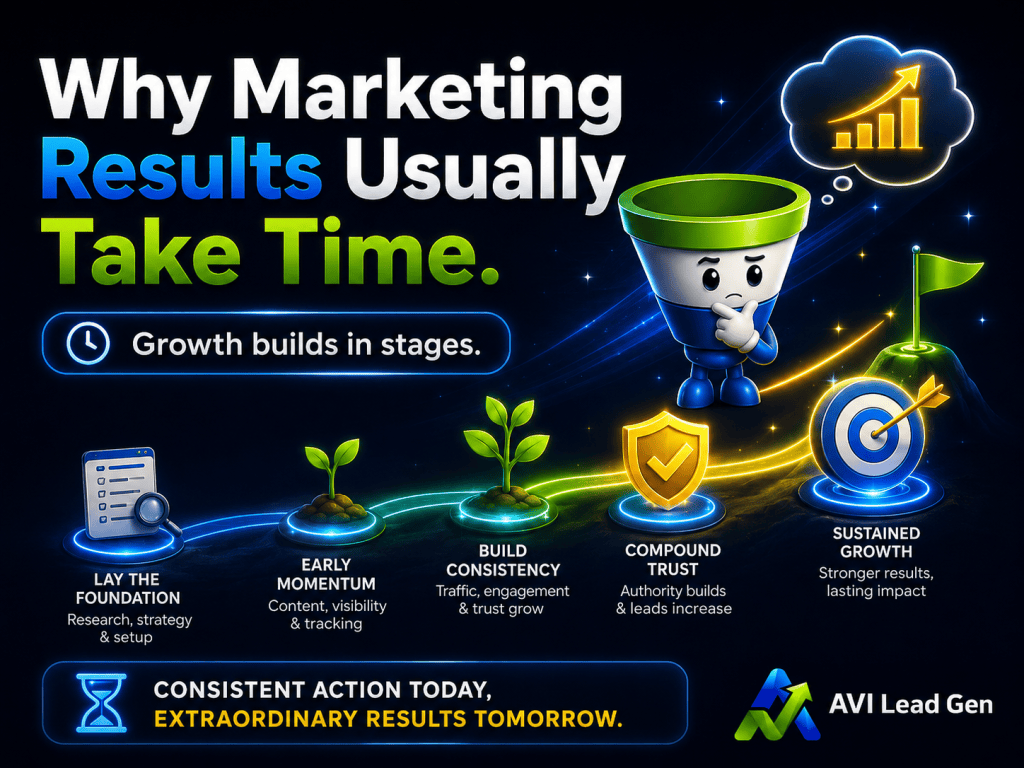
But sustainable marketing results usually build in stages.
Search engines need time to crawl your website, understand your content, compare your authority against competitors, and decide where your pages belong. Visitors need time to find your content, trust your message, and take action. Your business needs time to collect data, see what is working, and improve weak points in the process.
That’s why the first few weeks can feel quiet.
It doesn’t always mean the strategy is failing. Sometimes it means the foundation is being built.
This is especially true if your business is starting with a newer website, limited content, weak local visibility, few backlinks, or no consistent tracking. In those cases, early work may not create immediate traffic, but it can still be necessary before traffic becomes reliable.
SEO Is a Long-Term Asset
SEO is one of the strongest long-term marketing channels for small businesses, but it’s rarely instant.
A paid ad can start sending traffic quickly. A referral can create an opportunity quickly. A direct outreach message can start a conversation quickly.
SEO usually works differently.
It builds over time.
A page published today may take weeks or months to gain traction. A blog post may start with impressions before it earns clicks. A service page may need supporting content and internal links before it becomes more competitive.
That can feel slow, but the upside is important.
When SEO begins working, it can become a long-term asset. Instead of relying only on ads, referrals, or manual outreach, your website can begin attracting qualified visitors on its own.
That doesn’t happen by accident. It happens when your website, content, structure, and authority all improve together.
If you’ve already tried paid ads and you’re worried you’ll throw money down the drain, then start with our article to help grow qualified traffic.
A Realistic SEO Timeline for Small Businesses
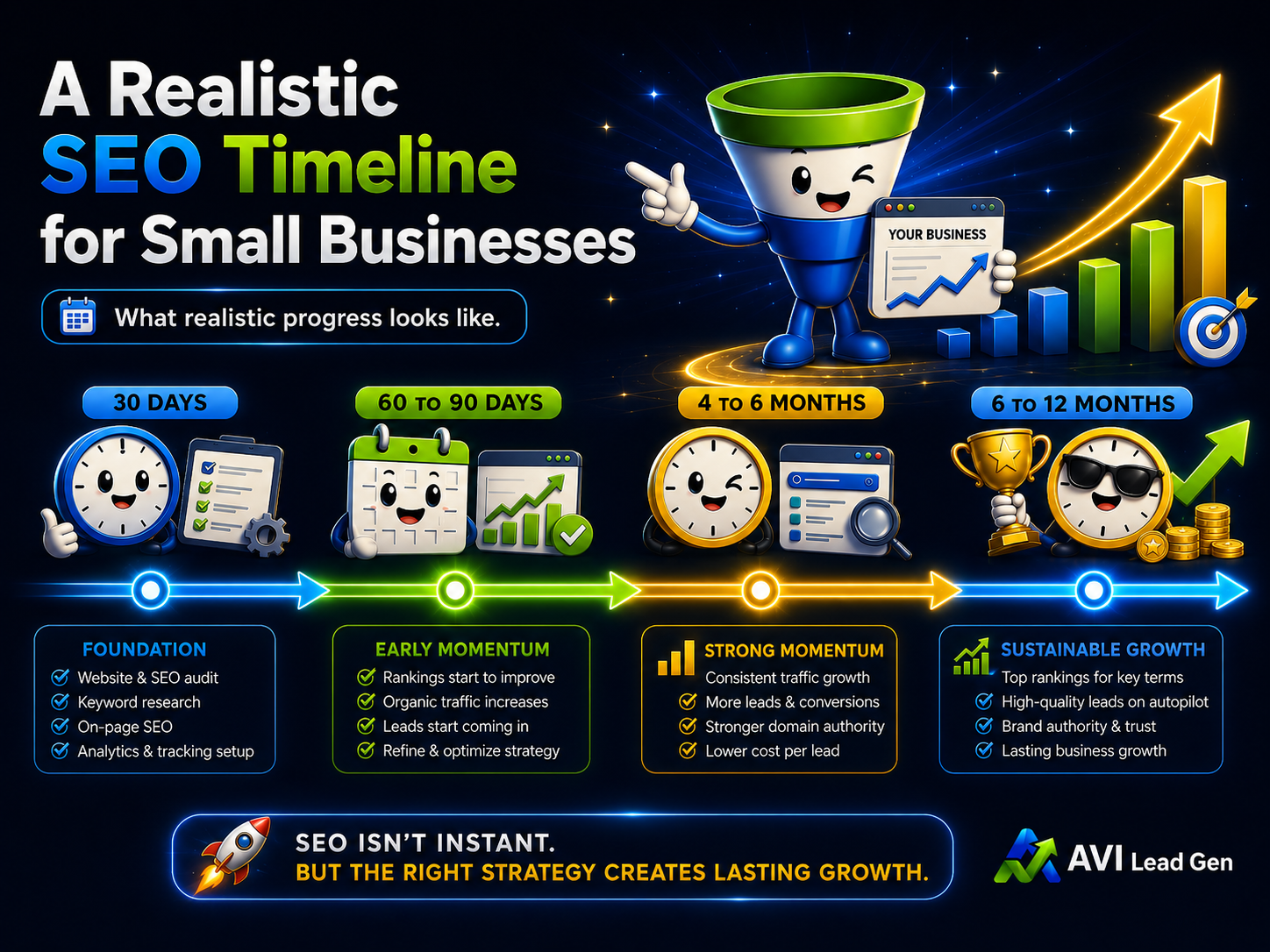
Every business is different, but most SEO campaigns follow a similar pattern. Below is the most common SEO timeline for small business.
During the first 30 days, the work is usually foundational. This is where you clean up technical issues, review messaging, set up analytics, identify keywords, improve page structure, and plan content. It may not feel exciting because traffic often does not change much yet, but this stage matters.
From 60 to 90 days, you may begin seeing early signs of movement. Pages may get indexed, impressions may increase, and some long-tail keywords may start gaining visibility. This is often where business owners begin to see that Google is noticing the work, even if the traffic is still modest.
Between 4 and 6 months, results usually become easier to evaluate. If the strategy is consistent, rankings may improve, traffic may become more noticeable, and leads may start appearing more regularly. This is also when weak points become clearer. You may discover that traffic is improving, but the website is not converting well. Or leads are coming in, but follow-up is too slow.
From 6 to 12 months, SEO can begin to compound. The site has more content, more internal links, more data, and more authority. This is when many businesses begin to see the difference between short-term activity and long-term marketing assets.
That timeline is not a guarantee. Competition, location, industry, website age, content quality, backlinks, and consistency all matter.
But as a general rule, SEO often feels slow at the beginning because the work is building trust before it builds momentum.
A Realistic Example
Imagine a local service business launches a new website and starts publishing one helpful article each week.
In the first month, the owner checks analytics and feels disappointed. Traffic barely moves. There are no major ranking jumps. The site looks better, but the phone isn’t suddenly ringing more.
By the third month, a few articles are getting impressions. Some service pages are showing up for longer search terms. A few visitors are coming from organic search, but lead flow is still inconsistent.
By month six, the picture starts to change. The website has a stronger content base, Google has more context about what the business does, and a handful of articles are bringing in relevant visitors. But now a new problem appears: visitors are coming in, but not enough of them are becoming leads.
At that point, the issue may not be SEO anymore.
It may be the website’s conversion path, the call-to-action, the form, the offer, or the follow-up system.
That’s why SEO and lead generation should not be treated as separate conversations. Traffic matters, but traffic only creates value when the rest of the system is built correctly and ready to turn that attention into action.
Lead Generation Systems Also Need Optimization

Even if traffic starts growing, lead generation still needs optimization.
That’s where many businesses get frustrated.
They think, “We’re getting visitors now, so why are we not getting more customers?”
The answer is usually that traffic is only one part of the process.
A complete lead generation system includes messaging, calls-to-action, lead capture, CRM organization, follow-up, booking, qualification, sales conversion, and tracking.
If one of those pieces is weak, results can stall.
For example, a business may start getting more visitors from SEO, but if the website does not clearly explain the offer, those visitors may leave. If the form is too long or hard to find, they may never reach out. If they do submit a form but nobody responds quickly, the opportunity may disappear. If every lead is allowed to book without qualification, the calendar may fill with poor-fit appointments.
That is why lead generation improves through data and refinement.
You launch the system. You watch what happens. You find the bottleneck. Then you improve the part that is limiting results.
Determining how long does lead generation take depends largely on the strength of the system behind it. Generating a lead is only the beginning. The real results come from what happens next, including follow-up, qualification, nurturing, and the processes that guide prospects toward becoming customers.
Why Some Businesses See Faster Results Than Others
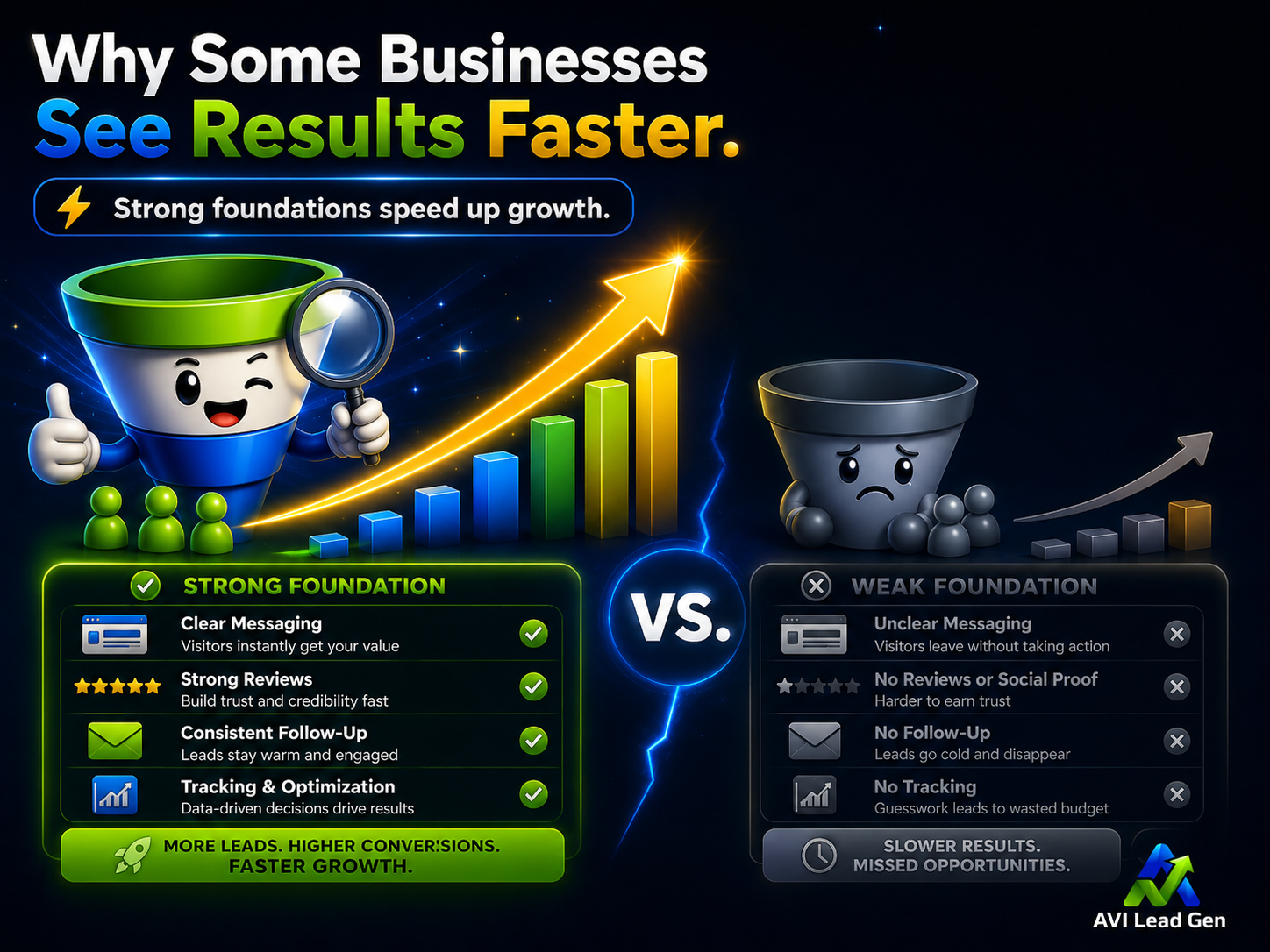
Some businesses see results faster than others because they already have stronger foundations.
A business with a clear offer, good reviews, strong local presence, fast follow-up, and a website that already converts may see traction faster once SEO or content begins improving.
Another business may need more time because the foundation is weaker. Maybe the website is confusing. Maybe the offer is too broad. Maybe the content is thin. Maybe leads are not tracked. Maybe the business waits too long to respond.
In that case, marketing may not fail because SEO is bad.
It may fail because the system around SEO is not ready.
This is one of AVI’s core beliefs: more traffic doesn’t fix a broken conversion process. It only sends more people into that broken process.
If your website is getting traffic but not enough leads, the issue may be conversion. If leads are coming in but not booking, the issue may be follow-up. If calls are happening but deals aren’t closing, the issue may be sales process or qualification.
That’s why sustainable lead generation requires more than rankings.
It requires a system that can handle the opportunity once it arrives.
Common Reasons Businesses Don’t See Results
The businesses that struggle most are often not doing one thing wrong. They usually have several small gaps working against them.
The website may look fine but fail to guide visitors toward action. The call-to-action may be vague. The lead form may be buried. Follow-up may depend on memory instead of automation. Leads may not be qualified before they book. Analytics may show traffic, but not where the funnel is breaking.
Each gap may seem small on its own.
Together, they slow down growth.
This is why it helps to look at the full path from search to sale. If someone finds your business through Google, lands on your website, reads a page, fills out a form, receives a response, books a call, and becomes a customer, every step matters.
The weaker the system, the longer it takes for marketing to produce reliable results.
These resources can help you avoid common growth bottlenecks, like slow response times, missed follow-up, and calendars filled with poor-fit leads.
The 3 Phases of Sustainable Lead Generation
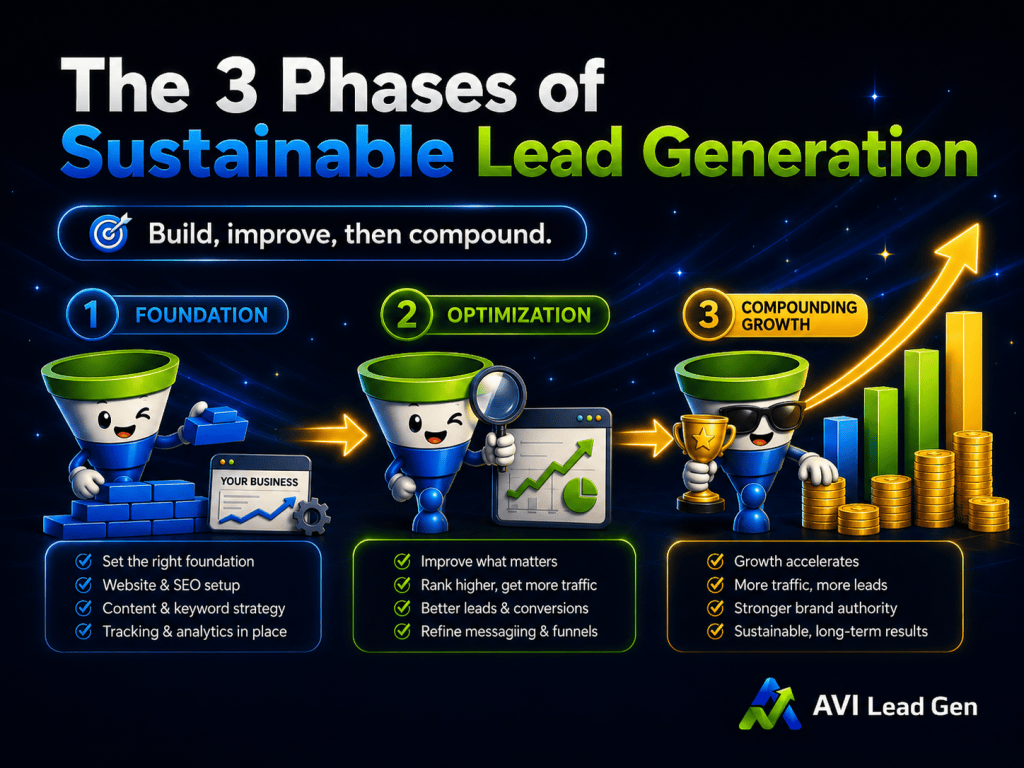
Most businesses grow through three broad phases.
The first phase is foundation. This is where you build or improve the website, clarify the message, set up tracking, connect the CRM, create lead capture points, and make sure the business has a process for handling inquiries.
The second phase is optimization. This is where you improve based on what the data shows. You refine calls-to-action, adjust messaging, strengthen content, improve response times, qualify leads, and fix the parts of the funnel where people drop off.
The third phase is compounding growth. This is where the pieces begin to support each other. SEO brings in more relevant traffic. The website converts more of that traffic. Follow-up keeps leads from going cold. Better tracking shows what is working. Stronger customer experiences create more retention and referrals.
This is the stage most business owners want, but it depends on the earlier stages.
You can’t compound what was never built.
So, How Long Does Lead Generation Take?
Lead generation can work faster than SEO in some cases, especially if you are using paid ads, outreach, referrals, or an existing audience.
But consistent lead generation still takes time because the system has to be tested and improved.
A business may get leads quickly, but it still needs to learn which leads are best, which pages convert, which calls-to-action work, how fast the team responds, and how many appointments become customers.
That means the early goal should not only be more leads.
The early goal should be clarity.
You want to know where leads are coming from, which ones are worth pursuing, how quickly they are being handled, and where opportunities are being lost.
Once you have that visibility, growth becomes much easier to improve.
The Businesses That Win Long-Term
The businesses that win with SEO and lead generation usually aren’t the ones chasing shortcuts.
They are the ones that stay consistent long enough for the system to improve.
They publish useful content. They strengthen their website. They track performance. They respond quickly. They follow up. They qualify leads. They keep improving the sales process.
That may not sound as exciting as a quick marketing hack, but it is far more dependable.
Shortcuts may create spikes.
Systems create momentum.
At AVI Lead Gen, that’s the difference we care about. A lead generation website, CRM, follow-up automation, content strategy, and tracking setup shouldn’t be separate pieces. They should work together to help turn attention into opportunities and opportunities into customers.
For more on our system strategies, check out our breakdown of these lead generation systems.
How Long Does Lead Generation Take? (The Bottom Line)
SEO and lead generation take time because real growth depends on more than traffic.
SEO has to build visibility and trust. Your website has to turn visitors into leads. Your follow-up process has to move those leads forward. Your sales process has to turn conversations into customers. Your tracking has to show what’s working and what needs to improve.
For most small businesses, the first 30 days are about foundation. The next 60 to 90 days are about early movement. The 4 to 6 month mark is often where patterns become clearer. The 6 to 12 month range is where consistent work can begin compounding.
The exact timeline will vary.
But the principle stays the same:
The businesses that get better results are usually not just waiting for marketing to work.
They’re building a system that improves over time.
Ready to Build a Lead Generation System That Works Around the Clock?
AVI Lead Gen helps small businesses capture leads, automate follow-up, and turn more website visitors into real opportunities.
Ready to stop guessing and build a lead generation system that works around the clock?
AVI Lead Gen helps small businesses capture leads, automate follow-up, and turn more website visitors into real opportunities.
Frequently Asked Questions
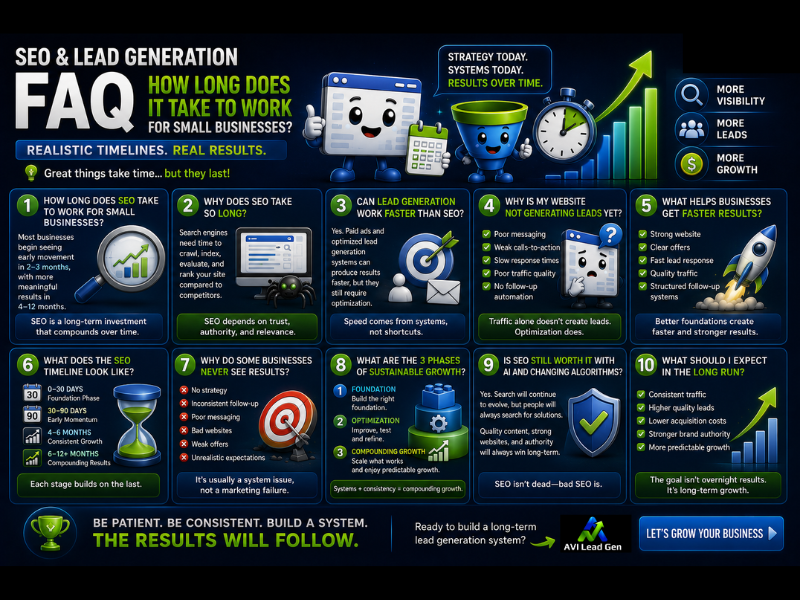
How long does SEO take to work for small businesses?
Most small businesses should expect SEO to take several months before meaningful results appear. Some early movement can happen within 60 to 90 days, but stronger growth often takes 4 to 12 months depending on competition, website quality, content consistency, and authority.
Why does SEO take so long?
SEO takes time because search engines need to crawl your website, understand your content, evaluate trust, compare your pages against competitors, and see consistent signals over time.
Can lead generation work faster than SEO?
Yes. Paid ads, referral campaigns, outreach, and optimized landing pages can create leads faster than SEO. However, those leads still need a strong follow-up and conversion system if they are going to turn into customers.
Why is my website not generating leads yet?
Traffic without leads usually points to a conversion problem. The messaging may be unclear, the call-to-action may be weak, the form may be hard to find, or the offer may not be compelling enough for visitors to act.
What helps businesses get faster marketing results?
Small businesses usually get faster results when they have a clear offer, a conversion-focused website, fast follow-up, good lead tracking, strong reviews, and content that speaks directly to the problems their customers are trying to solve.


