

Getting a lead is progress.
Getting that lead to book an appointment is even better.
But neither one guarantees revenue.
A booked appointment is not the finish line. It’s the point where interest turns into a real conversation, and that conversation still has to be handled the right way.
This is where many small businesses lose momentum.
They generate leads.
They get calls scheduled.
They show up to the appointment.
Then the conversation feels scattered, unclear, or hard to move forward.
The problem usually isn’t effort. It’s the lack of a repeatable process.
At AVI Lead Gen, we don’t look at booked appointments as isolated sales calls. We look at them as part of a larger lead generation system.
Your website captures the lead.
Your follow-up helps book the appointment.
Your sales process turns the conversation into a customer.
When those pieces work together, you’re not just getting more calls on the calendar. You’re creating a clearer path from interest to revenue.
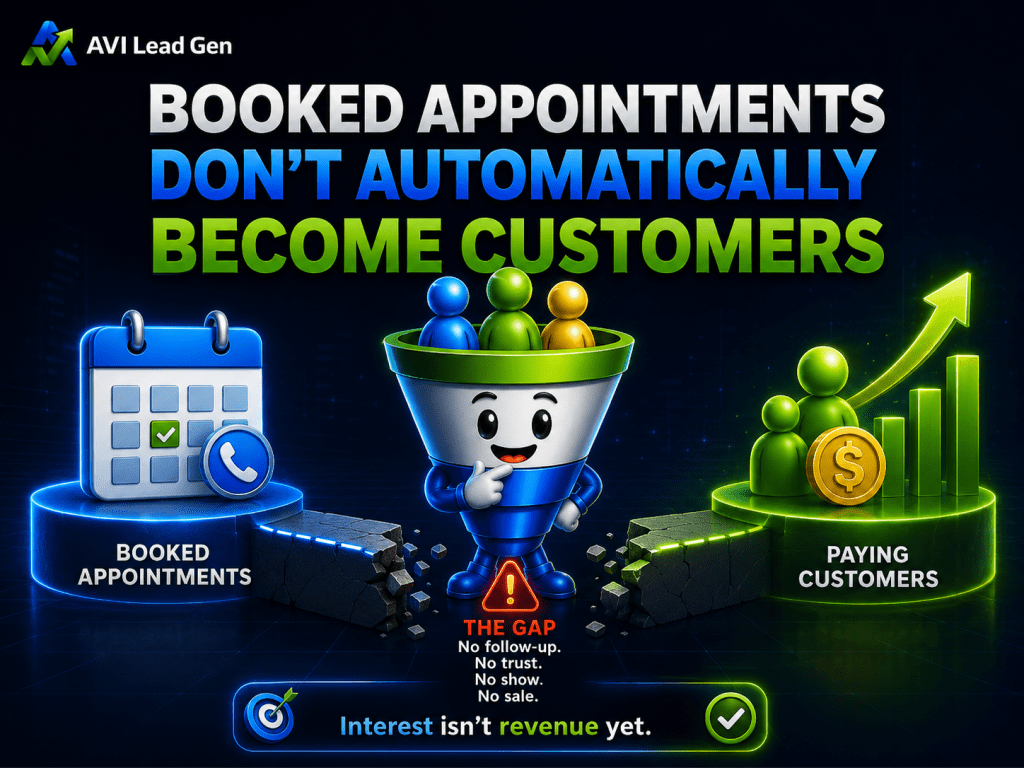
Booked Appointments Don’t Automatically Become Customers
A booked appointment means the prospect is interested enough to have a conversation.
That’s a good sign, but it doesn’t mean they’re ready to buy.
They may still be comparing options.
They may not fully understand the problem yet.
They may not know what the right solution should cost.
They may need reassurance before making a decision.
They may not be the only person involved.
They may be curious, but not urgent.
That’s why booked appointments don’t automatically become paying customers.
The appointment has to help the prospect move from interest to clarity.
A strong call should answer a few important questions:
What problem are they trying to solve?
Why does it matter now?
What have they already tried?
What happens if nothing changes?
Are they a good fit for your offer?
Can your solution clearly help them?
What should happen next?
Without that structure, the call can turn into a friendly conversation that goes nowhere.
The prospect talks.
You explain your services.
Everyone is polite.
Then the call ends with, “Let me think about it.”
That’s not always bad, but it’s often a sign the conversation didn’t create enough clarity.
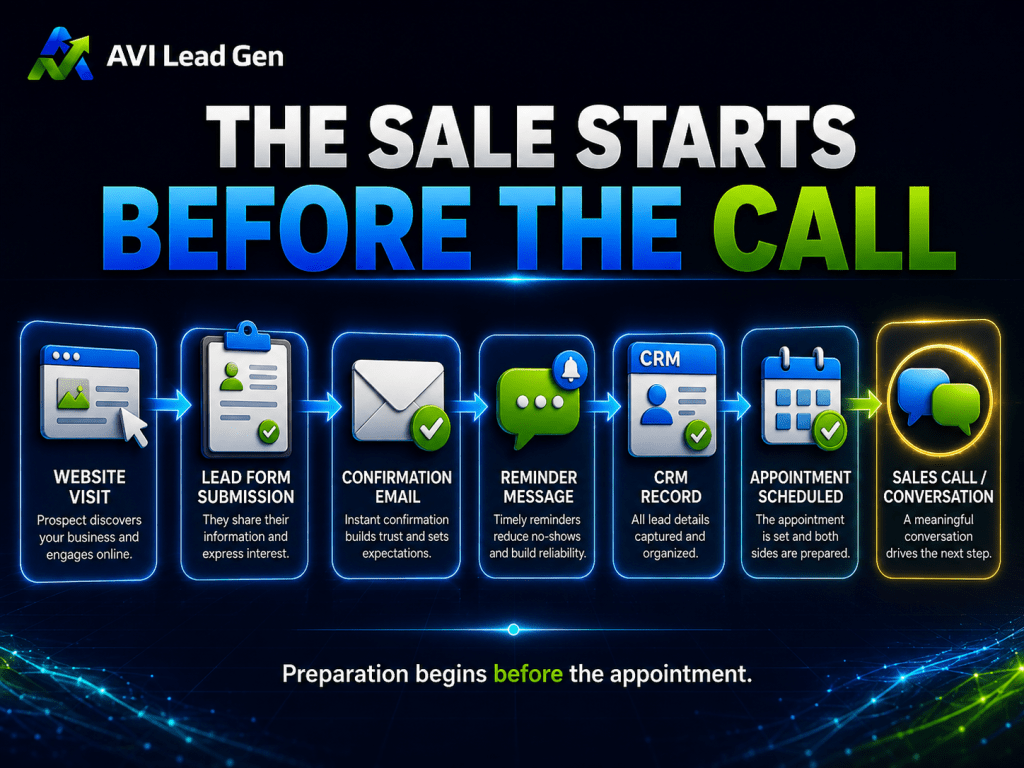
The Sale Starts Before the Call
A booked appointment should not be the first time your business starts shaping the buying decision.
The sales process begins before the call ever happens.
It starts with the page the prospect visited. It continues with the form they filled out, the confirmation they received, the emails they opened, the reminders they saw, and the expectations you set before the appointment.
By the time someone gets on a call, they should already understand:
Who you help
What problem you solve
What the appointment is for
What they can expect
Why the conversation matters
What the next step may look like
That’s why your lead generation system matters so much. It utilizes lead capture and booking, as well as follow-up automation, to make better use of everyone’s time.
A well-built system doesn’t just book appointments. It prepares the prospect for a better conversation.
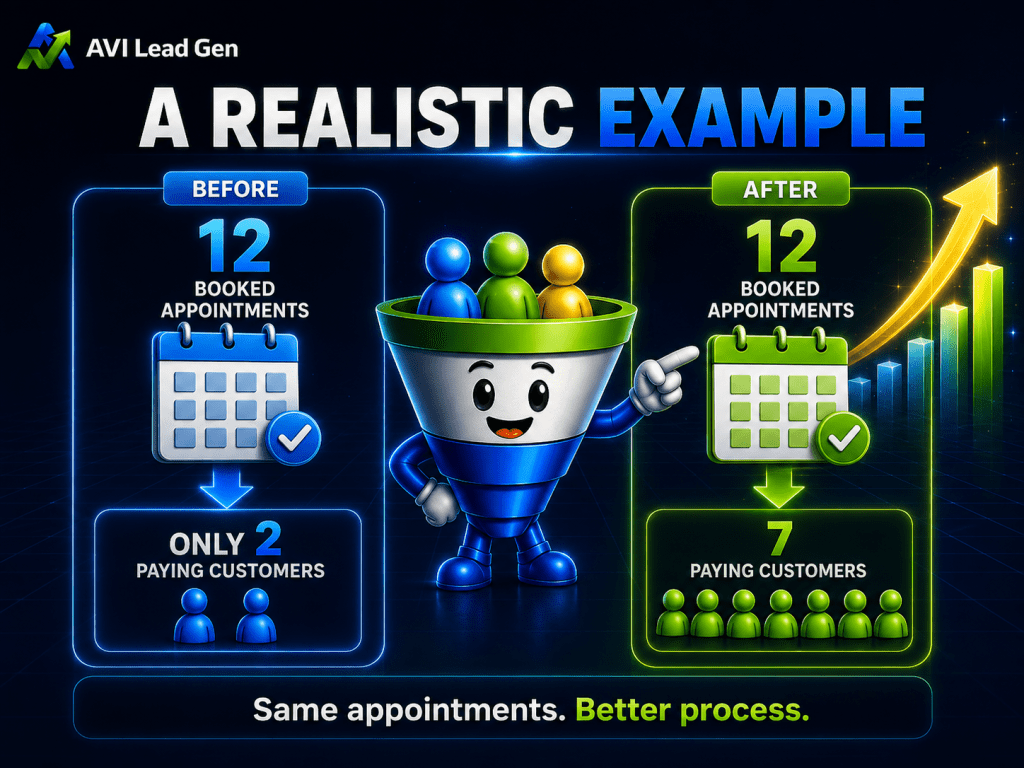
A Realistic Example
Imagine a small service business books 12 appointments in a month.
On paper, that sounds good.
But after reviewing the results, the owner sees a problem.
Four prospects were a poor fit.
Three calls had no clear next step.
Two people asked for more information but never received a timely follow-up.
One person no-showed.
Two became customers.
The owner may think, “We need more appointments.”
Maybe they do.
But there’s another issue: the appointment-to-customer process is weak.
Now imagine the same 12 appointments going through a stronger system.
Leads are qualified before booking.
The prospect receives a clear confirmation and reminder.
The business reviews the form submission before the call.
The call follows a simple structure.
The conversation focuses on the prospect’s problem, not just the service.
The offer is connected directly to what the prospect said.
The call ends with a clear next step.
Follow-up happens automatically if they don’t move forward right away.
The number of appointments didn’t change.
The process did.
That’s the difference between hoping sales calls convert and building a system that helps more of them turn into customers.
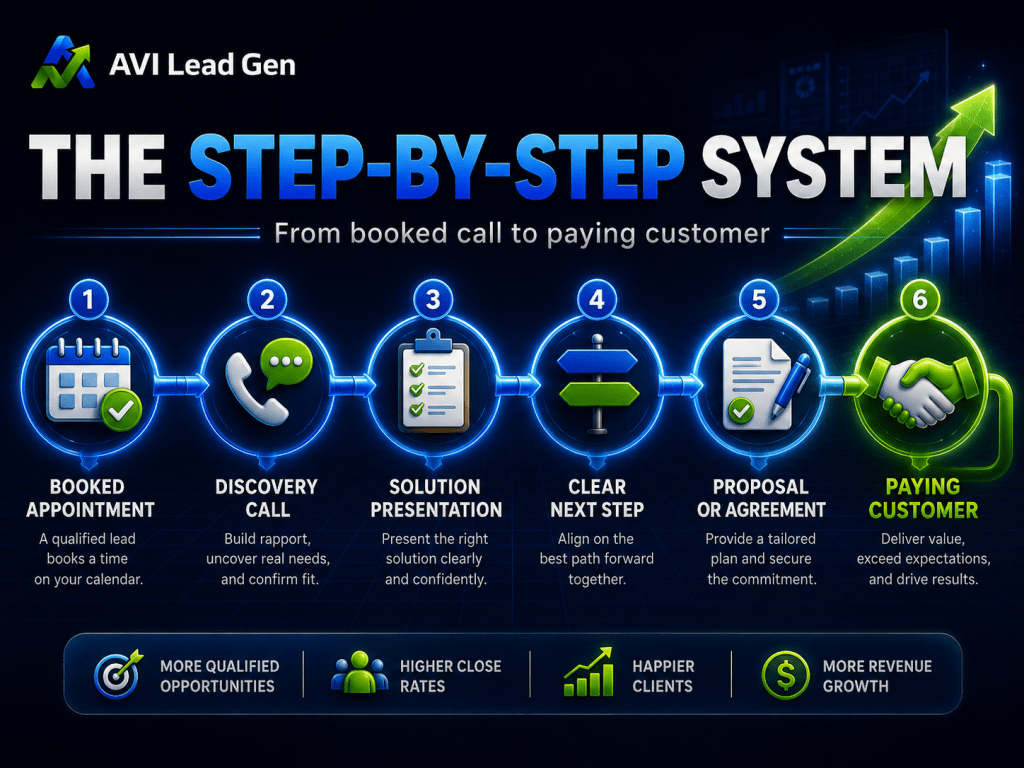
The Step-by-Step System for Turning Appointments Into Paying Customers
Turning booked appointments into paying customers works best when every stage supports the next one.
The goal isn’t to pressure people. The goal is to create clarity.
A good sales process helps both sides understand whether there’s a real fit, what problem needs to be solved, what the solution looks like, and what should happen next.
Here’s a practical system to follow.
Step 1: Prepare Before the Call
The call should not start from zero.
Before the appointment, review the CRM tracking information the lead already gave you.
Look at:
The form they submitted
The service they’re interested in
Their main question or challenge
Their timeline
Their source or campaign
Any previous email replies
Any notes in the CRM
Whether they seem like a strong fit
This helps you start the call with context.
Instead of asking generic questions, you can say something like:
“Thanks for booking the call. I saw that you’re looking for help getting more website leads to turn into actual appointments. I’d like to understand what’s happening now, what you’ve already tried, and whether there’s a clear way we can help.”
That shows the prospect you paid attention.
It also keeps the conversation focused from the beginning.
Preparation helps you avoid wasting the first half of the call trying to figure out why they booked.
Step 2: Set the Agenda Early
A strong call needs structure.
Setting the agenda at the beginning helps the prospect understand what to expect. It also keeps the conversation from drifting.
You don’t need anything complicated.
A simple agenda might sound like this:
“Here’s how I’d like to use our time today. First, I’ll ask a few questions so I can understand what’s going on. Then, if it seems like we can help, I’ll walk you through what the next step could look like. If it’s not a fit, I’ll tell you that too.”
This does three important things.
It lowers pressure.
It positions you as a guide.
It gives the conversation a clear direction.
Without an agenda, sales calls can become scattered.
The prospect may jump between problems.
You may start explaining too soon.
The call may end without a defined outcome.
Setting the agenda gives the conversation a path.
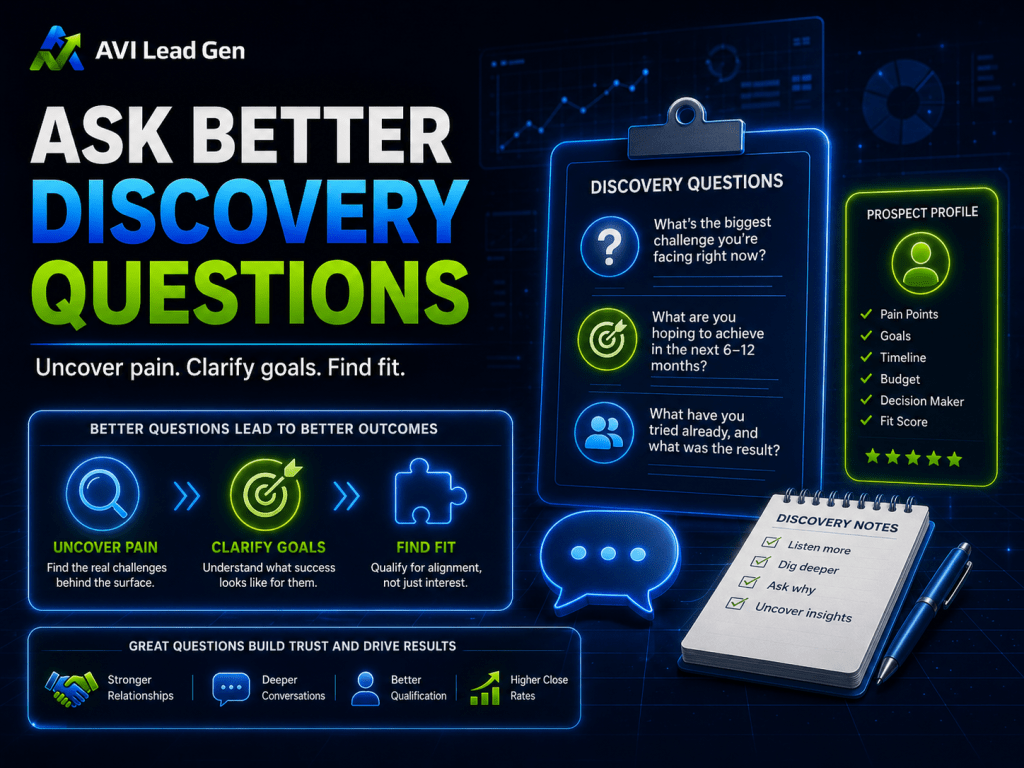
Step 3: Ask Better Discovery Questions
Discovery is where many sales calls are won or lost.
Your goal is not to pitch as quickly as possible.
Your goal is to understand.
The prospect booked the appointment for a reason. Your job is to uncover that reason clearly enough to know whether your offer can help.
Good discovery questions include:
What made you book this call today?
What’s happening right now that you want to improve?
What have you already tried?
What’s working?
What isn’t?
How long has this been an issue?
What would a better situation look like?
What happens if this doesn’t get fixed?
What would make this worth solving now?
The best discovery questions do more than collect information.
They help the prospect clarify their own thinking.
Many prospects know they have a problem, but they haven’t fully defined it yet. A good conversation helps them see the gap between where they are and where they want to be.
That clarity makes your solution easier to understand later.
Step 4: Identify Fit, Pain, and Urgency
Not every booked appointment should become a customer.
Qualifying leads matter.
A strong sales process isn’t just about closing more people. It’s about helping the right people move forward.
During the call, listen for three things:
Fit
Pain
Urgency
Fit means your service actually matches what they need.
Pain means the problem is real enough to matter.
Urgency means there’s a reason to act instead of waiting indefinitely.
A lead may have pain but no urgency.
They may have urgency but not be a good fit.
They may be a good fit but not understand the value yet.
You need to know which one you’re dealing with.
Ask questions like:
Why is this important now?
How is this affecting your business?
What happens if nothing changes for another 90 days?
What would solving this make possible?
Is this something you’re actively trying to fix, or are you still exploring?
These questions help you understand whether the conversation should move toward a proposal, a follow-up, a nurture sequence, or a polite disqualification.
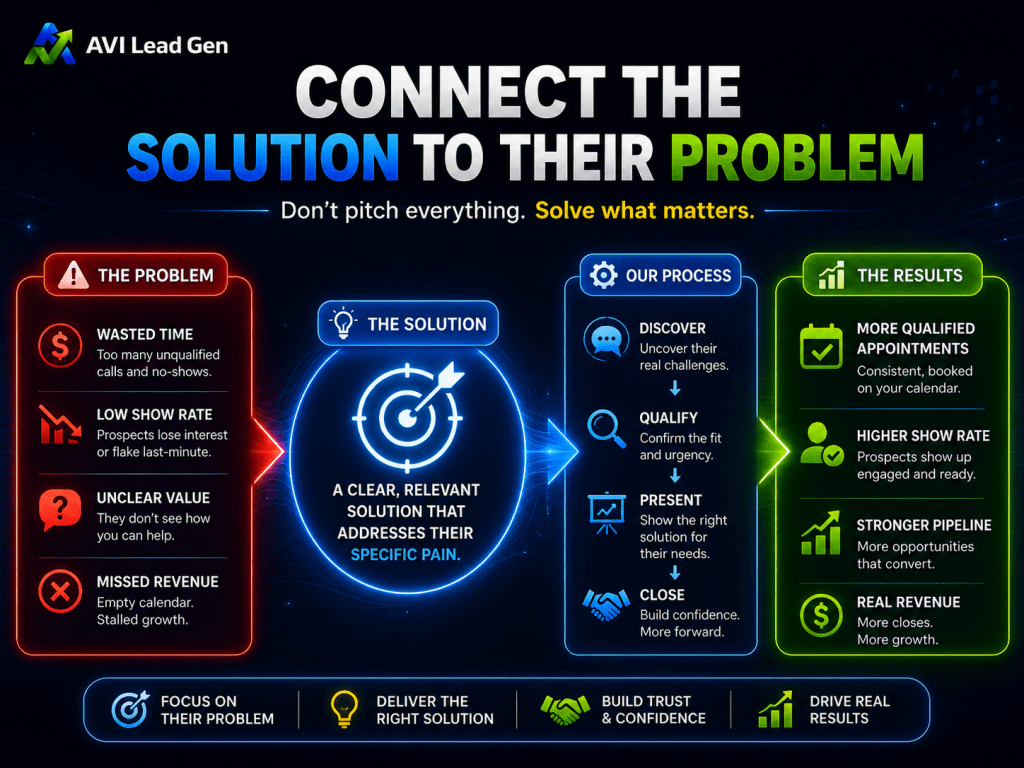
Step 5: Connect the Solution to Their Problem
Once you understand the prospect’s situation, then you can present the solution.
Not before.
This is where many businesses go wrong. They start explaining their services too early, before the prospect feels understood.
A better approach is to connect your solution directly to what the person just told you.
Instead of saying:
“We build websites, forms, automations, and booking systems.”
Say:
“Based on what you shared, the main issue is that leads are coming in, but they’re not consistently turning into booked appointments. What we’d focus on first is tightening the path after the form submission: confirmation, CRM tracking, follow-up, booking links, and reminders.”
That’s clearer.
It shows that the solution is not generic. It’s tied to the problem.
Your offer should feel like the next logical step, not a memorized pitch.
To do that, keep the explanation:
Simple
Relevant
Outcome-focused
Connected to their words
Focused on the problem they care about most
The prospect doesn’t need every detail right away.
They need to understand why your solution fits their situation.
Step 6: Handle Concerns Without Getting Defensive
Questions and objections are part of the process.
They don’t always mean the prospect isn’t interested.
Sometimes they mean the prospect needs more clarity before moving forward.
Common concerns include:
How much does it cost?
How long does it take?
What happens if it doesn’t work?
How much time will this require from us?
Why should we do this now?
How is this different from what we’ve tried before?
The mistake is getting defensive or rushing to overcome every concern.
Instead, slow down.
Clarify what they’re really asking.
For example, if someone says the price feels high, the real question may be about value, timing, trust, or cash flow.
You might respond:
“That makes sense. When you say it feels high, are you comparing it to another option, or are you trying to figure out whether the return would justify the investment?”
That keeps the conversation open.
Strong sales conversations don’t ignore concerns. They address them clearly and respectfully.
The goal isn’t to argue someone into buying.
The goal is to help them make a confident decision.
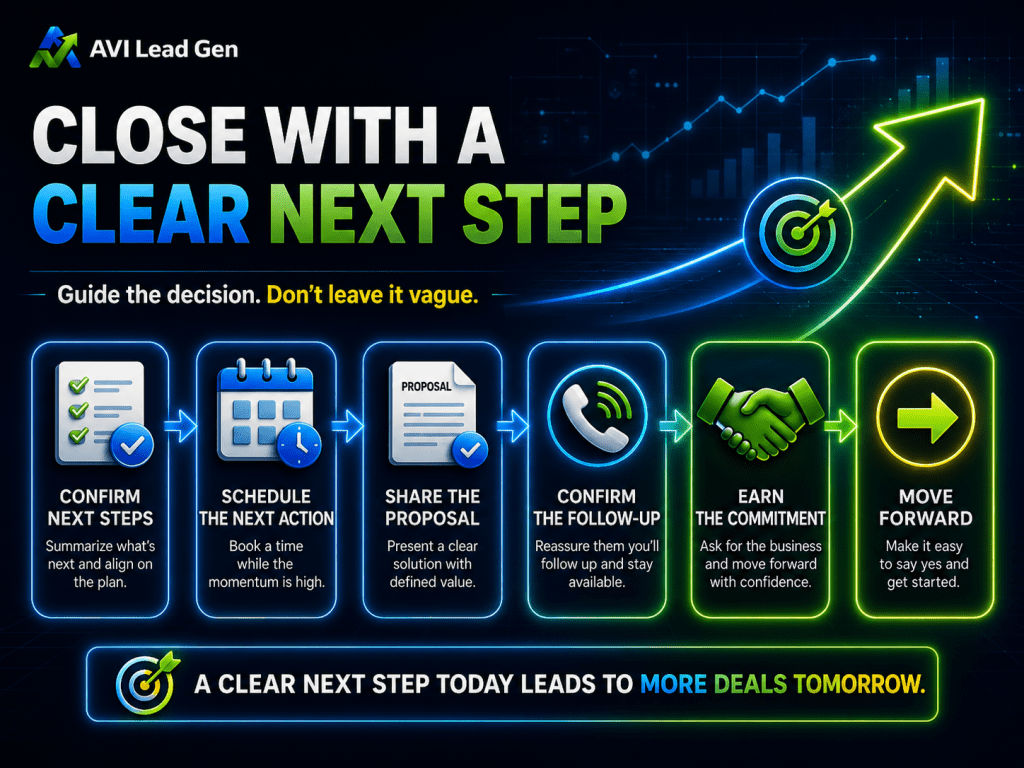
Step 7: Close With a Clear Next Step
Every call should end with a defined outcome.
Too many sales calls end with:
“Let me know what you think.”
That sounds polite, but it often creates confusion.
A stronger call ends with a clear next step.
That next step may be:
Move forward with onboarding
Send an agreement
Send a proposal
Schedule a follow-up call
Request access or additional information
Add the lead to a nurture sequence
Disqualify the opportunity
Refer them elsewhere
The right next step depends on the conversation.
A simple close might sound like this:
“Based on everything we discussed, it sounds like the next step would be putting together a simple plan for your lead generation system. Does that feel like the right direction?”
Or:
“From what you shared, I do think this could be a fit. The next step would be reviewing the agreement and scheduling kickoff. Would you like me to send that over?”
The close should feel like a continuation of the conversation.
Not a sudden pressure move.
Not a vague ending.
A clear next step helps both sides know what happens after the call.
Step 8: Follow Up After the Call
The sales process doesn’t end when the call ends.
Many deals are won or lost in the follow-up.
After the call, send a recap that includes:
What you discussed
The main problem or goal
The recommended solution
The next step
Any timeline or deadline
Links, proposal, or agreement if needed
How to respond with questions
This helps the prospect remember the conversation and makes it easier to take action.
A simple recap might look like this:
“Thanks again for taking the time to talk today. Based on our conversation, the main issue is that your website is getting some inquiries, but the follow-up and booking process isn’t consistent. The next step we discussed is building a clearer lead capture, CRM, follow-up, and appointment booking system. I’ve included the next step below.”
That kind of follow-up is clear and useful.
It reinforces the value without sounding pushy.
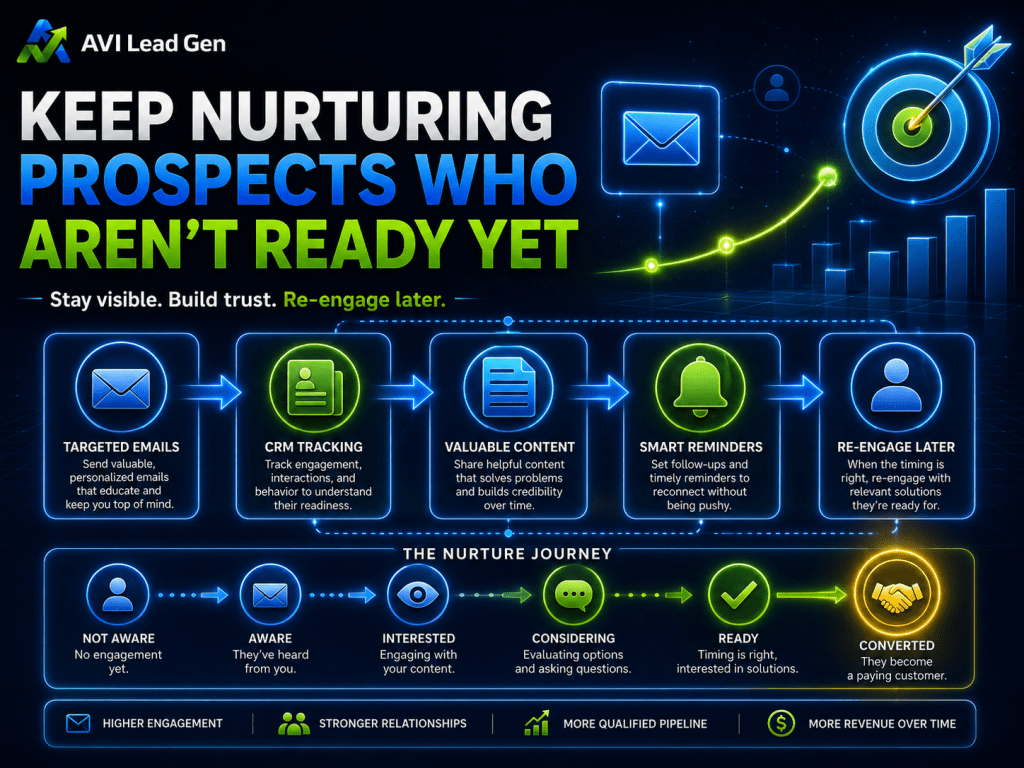
Step 9: Keep Nurturing Prospects Who Aren’t Ready Yet
Not every good-fit prospect will buy immediately.
That doesn’t mean the opportunity is dead.
Some people need more time.
Some need to talk with a partner or team member.
Some need budget approval.
Some need to solve another problem first.
Some are interested, but not urgent yet.
A strong system keeps these people organized.
Instead of letting them disappear, add them to a nurture process.
That process may include:
Helpful emails
Follow-up reminders
Relevant blog posts
Case study-style examples
Check-in messages
Future booking invitations
Seasonal or timing-based follow-up
The key is to stay useful.
Don’t follow up just to ask, “Are you ready yet?”
Follow up with context, value, and a clear way to restart the conversation.
A “not yet” lead can still become a customer later if the follow-up process keeps trust alive.
Step 10: Track Appointment-to-Customer Conversion
If you want to improve sales results, you need to track what happens after appointments are booked.
Look at numbers like:
Appointments booked
Appointments completed
No-shows
Qualified opportunities
Proposals sent
Agreements sent
Deals won
Deals lost
Follow-ups completed
Average time from appointment to close
These numbers help you find real system bottlenecks.
If appointments are booked but people don’t show up, the problem may be reminders or expectations.
If calls happen but few people are qualified, the problem may be lead quality or pre-call qualification.
If qualified prospects don’t move forward, the problem may be offer clarity, pricing, trust, or follow-up.
If proposals are sent but not signed, the problem may be urgency, next steps, or decision support.
Tracking helps you stop guessing and makes a lead generation audit possible.
It shows where the system needs work.

Common Reasons Booked Appointments Don’t Turn Into Customers
When booked appointments don’t become paying customers, there’s usually a reason.
The lead may not have been qualified before the call.
If poor-fit leads are filling the calendar, the sales process will feel harder than it should.
The call may not have enough structure.
Without an agenda, discovery, and a clear close, the conversation can drift.
The business may pitch too early.
If you explain the solution before understanding the problem, the offer can feel generic.
The prospect may not feel enough urgency.
If the problem doesn’t feel important now, the decision will usually get delayed.
The offer may not be connected clearly to the problem.
People buy when they understand how the solution helps them get from where they are to where they want to be.
The next step may be unclear.
If the call ends vaguely, the opportunity can stall.
Follow-up may be inconsistent.
Even interested prospects can go cold when follow-up is slow, unclear, or forgotten.

Where Automation Helps After the Appointment
Automation can help protect the sales process after a call.
It can’t replace the relationship, but it can make sure important steps don’t get missed.
Automation can help with:
Call reminders
Pre-call questionnaires
CRM deal stages
Post-call recap reminders
Proposal follow-up
Agreement follow-up
No-response follow-up
Long-term nurture
Task assignments
Lead status updates
This matters because sales follow-up is easy to forget when the business gets busy.
Automation keeps the process moving.
It helps make sure every prospect receives the right message at the right time, while the business still handles the personal parts of the conversation.

Where Human Follow-Up Still Matters
Automation can support the process, but human follow-up still closes the gap.
People usually don’t become customers because they received a perfectly timed automation alone.
They become customers because they trust the business, understand the value, and feel confident about the next step.
Human follow-up matters when:
The prospect has a specific concern
The decision is high value
The service requires trust
The buyer needs reassurance
The proposal needs explanation
There are multiple decision-makers
The prospect is a strong fit but hesitant
The best process uses both.
Automation protects consistency.
Human follow-up builds trust.
Together, they help more booked appointments become paying customers.

How to Know If Sales Conversion Is Your Bottleneck
Sales conversion may be the bottleneck if you’re getting leads and appointments, but revenue still feels inconsistent.
Signs include:
You’re booking calls, but few become customers.
Prospects seem interested but don’t move forward.
Calls often end with “I’ll think about it.”
You send proposals but don’t hear back.
You don’t have a consistent follow-up process.
You’re not tracking call outcomes.
You’re unsure why deals are lost.
You feel like you need more leads, but existing opportunities aren’t closing.
This doesn’t mean you need to become a pushy salesperson.
It means your conversion process may need more structure.
Better discovery, clearer positioning, stronger next steps, and more consistent follow-up can often improve results before you spend more money trying to generate more leads.
How to Close More Sales Calls – Bottom Line
Booked appointments are progress, but they’re not the finish line.
To turn booked appointments into paying customers, you need a process that prepares for the call, sets expectations, asks better questions, identifies fit and urgency, presents the solution clearly, defines the next step, and follows up consistently.
That’s how appointments become real opportunities.
And that’s how to close more sales calls.
More leads can help, but more leads won’t fix a weak conversion process.
If people are already booking calls, the next question is simple:
Is your system helping those conversations turn into revenue?
Ready to Turn More Appointments Into Paying Customers?
If you’re getting appointments but not enough paying customers, the problem may not be traffic alone.
It may be the system between the calendar and the close.
Ready to stop guessing and build a lead generation system that works around the clock?
AVI Lead Gen helps small businesses capture leads, automate follow-up, and turn more website visitors into real opportunities.
FAQ
How do you turn booked appointments into paying customers?
You turn booked appointments into paying customers by using a clear sales process. That process should include pre-call preparation, agenda setting, discovery questions, qualification, solution positioning, a defined next step, and consistent follow-up after the call.
Why don’t booked appointments always become customers?
Booked appointments don’t always become customers because interest does not automatically equal readiness to buy. The prospect may not be qualified, the call may lack structure, the problem may not feel urgent, or the next step may not be clear.
What should happen before a sales call?
Before a sales call, review the lead’s form submission, source, service interest, timeline, previous messages, and CRM notes. This helps you start the conversation with context and avoid treating every appointment like a cold conversation.
What questions should you ask during a sales call?
Good sales call questions include: “What made you book this call today?” “What have you already tried?” “What’s not working?” “What would success look like?” and “What happens if nothing changes?” These questions help uncover fit, pain, and urgency.
Should every booked appointment get a proposal?
No. Not every booked appointment should get a proposal. A proposal should usually be sent when the prospect is a good fit, has a real problem, understands the value, and has a clear next step. Sending proposals to poor-fit leads can waste time and weaken the sales process.
How soon should you follow up after a sales call?
Follow up as soon as possible after the call, ideally the same day. A timely recap keeps the conversation fresh, reinforces what was discussed, and makes the next step easier for the prospect to take.
Can automation help close more customers?
Yes. Automation can help with reminders, CRM deal stages, post-call follow-up, proposal follow-up, agreement follow-up, and long-term nurture. It should support the sales process, not replace the personal follow-up needed to build trust.
What should you track after booked appointments?
Track appointments booked, appointments completed, no-shows, qualified opportunities, proposals sent, agreements sent, deals won, deals lost, and follow-ups completed. These metrics help you see where prospects are stalling between appointment and customer.