
Getting more leads sounds like the obvious fix.
If you’re not closing enough deals, just fill the pipeline with more people, right?
Not always.
Sometimes more leads only create more calls, more follow-up, more proposals, more no-shows, and more frustration. If the sales process is weak, adding more leads just puts more pressure on the same broken part of the system.
That’s why close rate matters.
Your close rate shows how well your business turns real opportunities into paying customers. It’s not just a sales number. It’s a signal.
It tells you whether the right people are reaching the calendar.
It tells you whether your conversations are creating clarity.
It tells you whether your offer is easy to understand.
It tells you whether your follow-up is strong enough to keep momentum moving.
At AVI Lead Gen, we don’t look at leads as the finish line.
A lead is only one stage of the lead generation system.
The real goal is to move the right people from interest to conversation to decision without letting good opportunities stall.
That means you don’t always need more leads first.
Sometimes you need to convert more of the leads you already have.

Why More Leads Isn’t Always the Answer
More leads can help when the top of the funnel is truly empty.
But if you’re already getting inquiries, booking calls, or sending proposals, the first question shouldn’t be, “How do we get more leads?”
A better question is:
“Where are we losing the leads we already have?”
That question usually leads to better decisions.
A business with 10 leads and a 20% close rate gets 2 customers.
A business with 10 leads and a 40% close rate gets 4 customers.
Same number of leads.
Different result.
That doesn’t mean every business can double its close rate overnight. But it does show why conversion matters. When you improve the process near the bottom of the funnel, you may get more revenue from the same amount of traffic, the same number of form submissions, and the same number of booked calls.
That’s leverage.
More leads can hide problems.
A better close process exposes them.
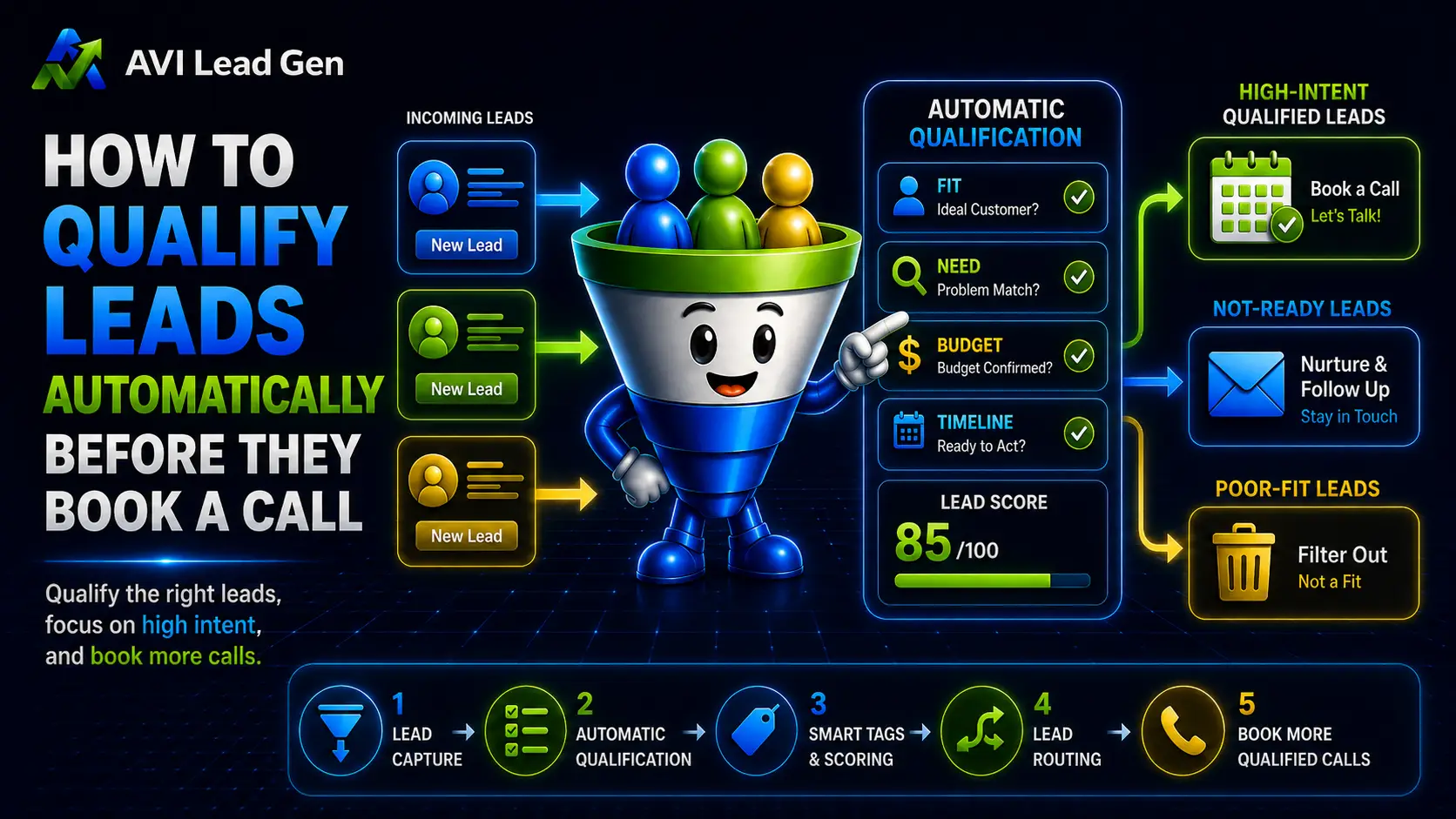
If leads are poor fit, you need stronger qualification.
If calls feel scattered, you need a better sales structure.
If prospects disappear after the call, you need clearer next steps.
If people hesitate on price, you may need stronger positioning.
If proposals sit unanswered, your follow-up may be too weak.
More leads won’t fix those problems.
A better system will increase close rate.
What Close Rate Actually Tells You
Close rate is the percentage of qualified opportunities that turn into customers.
But it’s important to measure the right version of it.
If you count every website visitor, your close rate will look meaningless.
If you count every form submission, the number may still be misleading because not every form submission is a real opportunity.
A more useful close rate looks at people who were actually qualified enough to have a sales conversation, receive a proposal, or make a buying decision.
That gives you a cleaner signal.
For example:
If 20 qualified prospects book calls and 5 become customers, that’s a 25% close rate.
That number tells you something useful.
It helps you understand whether your sales process is turning legitimate opportunities into revenue.
But even then, close rate should not be viewed by itself.
If you want to know how to convert more leads into customers, you’ll also need to know:
Where did those opportunities come from?
Were they qualified before the call?
Did they understand the offer before booking?
Did they show up prepared?
Was the problem clear?
Was the next step obvious?
Did follow-up happen after the call?
Close rate is not just a sales metric.
It’s a system metric.
It reflects traffic quality, website messaging, lead capture, qualification, booking, sales conversations, proposals, and follow-up.
Why Sales Calls Don’t Convert
Most sales calls don’t fall apart because the business owner forgot to say one magic line.
They fall apart because the conversation never created enough clarity.
The prospect may leave the call still unsure about the problem, the value, the process, the timeline, the cost, or the next step.
That uncertainty slows deals down.
Sometimes the call becomes too casual. Everyone has a pleasant conversation, but no one clearly defines what needs to happen next.
Sometimes the business starts pitching too early. The prospect hears a list of services before they feel understood.
Sometimes the owner asks a few surface-level questions, then jumps straight into pricing.
Sometimes the prospect is interested, but the offer feels too vague.
Sometimes the lead never should’ve made it to the calendar in the first place.
A better sales process does not mean being pushy.
It means making the conversation more useful.
You’re helping the prospect understand the problem, decide whether it matters, see what solving it would look like, and choose the next step with less confusion.
That’s what improves close rate.
Not pressure.
Clarity.
The Biggest Close Rate Killers
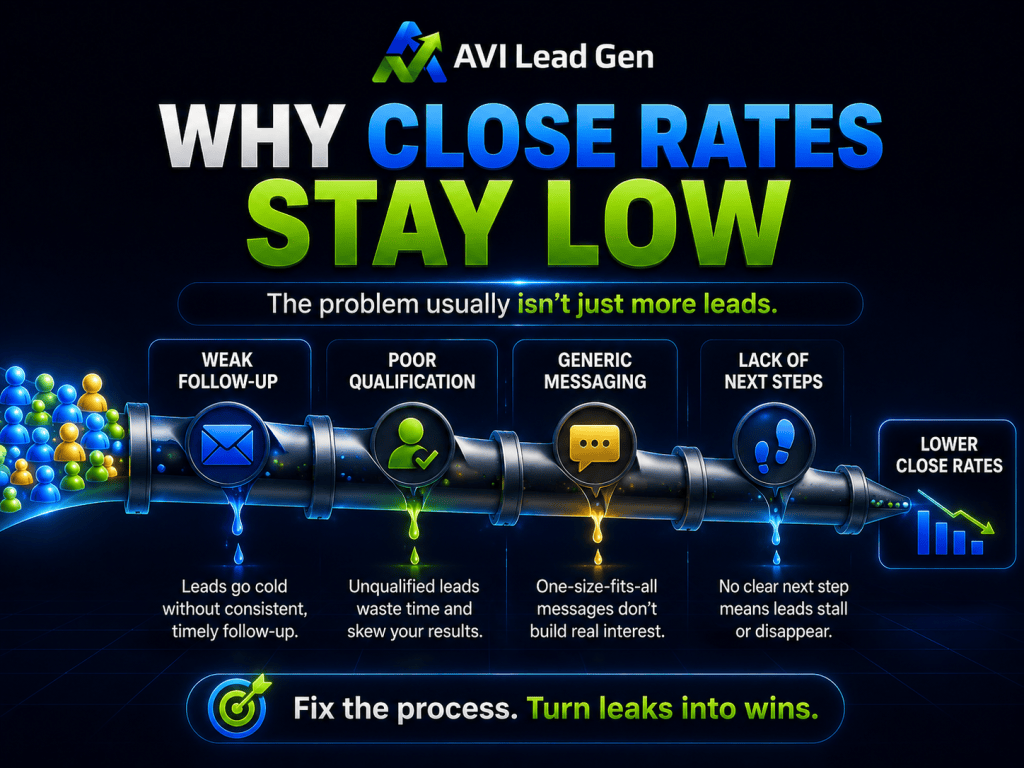
Low close rates usually come from a few predictable problems.
The details change from business to business, but the pattern is familiar.
The lead showed interest.
The conversation happened.
The opportunity seemed real.
Then the deal stalled, faded, or disappeared.
Here are the biggest reasons that happens.
Mistake 1: Pitching Too Early
A lot of businesses start selling before they understand what the prospect actually needs.
They hear one problem and immediately start explaining services.
That feels efficient, but it usually weakens the conversation.
When you pitch too early, you risk solving the wrong problem. You may explain features the prospect doesn’t care about, skip the issue that actually matters, or miss the real reason they reached out.
The prospect may also feel like they’re being sold before they’ve been understood.
That makes trust harder.
A better approach is to slow down long enough to understand what’s going on.
Ask why they reached out.
Ask what they’ve tried.
Ask what’s not working.
Ask what they want to change.
Ask what happens if they don’t fix it.
Then your offer can connect to the problem they actually described.
That’s when the conversation becomes more relevant.
Mistake 2: Weak Discovery
Weak discovery creates weak proposals.
If you don’t ask enough useful questions, you end up guessing.
You guess what matters.
You guess what they’re willing to invest.
You guess how urgent the problem is.
You guess whether they’re a good fit.
You guess what they need to hear before making a decision.
That guessing usually shows up later.
The proposal feels generic. The follow-up feels uncertain. The prospect has objections you didn’t uncover. The deal slows down because the real issue was never fully discussed.
Strong discovery gives you better information.
It helps you understand the problem, the cost of inaction, the decision process, the timeline, and the fit.
It also helps the prospect hear their own situation more clearly.
Sometimes people don’t fully understand the problem until someone asks the right questions.
That’s where good discovery earns its place.
Mistake 3: No Clear Urgency
A prospect can like you, understand the offer, and still do nothing.
That usually happens when there’s no urgency.
Urgency doesn’t mean fake scarcity.
It doesn’t mean pressuring someone with a countdown timer or pretending the offer disappears tomorrow.
Real urgency comes from the cost of staying where they are.
What is the problem costing them?
What happens if they wait another month?
What opportunities are they missing?
What mistakes keep repeating?
What does this affect besides the immediate issue?
For AVI, that might sound like:
If leads are coming in but follow-up is slow, opportunities are going cold.
If booked calls are happening but not closing, the business may be spending time on conversations that never turn into revenue.
If traffic is increasing but lead quality is poor, the business may be measuring activity instead of progress.
The prospect has to see why solving the problem matters now.
Without urgency, “sounds good” often turns into “I’ll think about it.”
And “I’ll think about it” often turns into silence.
Mistake 4: No Call Structure
A sales call without structure can feel friendly but still go nowhere.
You may talk for 45 minutes, cover a lot of ground, answer questions, explain the service, and still end the call with no clear direction.
That’s a problem.
A good call doesn’t need to feel scripted.
But it should have a path.
A simple sales call structure might look like this:
Confirm why they booked the call.
Set expectations for the conversation.
Ask discovery questions.
Clarify the real problem.
Confirm urgency and fit.
Explain the solution in plain language.
Address concerns.
Recommend the next step.
Confirm what happens after the call.
That structure protects both sides.
The prospect gets a clearer conversation.
The business gets better information.
And the call is less likely to turn into a vague chat that ends with, “Okay, just send me something.”
Mistake 5: No Defined Next Step
One of the easiest ways to lose a warm opportunity is to end the call without a clear next step.
The prospect shouldn’t leave wondering what happens now.
Are you sending a proposal?
Are they booking a follow-up call?
Are they completing an intake form?
Are they reviewing an agreement?
Are they waiting on pricing?
Are you waiting on access, details, or approval?
Are they making a decision by a specific date?
If the next step is vague, momentum drops.
A better close sounds simple:
“Based on what we discussed, I recommend we move forward with this plan. The next step is for me to send the proposal today, then we’ll review any questions before Friday. Does that work for you?”
That doesn’t pressure the prospect.
It gives direction.
And direction helps deals move.
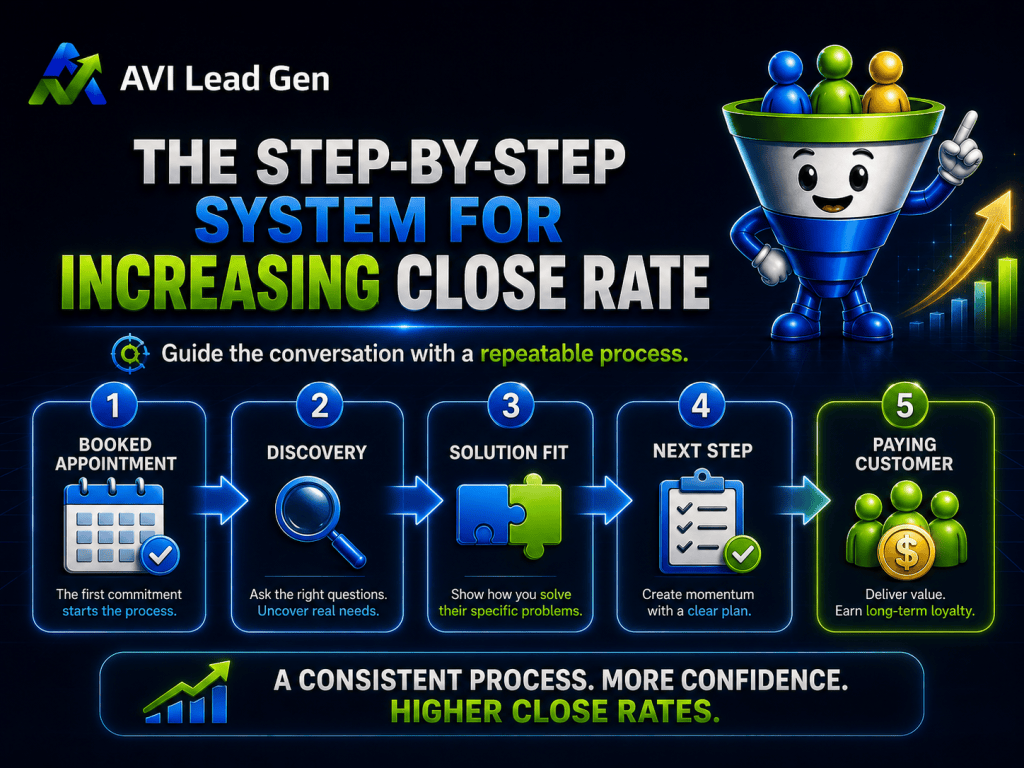
How to Increase Your Close Rate Without More Leads
You don’t need to reinvent your whole business to improve close rate.
You need to improve the parts of the process that influence whether a qualified prospect says yes.
That usually means better preparation before the call, stronger discovery during the call, clearer positioning, better qualification, and more consistent follow-up after the call.
Here’s how to increase your close rate.
Step 1: Make Sure the Right Leads Reach the Call
Close rate improves when better-fit prospects reach the sales conversation.
That starts before the call ever happens.
Your website, forms, lead magnets, booking pages, and follow-up should help people understand who the service is for and what the next step looks like.
A vague path creates vague calls.
A clearer path creates better conversations.
Before someone books, your system should help answer:
What problem does this service solve?
Who is it for?
Who is it not for?
What happens after someone reaches out?
What information should they provide?
What should they expect from the call?
You don’t need to make the process difficult.
But you do need enough qualification to protect the calendar.
If every lead gets treated the same, close rate usually suffers.
Better inputs create better sales conversations.
Step 2: Prepare Before the Call
A sales call should not start from zero.
Before the conversation, review what you already know.
Look at the form submission.
Check the lead source.
Review the page they came from.
Look at the service they asked about.
Check any previous email engagement.
Review their business, if relevant.
Think through the likely problem before the call starts.
This helps you lead a better conversation.
It also helps the prospect feel like you’re paying attention.
You don’t need to pretend you know everything.
But you shouldn’t sound like you’re reading their name for the first time when the call starts.
Preparation creates confidence.
It also helps you spot gaps.
Maybe the lead came from a blog article and still needs more education. Maybe they clicked from a pricing page and are closer to making a decision. Maybe they booked after a follow-up email and need reassurance. Maybe their form answers show they’re probably not a fit.
That context matters.
A better close often starts before the call.
Step 3: Start With the Problem, Not the Pitch
When the call begins, resist the urge to explain everything you do.
Start with the problem.
You might ask:
“What made you reach out?”
“What’s been happening that made this a priority?”
“What have you already tried?”
“What’s working right now?”
“What isn’t working?”
“What would need to change for this to feel successful?”
Those questions do two things.
They help you understand the real need.
They also help the prospect organize their own thinking.
That matters because people don’t buy a list of features.
They buy a solution to a problem they care about.
For AVI, the service is not just a website, CRM, forms, booking, and automation.
The real problem might be missed leads, poor follow-up, no booking path, low-quality inquiries, slow response time, unclear sales tracking, or inconsistent lead flow.
Once the problem is clear, the offer becomes easier to explain.
Step 4: Connect the Offer to the Prospect’s Situation
Generic pitching weakens close rate.
The prospect doesn’t need to hear everything your business can do.
They need to understand how your solution fits the problem they just described.
That means your explanation should sound connected, not canned.
Instead of saying:
“We build websites, funnels, CRM automations, booking systems, and follow-up sequences.”
Say something closer to:
“Based on what you shared, the main issue isn’t just traffic. You’re getting interest, but there’s no clear path turning that interest into booked calls. The system we’d build would tighten the page, capture the lead, follow up automatically, and make the next step easier to take.”
That’s more useful because it connects the solution to the pain.
The same service can be explained different ways depending on the prospect.
One person may care about speed.
Another may care about lead quality.
Another may care about booking more appointments.
Another may care about knowing what’s working.
The offer should stay consistent, but the explanation should connect to the buyer’s situation.
That’s how positioning supports sales conversion.
Step 5: Confirm Fit Before You Try to Close
Not every prospect should become a customer.
That’s not a bad thing.
A strong sales process should help both sides decide whether the fit is real.
Before you recommend the next step, confirm the basics.
Do they have the problem you solve?
Do they understand the value of fixing it?
Are they in the right stage to move forward?
Do they have realistic expectations?
Does the budget range make sense?
Can you actually help them?
Is this a good use of your time and theirs?
This protects your close rate in a healthy way.
You aren’t trying to force every lead into a sale.
You’re trying to move the right-fit opportunities forward.
There is a difference.
A poor-fit client can create more problems than revenue. A strong-fit client is more likely to understand the process, value the work, follow through, and get a better result.
Close rate improves when the sales process filters better.
Step 6: Make the Next Step Obvious
A prospect should never leave the call wondering what happens next.
This is where many deals slow down.
The conversation goes well. The prospect seems interested. Everyone agrees there is a need.
Then the call ends with:
“I’ll send something over.”
That may be true, but it’s not enough.
A stronger next step includes action, timing, and expectation.
For example:
“I’ll send the proposal by the end of the day. Once you review it, the next step would be to sign the agreement and complete the intake form so we can begin setup.”
Or:
“This sounds like a good fit, but I need one more detail before quoting. Send me access to the current setup by Friday, and I’ll follow up with the recommended plan.”
Or:
“I don’t think the full system is the right starting point yet. I’d recommend beginning with the audit so we can see where the biggest leak is before building anything new.”
Clarity keeps momentum alive.
The next step should feel natural, not forced.
Step 7: Follow Up With Context
Follow-up shouldn’t sound like a generic reminder.
A weak follow-up says:
“Just checking in.”
A better follow-up reminds the prospect what was discussed, why it matters, and what the next step is.
For example:
“Based on our conversation, the biggest issue is that leads are coming in but the follow-up and booking path are not consistent. The recommended next step is to tighten the lead capture process, connect the CRM, and automate the first follow-up so new leads don’t sit untouched.”
That kind of follow-up does more than remind.
It reinforces the value.
It shows you listened.
It gives the prospect a reason to re-engage.
Follow-up can also be partially automated, but the message should still feel relevant. The more specific the sales conversation, the stronger the follow-up can be.
This is one of the easiest places to improve close rate without adding more leads.

How Qualification Impacts Close Rate
If you want to know how to convert more leads into customers, you must understand that lead quality and close rate are connected.
If the wrong people reach the sales call, close rate suffers before the conversation even starts.
That doesn’t mean every lead has to be ready to buy immediately.
Some leads need education. Some need nurture. Some need a smaller first step. Some may become customers later.
But not every lead belongs on the calendar right away.
A qualification system helps separate:
High-intent leads
Good-fit prospects
Research-stage contacts
Poor-fit inquiries
Unsupported service requests
Low-budget leads
People who need nurturing first
That makes the sales process cleaner.
Strong-fit leads can move toward booking.
Earlier-stage leads can receive helpful follow-up.
Poor-fit leads can be routed away from the calendar without being ignored.
This protects time and improves the quality of sales conversations.
It also creates a better experience for the prospect because they get the next step that actually fits where they are.
When qualification improves, close rate often improves with it.
Not because the business became more persuasive.
Because the right conversations are happening with the right people.
The Role of Positioning and Offer Clarity
Close rate is not only about what happens on the call.
It’s also shaped by what the prospect believes before the call.
If your website is vague, your offer is unclear, or your messaging sounds like every other provider, the sales call has to do too much work.
The prospect may show up confused.
They may not understand what you actually solve.
They may compare you to cheaper options because they don’t see the difference.
They may ask for pricing before they understand the value.
That isn’t just a sales problem.
It’s a positioning problem.
Strong positioning helps people understand:
Who you help
What problem you solve
Why the problem matters
What makes your approach different
What outcome the service is built to support
What the next step looks like
For AVI, the positioning shouldn’t sound like “we build websites.”
That’s too small.
The stronger message is that AVI builds connected lead generation systems that help small businesses capture, follow up with, book, qualify, and convert more opportunities.
That makes the sales conversation easier because the prospect already has context.
The call doesn’t have to create all the clarity from scratch.
It can build on clarity that already exists.
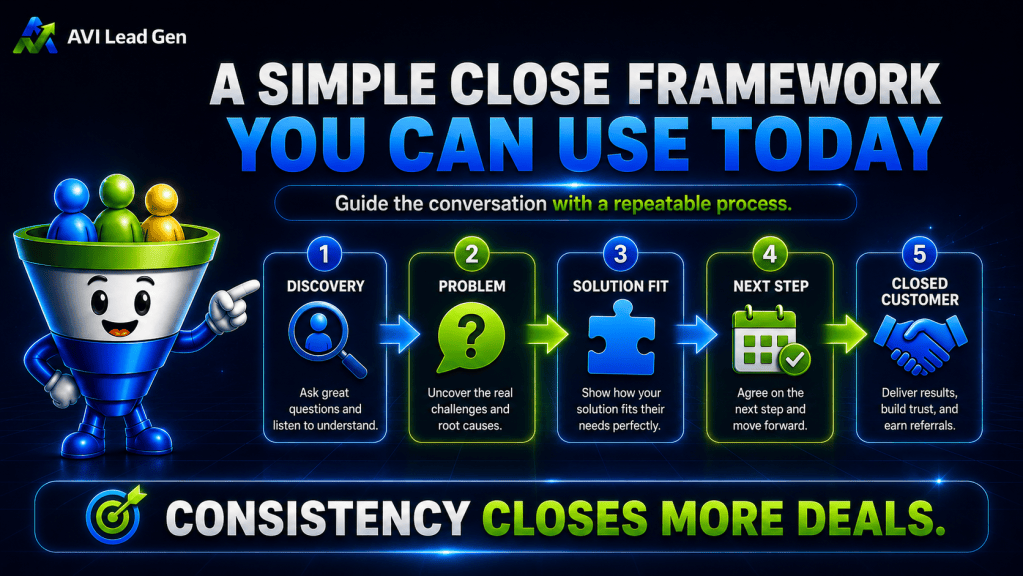
A Simple Close Framework You Can Use Today
A better close doesn’t need to feel complicated.
Use a simple five-step framework.
Step 1: Understand the Problem
Start by getting clear on what’s happening.
Don’t assume the first thing the prospect says is the whole problem.
They may say they need more leads, but the real issue may be that leads aren’t booking.
They may say they need a new website, but the real issue may be weak messaging or no follow-up.
They may say ads aren’t working, but the real issue may be that traffic is going to the wrong page.
Ask enough questions to understand the problem beneath the request.
Step 2: Confirm the Pain
Once you understand the problem, repeat it back.
This helps make sure you’re aligned.
You might say:
“So what I’m hearing is that traffic is coming in, but too few visitors are becoming real leads. And when leads do come in, there isn’t a consistent follow-up or booking path. Is that right?”
That moment matters.
It gives the prospect a chance to correct you.
It also helps them hear the problem clearly.
When the pain is confirmed, the solution becomes easier to connect.
Step 3: Present the Solution
After the problem is clear, explain the solution in plain language.
Keep it tied to what they said.
Don’t list every feature.
Explain the path.
For example:
“The first priority would be tightening the website path so visitors know what to do next. Then we’d connect the form, CRM, follow-up, and booking flow so new leads are captured and followed up with automatically.”
That’s easier to understand than a long feature list.
The prospect doesn’t need every technical detail during the first decision.
They need to understand why the solution fits.
Step 4: Check Alignment
Before moving to the next step, check whether the solution makes sense to them.
Ask:
“Does that sound like the kind of fix you were hoping for?”
“Does this match what you were trying to solve?”
“Is there anything about this direction that feels off?”
“What concerns would you have before moving forward?”
This gives the prospect room to respond.
It also surfaces objections before they disappear into silence.
A lot of deals are lost because concerns are never discussed directly.
Checking alignment makes the conversation cleaner.
Step 5: Guide the Next Step
Once the fit is clear, guide the next step.
Don’t leave it vague.
Say what happens, when it happens, and what they should expect.
For example:
“The next step is for me to send over the proposal with the setup and monthly plan. Once that’s approved, we’ll start with intake, access, and the kickoff process.”
Or:
“The next step isn’t a full build yet. I’d start with the audit so we can identify the first bottleneck before recommending a larger system.”
A clear next step reduces friction.
It also makes the decision feel less overwhelming.

What to Track When You’re Improving Close Rate
You cannot improve close rate if you don’t track what’s happening.
Start with a few practical numbers.
How many leads came in?
How many were qualified?
How many booked calls?
How many showed up?
How many became real opportunities?
How many received proposals?
How many became customers?
How many were lost?
Why were they lost?
You should also track patterns.
Which source produces the best customers?
Which service page creates better calls?
Which follow-up path gets more replies?
Which objections come up most often?
Which offers are easiest to sell?
Which leads are poor fit from the beginning?
This is where close rate connects back to the full system.
If you improve close rate but don’t track the reason, you may not know what worked.
If you lose deals but don’t record why, you may keep repeating the same mistakes.
Tracking helps you improve on purpose.

The Bottom Line
You don’t always need more leads to grow.
Sometimes the fastest improvement comes from closing more of the qualified opportunities already in motion.
That means better qualification before the call, better preparation, stronger discovery, clearer positioning, a more useful sales conversation, and a defined next step after the call.
More leads can help when the system is ready.
But when the close process is weak, more leads can just create more noise.
A better close rate gives you more value from the traffic, leads, and appointments you already have.
That’s the point.
Don’t only ask, “How do we get more leads?”
Ask:
“How do we turn more of the right leads into customers?”
That question leads to better systems, better conversations, and better growth.
Ready to Turn More Leads Into Customers?
If you’re getting leads or booked calls but not enough customers, the answer may not be more traffic.
It may be a better system for converting the opportunities you already have.
Ready to stop guessing and build a lead generation system that works around the clock?
AVI Lead Gen helps small businesses capture leads, automate follow-up, and turn more website visitors into real opportunities.
[Internal link: lead generation systems → Lead Generation System for Small Businesses]
FAQ
What is close rate?
Close rate is the percentage of qualified opportunities that become customers. For small businesses, it is usually more useful to measure close rate from qualified sales calls or proposals instead of counting every visitor or every form submission.
How do I increase my close rate without getting more leads?
You can increase your close rate by improving lead qualification, preparing before calls, asking better discovery questions, connecting your offer to the prospect’s problem, creating a clear next step, and following up with context after the conversation.
Why am I getting leads but not closing deals?
You may be getting leads but not closing deals because the leads are poor fit, the sales call lacks structure, the problem is not being uncovered clearly, the offer is not positioned well, follow-up is weak, or the next step is unclear.
Does lead quality affect close rate?
Yes. Lead quality has a major impact on close rate. If poor-fit leads reach your calendar, you will spend more time on calls that are unlikely to become customers. Better qualification helps stronger prospects reach the sales conversation.
Should I focus on more leads or better conversion?
If you have very few leads, traffic and lead generation may need attention first. But if you already have leads, booked calls, or proposals, improving conversion may be the higher-leverage move. The right answer depends on where the system is leaking.
What should every sales call include?
A strong sales call should include a clear agenda, discovery questions, problem clarification, urgency, fit, a solution tied to the prospect’s situation, time for concerns, and a defined next step.
How does follow-up improve close rate?
Follow-up improves close rate by keeping momentum alive after the call. Strong follow-up reminds the prospect what was discussed, reinforces the value of the solution, answers concerns, and makes the next step clear.
Can automation help improve close rate?
Yes. Automation can help with confirmations, reminders, lead nurturing, proposal follow-up, CRM updates, task reminders, and segmentation. But automation works best when the sales process is already clear. It should support the process, not replace the human conversation.