
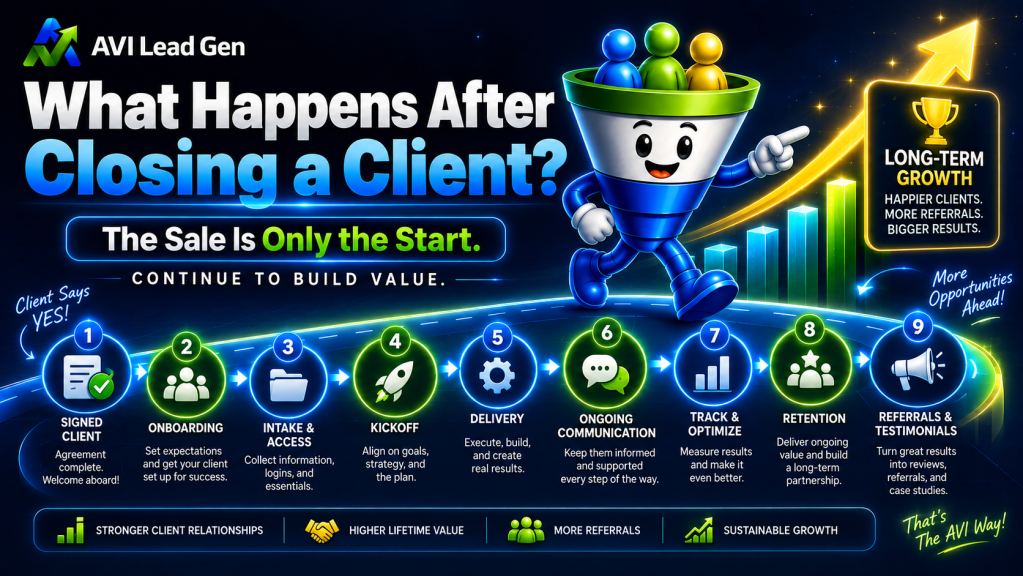
Closing a prospect feels like the win.
The call went well.
The proposal was accepted.
The agreement is signed.
The payment came through.
That moment matters.
But it’s not the finish line.
It’s the handoff.
What happens after someone says yes has a major impact on how they feel about the decision they just made. A strong close can create momentum. A weak onboarding process can drain it fast.
That’s where a lot of small businesses lose value.
They work hard to generate the lead, book the call, handle the sales conversation, and win the client. Then, once the deal closes, the next step feels scattered.
The client is waiting.
The business owner is trying to remember what to send.
Access requests happen late.
Expectations are unclear.
The project starts slowly.
Communication becomes reactive.
That doesn’t just create operational stress.
It weakens trust.
A customer who feels confident after signing is more likely to stay engaged, provide what you need, trust the process, and see the value in the work. A customer who feels confused after signing may start second-guessing the decision before delivery even begins.
That’s why the post-sale process matters.
A strong lead generation system shouldn’t stop when someone becomes a customer. It should continue into onboarding, delivery, communication, tracking, retention, referrals, and proof.
The goal isn’t just to close the client.
The goal’s to keep building value after the sale.
What Happens After Closing A Client
A new client doesn’t automatically become a long-term customer.
They become a long-term client when the experience after the sale confirms that they made the right decision.
That starts immediately.
The first few days after they sign are important because that’s when confidence is either reinforced or weakened. The client is paying attention, even if they don’t say it out loud.
They want to know:
Did I make the right choice?
Does this business have a process?
Do they know what they need from me?
Will this be organized?
Will they communicate clearly?
Will I understand what’s happening next?
A messy post-sale experience creates doubt.
A smooth one creates trust.
That doesn’t mean everything has to be perfect. But it does need to feel intentional.
They should know what happens next, what they need to provide, when the next conversation happens, what the timeline looks like, and how progress will be communicated.
When that’s clear, the relationship starts stronger.
When it’s not, the business may have to spend the rest of the project rebuilding confidence that should have been protected from the beginning.
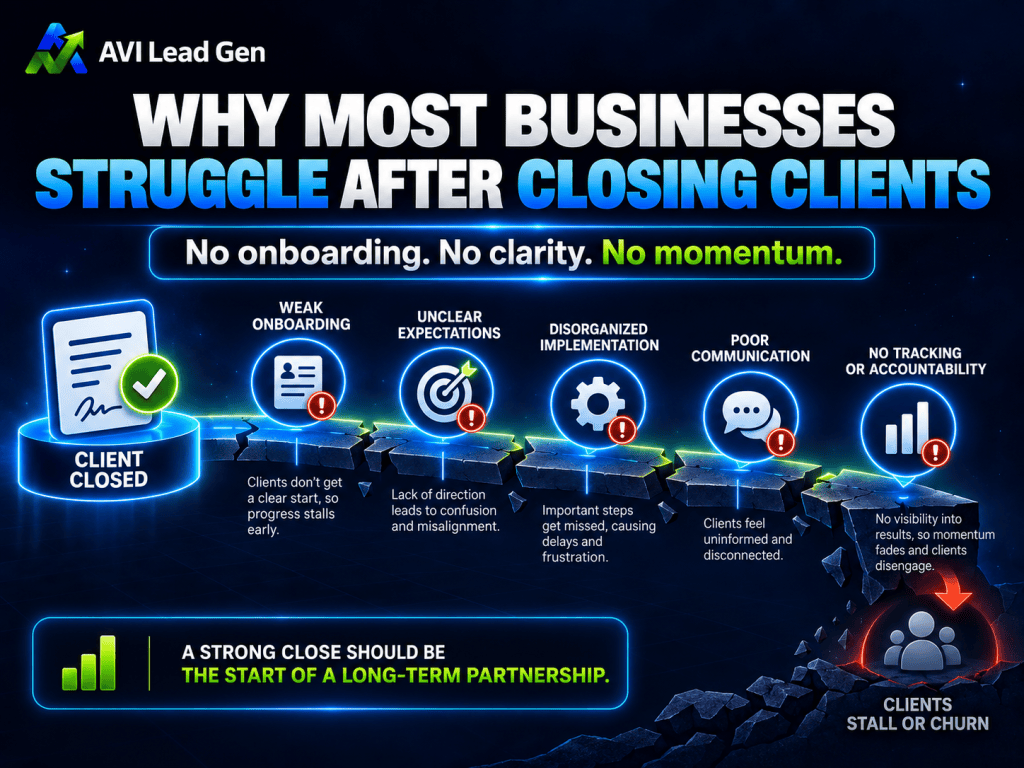
Why Businesses Struggle After Closing Clients
Most businesses don’t struggle after closing a prospect because they don’t care.
They struggle because they don’t have a repeatable process.
The sale gets all the attention.
Then the delivery side depends on memory, scattered notes, inbox threads, one-off messages, and last-minute checklists.
That creates avoidable problems.
The client may not know what to expect.
The business may not collect the right information early.
The project may stall while waiting for access.
Important details may get buried in the sales conversation.
They may not understand what work is happening behind the scenes.
Progress may happen, but the client may not feel it.
That last point matters.
Value that’s not communicated is easy to miss.
A business can be doing good work, but if they don’t understand what’s happening, why it matters, and what comes next, the relationship can still feel shaky.
What happens after closing a client should protect the relationship, foster trust, and improve communication.
It turns “Thanks for signing” into a clear next step.
The Client Onboarding Process Every Business Needs
After you close a prospect, your system should answer six questions:
What happens immediately after the sale?
What information or access is needed?
How will expectations be set?
How will delivery begin?
How will progress be communicated?
How will the relationship continue after the first milestone?
Those questions matter because the customer experience isn’t just about the quality of the final deliverable.
It’s also about the path to getting there.
A strong post-sale process usually includes:
A welcome message
A clear next step
An intake form or access request
A kickoff call
A delivery timeline
A communication rhythm
Internal task assignment
Progress updates
Reporting or review points
A retention and growth plan
This doesn’t need to be complicated.
It needs to be consistent.
A simple client onboarding process that happens every time is usually better than a perfect process that only happens when someone remembers to use it.
Step 1: Send a Clear Welcome Message
The first message after a they say yes should do more than say thank you.
It should create confidence.
A good welcome message confirms the decision, explains what happens next, and gives them a simple path forward.
It should answer:
What did they just sign up for?
What happens next?
What do they need to do now?
When will they hear from you again?
Where should they send questions?
This isn’t the place for a vague “Excited to get started.”
That’s fine as a sentence, but it’s not a process.
A stronger welcome message might say:
“Thanks again for moving forward. The next step is to complete the intake form and provide access to the tools we’ll need for setup. Once we have that, we’ll review everything, confirm the build plan, and schedule the kickoff call.”
That kind of message reduces uncertainty.
The client knows what to do.
You know what to ask for.
The project starts with direction instead of drift.

Step 2: Collect the Right Information Early
A project slows down when key information is missing.
That is especially true for services involving websites, CRM, automation, booking tools, analytics, content, or marketing assets.
For AVI-style work, this could include:
Website login access
Domain or hosting details
CRM access
Form access
Booking calendar access
Email sending domain details
Brand assets
Service details
Current lead sources
Offer information
Target customer information
Existing analytics access
Previous marketing context
Sales process details
The exact list depends on the service.
The point is to ask early.
When access and information are collected in a structured way, delivery becomes smoother. When they are requested one at a time, the customer may feel like the process is disorganized.
A good intake system also protects your time.
Instead of chasing details across emails, texts, notes, and calls, you can collect what you need in one place.
That makes the client experience better and the project easier to manage.
Step 3: Set Expectations Before Delivery Starts
Misaligned expectations create frustration.
Sometimes the work is going fine, but the customer expected something different.
That’s why expectations need to be set early.
Before delivery starts, they should understand:
What will be delivered
What is not included
What the timeline looks like
What depends on their input
What happens if access is delayed
How communication will work
How revisions or approvals are handled
What success looks like
What early results should and shouldn’t be expected to mean
This is especially important in lead generation.
A client may expect a new system to create results immediately. But a real lead generation system often needs setup, testing, traffic, follow-up, tracking, and optimization.
That doesn’t mean the system isn’t working.
It means they need to understand the path.
Expectation setting isn’t about lowering excitement.
It’s about grounding the work.
When they know what to expect, they’re less likely to panic during normal parts of the process.
Step 4: Schedule the Kickoff Quickly
A kickoff call gives the project a clean start.
It helps turn the signed agreement into an active working relationship.
The kickoff doesn’t need to be long, but it should be useful.
A good kickoff call can cover:
The client’s goals
The service scope
The immediate priorities
The timeline
Their responsibilities
The main risks or bottlenecks
The communication plan
The first milestone
The next internal steps
This is also where you can clarify anything that changed between the sales conversation and the start of delivery.
That matters because details can shift.
The prospect may have shared one version of the problem during the sales call, then remember additional details after signing. The kickoff gives you a chance to catch those before the work begins.
It also reinforces that there’s a process.
A new customer should leave the kickoff thinking:
“Okay, they know what they’re doing.”
That confidence is valuable.
Step 5: Turn the Sale Into an Internal Delivery Plan
A client-facing process is only half the system.
The business also needs an internal handoff.
The details from the sales process shouldn’t disappear after the agreement is signed.
Your internal delivery plan should capture:
What they bought
Why they bought it
What problem they are trying to solve
What expectations were discussed
What promises were made
What timeline was shared
What assets are needed
What team member owns each task
What milestones need to happen next
What risks need to be watched
This protects the client experience.
It also prevents the common disconnect between sales and delivery.
Even if you’re a solo business owner, this still matters.
You’re handing off from “sales version of you” to “delivery version of you.”
That handoff needs structure.
Otherwise, important context gets lost.
Step 6: Communicate Progress Before the Client Asks
One of the biggest mistakes after closing a client is going quiet.
You may be working.
You may be making progress.
You may be solving problems.
But if they hear nothing, they may assume nothing is happening.
That is why proactive communication matters.
The customer shouldn’t have to chase you to understand the status of the work.
A simple update can go a long way:
“Here’s what we completed this week.”
“Here’s what we’re working on next.”
“Here’s what we still need from you.”
“Here’s one thing we noticed.”
“Here’s the next milestone.”
This does not need to be overdone.
Too many updates can create noise.
But no updates create uncertainty.
A strong communication rhythm keeps momentum alive and reinforces value while the work is still in progress.
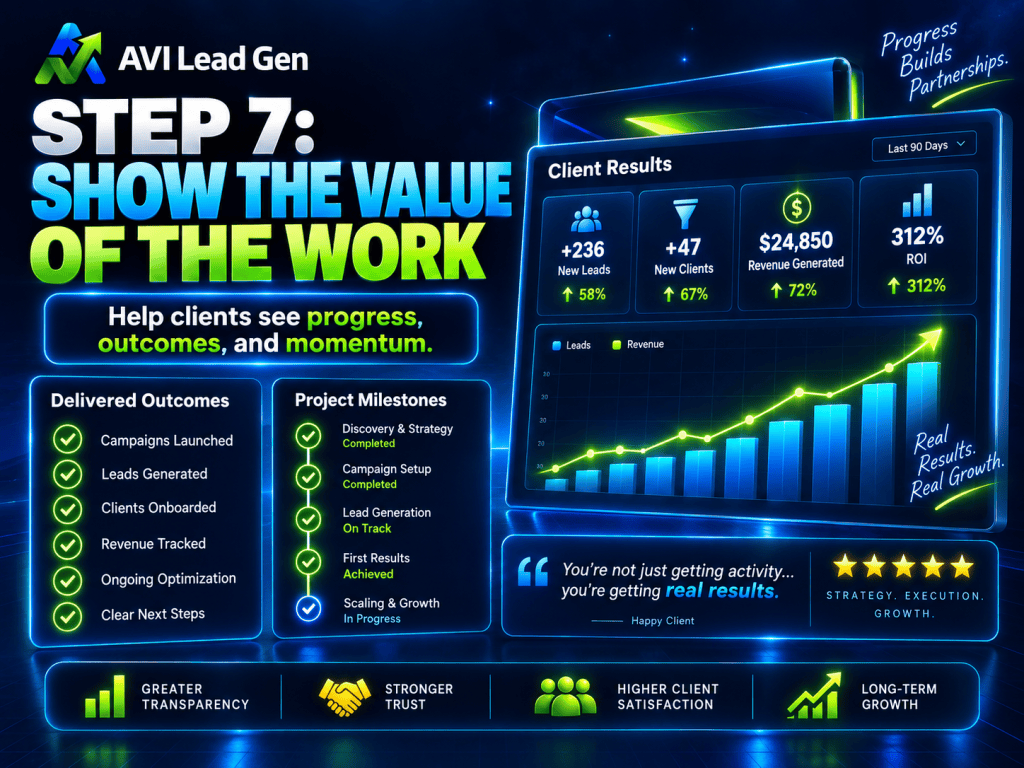
Step 7: Show the Value of the Work
A lot of service businesses assume clients will recognize the value automatically.
Sometimes they will.
Often, they won’t.
That’s not because they are unreasonable. It’s because they don’t see everything happening behind the scenes.
If you build a CRM automation, they may not see every condition, tag, trigger, email, notification, form connection, or cleanup step.
If you improve a website, they may not understand the strategic reasoning behind the copy, structure, CTA placement, lead capture path, or tracking setup.
If you organize the booking process, they may not notice every friction point that was removed.
That means you need to translate the work into business value.
Instead of only saying:
“We set up the automation.”
Explain:
“This automation makes sure new leads are tagged, organized, and followed up with quickly, so fewer inquiries sit untouched.”
Instead of only saying:
“We updated the service page.”
Explain:
“This page now gives visitors a clearer path to understand the offer and take the next step.”
Value should be visible.
When people understand what changed and why it matters, they’re more likely to appreciate the work, stay engaged, and continue the relationship.
Step 8: Track Results and Optimize the System
Delivery doesn’t end when the first version is launched.
That’s where improvement begins.
A website, CRM, booking flow, follow-up system, or lead generation process should be reviewed after it goes live.
You need to know what’s happening.
Are people visiting the right pages?
Are visitors converting into leads?
Are form submissions complete?
Are leads being tagged correctly?
Are follow-up emails being delivered?
Are leads booking appointments?
Are appointments turning into customers?
Are the right leads coming through?
Where’s the system leaking?
Without tracking, optimization becomes guesswork.
The business may keep changing the wrong things.
That’s why tracking needs to be part of the post-sale process, not an afterthought.
If the system is built and never reviewed, you’re leaving value on the table.
Step 9: Build Retention Into the Relationship
Retention doesn’t happen only because they like you.
Retention happens when the client continues to see value.
That means the relationship needs a path beyond the first deliverable.
After the initial project or setup, ask:
What needs to be monitored?
What needs to be optimized?
What content needs to be added?
What automations need to be improved?
What reporting should be reviewed?
What new bottlenecks are appearing?
What opportunities should be prioritized next?
This is where many businesses miss the bigger opportunity.
They treat the sale as a single transaction.
But the real value often comes from the ongoing relationship.
A person who trusts the process may need more content, stronger follow-up, additional landing pages, better tracking, new automations, campaign support, conversion improvements, or strategic guidance.
Retention isn’t just “keeping the client.”
It’s continuing to help them solve the next right problem.
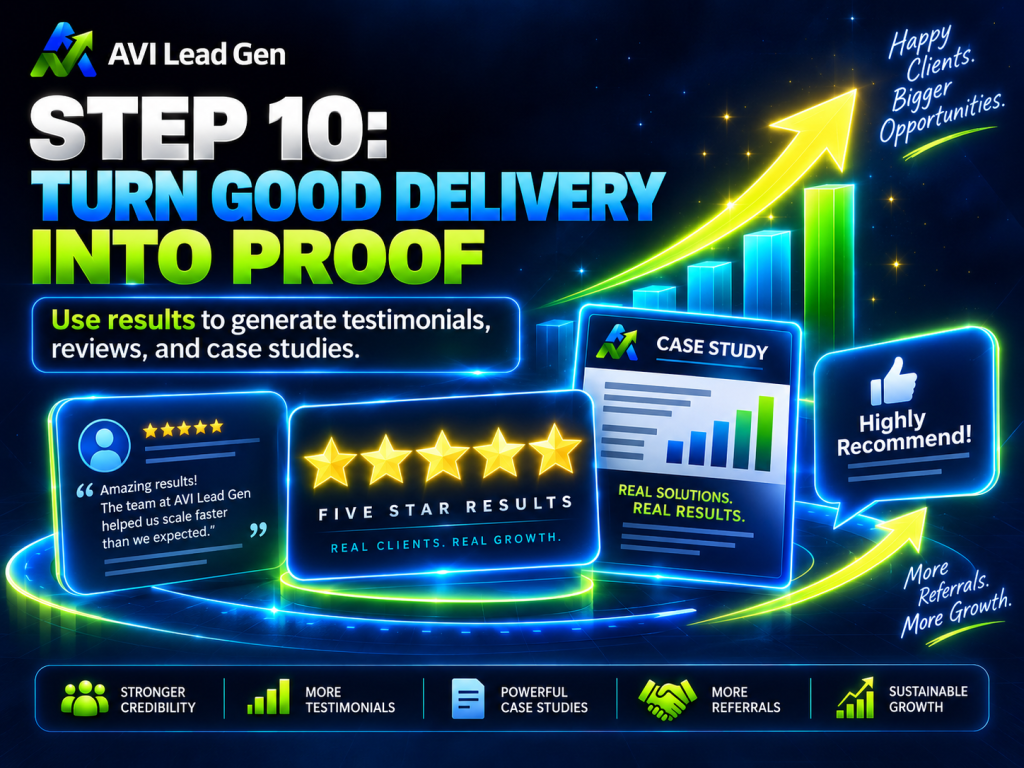
Step 10: Turn Good Delivery Into Proof
A successful client relationship should create more than revenue.
It should create proof.
That proof may become:
A testimonial
A case study
A referral
A review
A before-and-after example
A performance snapshot
A process improvement story
A stronger sales conversation for future prospects
But proof doesn’t appear automatically.
You need to plan for it.
That starts by tracking the before state.
What was broken before the work started?
What was the client struggling with?
What did the system look like?
What was missing?
What did the client want to improve?
Then track the after state.
What changed?
What got cleaner?
What became easier?
What started working better?
What did the client notice?
What results or improvements can be shown honestly?
For many businesses, this matters because proof will become one of the strongest sales assets over time.
The goal isn’t to exaggerate results.
The goal is to document real improvements.
A good delivery process makes that easier.
Where Automation Helps After the Sale
Automation can make the post-sale experience more consistent.
It can help with:
Welcome emails
Intake form delivery
Access request reminders
Kickoff scheduling
Task creation
Client status updates
Internal notifications
Follow-up reminders
Review requests
Testimonial requests
Reporting reminders
Renewal or next-step workflows
That matters because the post-sale process has a lot of repeatable steps.
Those steps are easy to forget when you’re busy.
Automation helps make sure they happen.
But automation shouldn’t make the relationship feel cold.
The goal isn’t to remove the human part.
The goal is to protect the important steps so the human part can be stronger.
Use automation for consistency.
Use personal communication for trust.
Where Human Judgment Still Matters
Not everything after the sale should be automated.
Some moments need human judgment.
A customer may be confused.
A project may hit a delay.
A result may need context.
A strategy may need to shift.
An expectation may need to be reset.
A new opportunity may appear.
They may need reassurance.
Automation can remind you to communicate.
It cannot decide the best way to handle a sensitive conversation.
That’s why a good post-sale system includes both structure and judgment.
The system keeps the process moving.
The person protects the relationship.
That combination is powerful.
Clients don’t stay just because tasks were completed.
They stay because they trust the process, understand the value, and believe the business is paying attention.
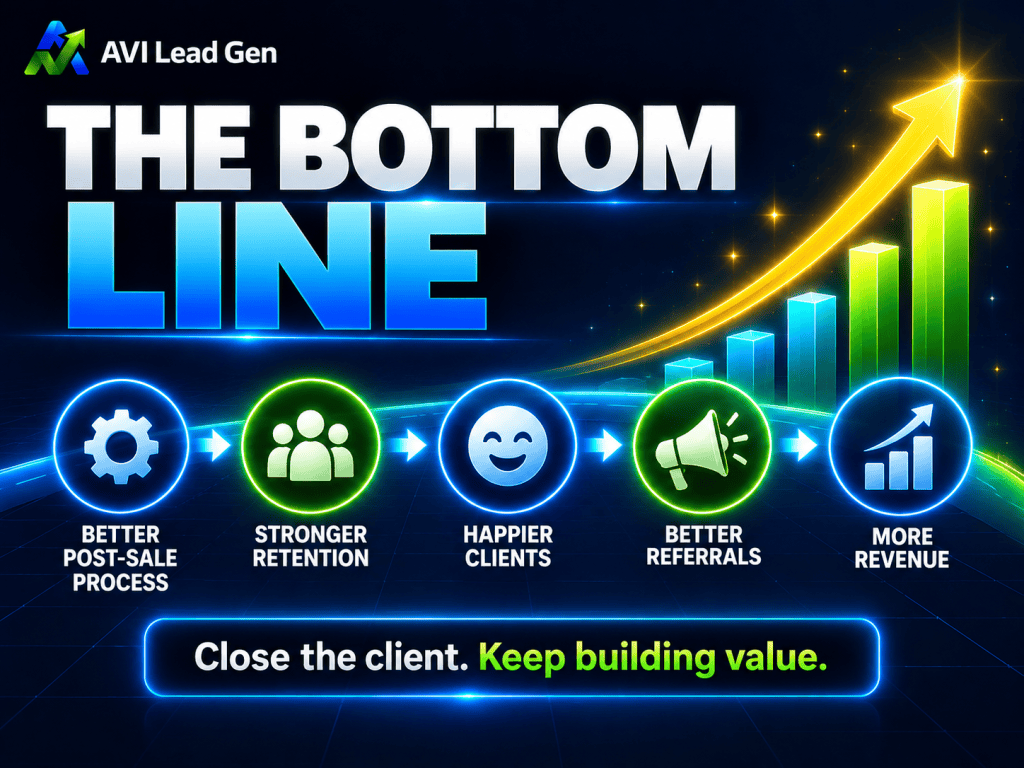
The Bottom Line
For a strong client delivery process, closing isn’t the end of the system.
It’s the beginning of delivery.
What happens after the sale shapes customer confidence, project momentum, retention, referrals, proof, and long-term growth.
A strong post-sale process helps you:
Welcome the client clearly
Collect the right information
Set expectations
Schedule kickoff
Turn the sale into a delivery plan
Communicate progress
Show value
Track results
Optimize the system
Build retention
Create proof
That’s how one closed deal becomes more than a transaction.
It becomes a stronger relationship.
And a stronger relationship can become repeat revenue, referrals, testimonials, case studies, and better future sales conversations.
The sale matters.
But the value is built after the sale.
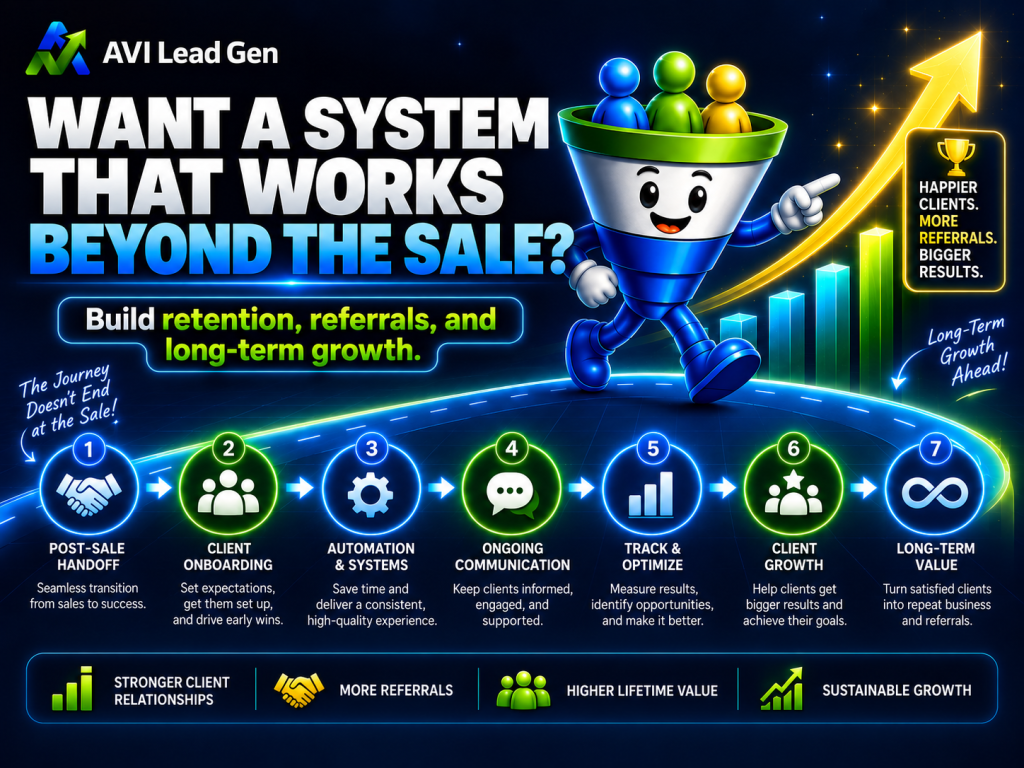
Ready to Build a System That Works Beyond the Sale?
AVI Lead Gen helps small businesses build connected lead generation systems that do more than capture inquiries.
Because growth doesn’t stop when someone fills out a form or books a call.
And it doesn’t stop when they become a client.
The right system keeps working after the sale.
Ready to stop guessing and build a lead generation system that works around the clock?
AVI Lead Gen helps small businesses capture leads, automate follow-up, and turn more website visitors into real opportunities.
FAQ
What should happen after closing a client?
After closing a client, you should send a clear welcome message, collect needed information, set expectations, schedule kickoff, create an internal delivery plan, communicate progress, track results, and continue building value after the sale.
Why is client onboarding important?
Client onboarding is important because it sets the tone for the relationship. A strong onboarding process reduces confusion, builds confidence, collects important details early, and helps the client understand what happens next.
What should be included in a client onboarding process?
A client onboarding process should usually include a welcome message, intake form, access requests, kickoff call, timeline, communication expectations, project milestones, and clear next steps.
How do you keep building value after closing a client?
You keep building value by communicating progress, showing what changed, explaining why the work matters, tracking results, optimizing the system, and helping the client solve the next right problem.
How does automation help after the sale?
Automation helps after the sale by making repeatable steps more consistent. It can support welcome emails, intake forms, reminders, kickoff scheduling, task creation, follow-up, reporting, and testimonial requests.
What causes clients to lose confidence after signing?
Clients often lose confidence when onboarding is unclear, communication is inconsistent, expectations are vague, progress is hard to see, or the business does not explain what happens next.
How does a client delivery process affect retention?
Post-sale delivery affects retention because clients are more likely to stay when they understand the process, see progress, receive clear communication, and continue getting value after the initial sale.
Why should businesses track results after delivery?
Businesses should track results after delivery because it shows what is working, what needs improvement, and where the next opportunity is. Without tracking, optimization becomes guesswork.