


Tax season can make an accounting firm feel like it has more work than it could possibly need.
Phones ring. Documents arrive. Returns pile up. Clients ask questions they haven’t thought about since last spring.
Then the deadline passes.
The volume drops, and many of those same client relationships quietly go dormant until the following year.
That’s where accounting firms can miss an important opportunity.
A tax return doesn’t just tell you what happened last year. The process of preparing it often reveals which clients have financial problems that will still be there next month.
Their books are consistently behind.
They don’t know where the cash went.
They were surprised by their tax bill again.
They’re hiring employees, buying equipment, changing entities, or making large business decisions without current financial information.
Those aren’t necessarily tax-return problems.
They may be signs that the client needs bookkeeping, planning, accounting advisory services, or another form of ongoing financial support.
The goal isn’t to pitch every tax client.
It’s to recognize which problems are recurring and make sure the next conversation doesn’t disappear when tax season ends.
Tax Season Can Tell You What a Client Needs Next
An accounting firm gets an unusually detailed look at a client’s financial life during tax preparation.
You see the records.
You see where information is missing.
You see the adjustments.
You hear the questions.
And business owners often volunteer information that tells you far more than the return itself.
Maybe revenue increased significantly, but the owner says there never seems to be enough cash.
Maybe payroll grew quickly and nobody has modeled what another hire would do to margins.
Maybe the bookkeeping needs several hours of cleanup every year before the tax work can even begin.
Maybe the client is still making major business decisions from a bank balance instead of current financial statements.
Those issues don’t suddenly stop existing because the return has been filed.
Tax season can become the point where the firm identifies what the client may need next.
That makes the tax process more than a compliance event. It can also become an opportunity to understand which clients may benefit from a deeper year-round relationship.
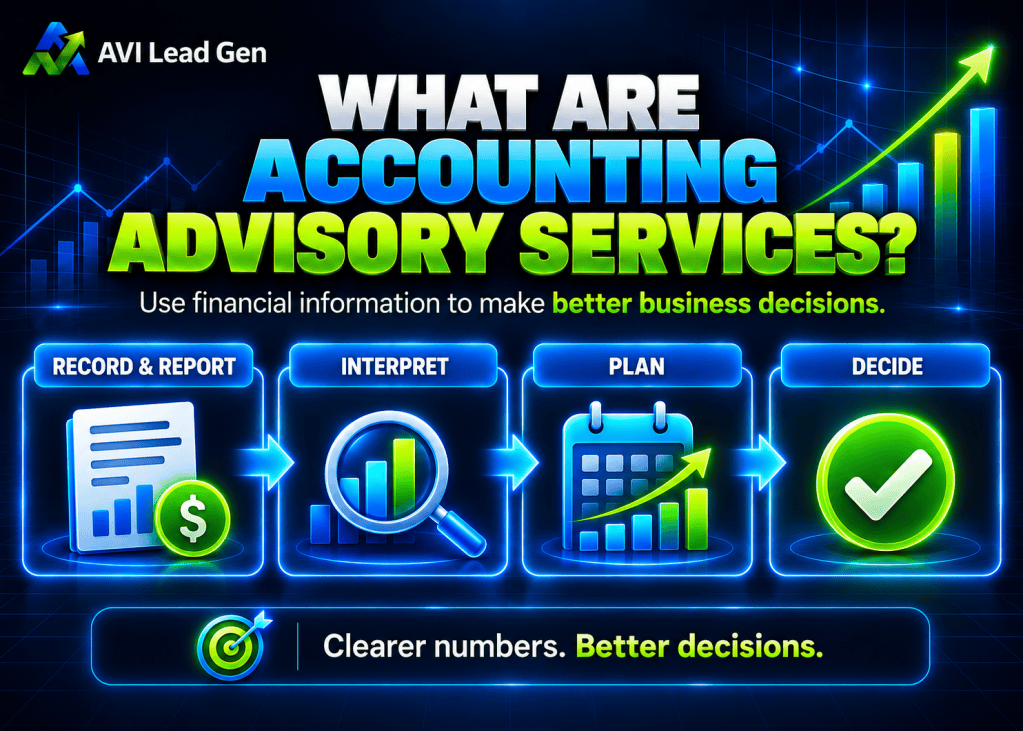
What Are Accounting Advisory Services?
Accounting advisory services generally move beyond recording or reporting what already happened.
They help clients understand financial information and use it to make decisions.
Depending on the firm and the client, that may involve:
- cash-flow forecasting
- budgeting
- KPI review
- scenario planning
- management reporting
- financial interpretation
- business planning
- tax planning
- profitability analysis
- decision support
- controller or CFO-level guidance
That doesn’t mean every accounting service is advisory.
Bookkeeping creates reliable financial information. Advisory helps a client use that information to make better decisions.
That distinction matters.
A client whose books are six months behind may not need advisory first. They may need consistent bookkeeping.
A client whose books are current but still doesn’t know whether the business can afford another employee may need something different.
The service should follow the problem.
CPA.com’s 2024 CAS Benchmark Survey reported a 17% median growth rate among participating client advisory services practices, continuing a pattern of double-digit CAS growth. CPA.com
That doesn’t mean every firm should immediately build a large CAS practice.
It does show why more accounting firms are examining how advisory work fits into the services they provide.

Tax Season Exposes Problems That Don’t End When the Return Is Filed
Some of the strongest year-round opportunities are already visible during tax preparation.
Consider a few common examples.
A business owner repeatedly arrives with disorganized records.
The immediate problem is getting the return finished.
The recurring problem is that the bookkeeping process isn’t working.
Another owner is shocked by the tax liability.
You can explain what happened this year, but the deeper issue may be that nobody is doing proactive tax planning while there’s still time to make decisions.
Another client asks:
“Can I afford to hire someone?”
That isn’t really a tax-preparation question.
It may require current financial reporting, budgeting, cash-flow analysis, and scenario planning.
The important question is:
Will this problem still exist after the return is filed?
If the answer is yes, there may be an opportunity for a more appropriate year-round service.
That service may be bookkeeping.
It may be tax planning.
It may be accounting advisory services.
Or it may be something your firm doesn’t want to provide at all.
The point is to recognize the difference between a one-time tax question and an ongoing financial need.
Not Every Tax Client Should Become an Advisory Client
A tax-only relationship isn’t automatically incomplete.
Some clients have simple financial lives, clean records, limited planning needs, and no interest in a deeper relationship.
That can be perfectly fine.
Trying to turn every tax client into an advisory engagement creates a different problem: the firm starts selling services based on its own revenue goals instead of the client’s actual needs.
A stronger potential advisory client may be someone who:
- owns a growing business
- regularly asks financial decision-making questions
- lacks useful management reporting
- experiences recurring cash-flow uncertainty
- makes major decisions without forecasts or budgets
- repeatedly needs cleanup before tax preparation
- has increasingly complex financial operations
- needs more proactive tax planning
- wants help understanding what the financial statements actually mean
Those signals matter because advisory works best when there’s something meaningful to advise on.
The question isn’t:
“How do we sell this client more?”
It’s:
“Does this client have a recurring problem we’re equipped to help solve?”
Look for Problems That Repeat Throughout the Year
The easiest way to identify a year-round opportunity is to listen for recurring problems.
A client might say:
“Why do I never have enough cash?”
A profitable business can still experience cash pressure.
Receivables, debt payments, inventory, owner distributions, tax obligations, rapid growth, or poor timing between inflows and expenses can all affect the answer.
That could point toward cash-flow analysis, forecasting, or ongoing financial review.
“Can I afford another employee?”
The tax return can’t answer that by itself.
The client may need a current view of margins, cash reserves, payroll burden, projected revenue, and different hiring scenarios.
“Why was my tax bill so high?”
The return explains the result.
A year-round tax-planning relationship may help the client make decisions before the next result is locked in.
“Which jobs are actually making money?”
That may require better bookkeeping, job costing, management reporting, or advisory support.
“Why are my books always behind?”
That may not be an advisory opportunity yet.
It may be a monthly bookkeeping opportunity.
And that distinction is important.
Recurring revenue for accounting firms shouldn’t come from relabeling every service as advisory. It should come from matching recurring client needs with services the firm can deliver well.
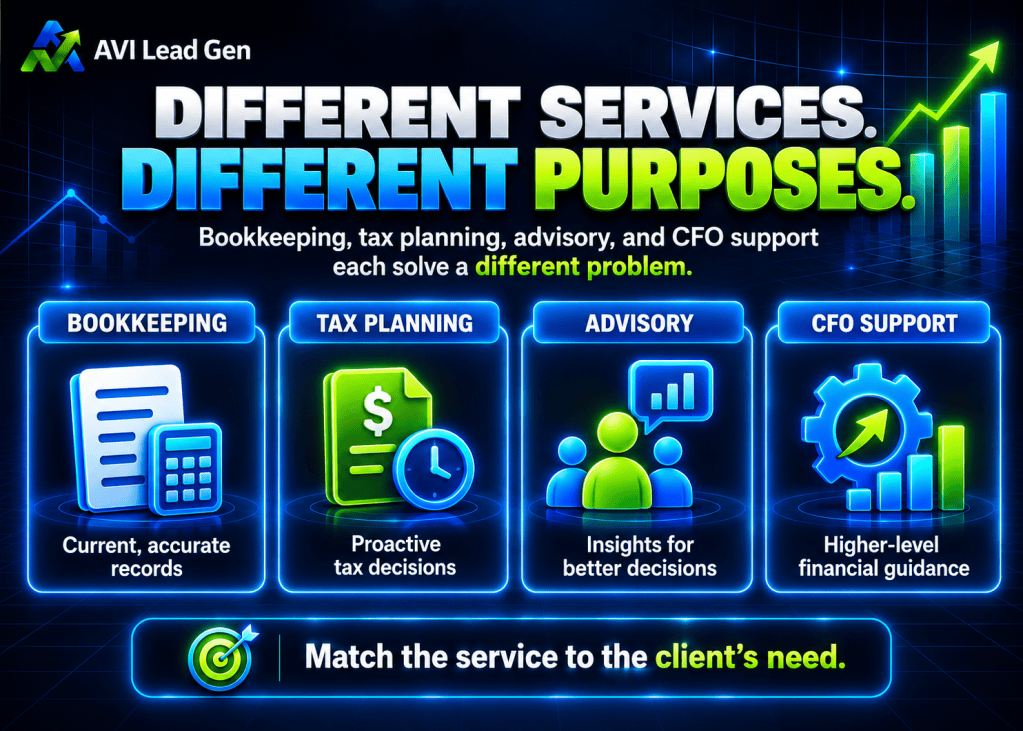
Bookkeeping, Tax Planning, and Advisory Aren’t the Same Service
Accounting firms sometimes make the client journey harder by using internal service terminology that clients don’t fully understand.
A client may not know what CAS means.
They may not know the difference between advisory, outsourced accounting, controller services, or fractional CFO support.
They do understand their problems.
So the service structure needs to be clear.
Monthly Bookkeeping
The focus is maintaining reliable, current financial records.
The client may need:
- transaction categorization
- reconciliations
- monthly close
- financial statements
- cleanup
- consistent recordkeeping
Without accurate records, higher-level advisory becomes difficult.
Tax Planning
Tax planning focuses on decisions that can affect future tax outcomes.
That may involve estimated payments, entity decisions, compensation strategy, major purchases, timing decisions, or other planning that should happen before the return is prepared.
Accounting Advisory Services
Advisory focuses on helping clients interpret financial information and make better decisions.
That can include:
- forecasting
- budgeting
- KPI analysis
- profitability review
- scenario planning
- management reporting
- strategic financial conversations
Controller or CFO-Level Support
Some growing companies need a deeper level of financial management.
That can involve reporting infrastructure, budgeting, forecasting, cash management, internal processes, strategic planning, or coordination with lenders, owners, and leadership.
A client may move through several of these relationships over time.
The important part is that each stage solves a real problem.
Don’t Turn Tax Season Into a Sales Pitch
Tax season is already stressful enough.
Your team is busy.
Clients want their returns completed.
Nobody needs a complicated sales presentation in the middle of that.
But that doesn’t mean the opportunity should be ignored.
Instead of selling, notice.
If a recurring issue becomes obvious, acknowledge it.
For example:
“I noticed we had to do quite a bit of cleanup before we could prepare the return this year. That’s something we could help keep current during the year if you’d like to talk about it after tax season.”
Or:
“You mentioned that cash has felt unpredictable even though sales are growing. Once we get through filing season, it may be worth reviewing the numbers together and seeing what’s driving that.”
Or:
“Your company has changed quite a bit since last year. An annual review may not give you enough information to make some of the decisions you’re facing now.”
That creates a natural bridge without forcing the conversation at the wrong time.
Tax season can be the discovery point.
The actual advisory conversation can happen later.
Capture the Opportunity Even If You Follow Up Later
This is where firms often lose the opportunity.
Someone notices an issue.
They think:
“We should talk to this client about that after tax season.”
Then April ends.
Everyone catches up.
Summer arrives.
And nobody remembers.
A simple process changes that.
When the issue comes up:
- record what the client said
- note the recurring problem
- identify the likely service fit
- assign a follow-up date
- tag or categorize the client
- identify who owns the next conversation
That’s where a CRM becomes useful beyond marketing.
It gives the firm a place to preserve context and create a next step instead of relying on someone’s memory.
A connected CRM and follow-up process can help the firm organize those opportunities without turning the entire workflow into a manual spreadsheet exercise.
The principle is the same whether the contact is a new lead or an existing client:
Good opportunities disappear when nobody owns the next action.
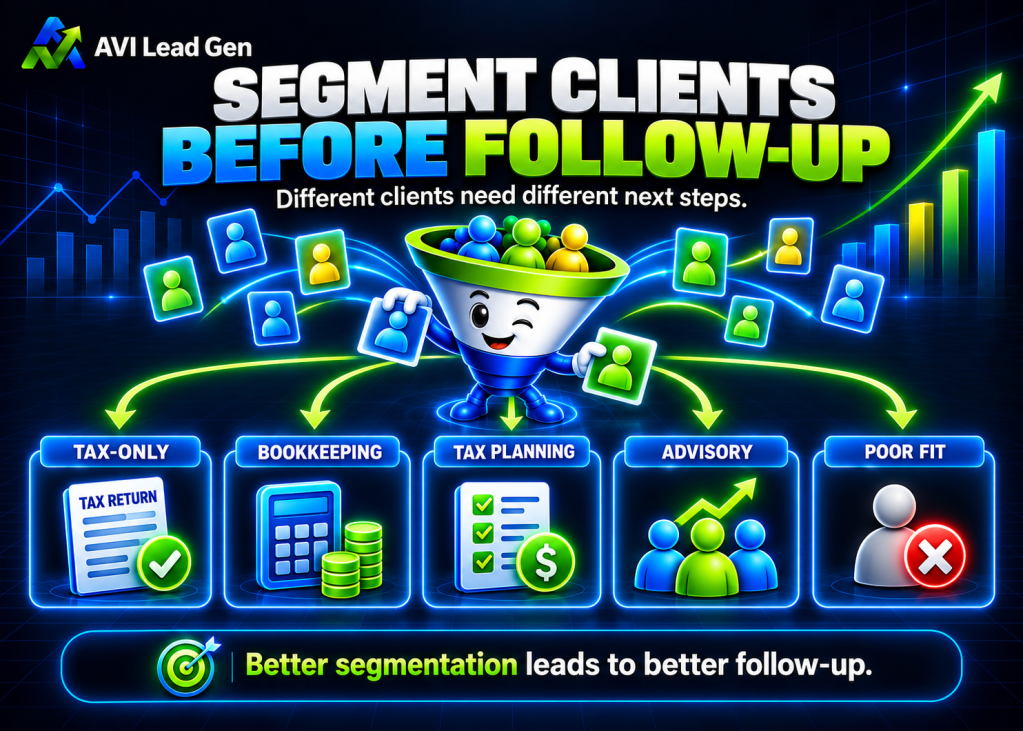
Segment Clients Before You Build Follow-Up
A single “tax clients” list isn’t very useful.
Different clients need different things.
A more useful structure might look like this:
Tax-Only
No additional need identified.
Maintain a good client experience and make next year’s process easy.
Bookkeeping Opportunity
Books are consistently late, unreliable, or require cleanup.
The next conversation may be about monthly bookkeeping or cleanup services.
Tax-Planning Opportunity
The client experiences recurring surprises, complex decisions, or changes that should be addressed before filing season.
Advisory Opportunity
The client needs help interpreting financial information, planning, forecasting, or making decisions.
Controller or CFO-Level Opportunity
The business has enough complexity to justify deeper financial management and oversight.
Poor Fit
Not every client should be expanded.
The relationship may be unprofitable, difficult to service, outside the firm’s expertise, or misaligned with the type of work the firm wants.
Segmentation helps the firm avoid a one-size-fits-all follow-up campaign.
It also makes the next conversation more relevant.
Build a Post-Tax-Season Follow-Up Process
The follow-up doesn’t need to be complicated.
A practical approach could look like this.
Immediately After Filing
Document the opportunity while the conversation is still fresh.
30–60 Days Later
Reach out to clients who had an identified ongoing need.
The message should refer to the actual issue, not a generic service promotion.
Midyear
Review major business changes, financial performance, estimated taxes, or other planning needs.
Q3 and Q4
Tax planning and year-end decision-making become increasingly relevant.
This creates a very different relationship from:
“See you next tax season.”
The Journal of Accountancy profiled one firm that intentionally structured client service across the year, with financial review and planning in May through August, tax projections and planning later in the year, and tax preparation after much of the advisory work had already occurred. Journal of Accountancy
That exact calendar won’t fit every firm.
The broader lesson is more useful:
Year-round service doesn’t happen accidentally.
It requires a reason and a process for the next conversation.
Be Selective Before Expanding Advisory
There’s a danger in seeing strong demand for advisory and immediately trying to offer everything.
The firm still has to deliver the work.
Before expanding accounting advisory services, clarify:
- which clients are a strong fit
- what problems the service solves
- what’s included
- what’s outside scope
- who performs the work
- how often clients meet with the firm
- how the service is priced
- what technology is needed
- how many clients the team can realistically support
Capacity matters.
So does pricing.
Thomson Reuters’ 2026 State of Tax Professionals report found strong demand for additional financial advice, while also noting that many firms continue to underprice advisory work relative to other services. Thomson Reuters
More advisory work isn’t automatically better if the service is poorly scoped, underpriced, or creates an unsustainable workload.
The goal is to build a service model that works for both the client and the firm.

Existing Clients Can Become a Second Growth Engine
Accounting-firm growth doesn’t have to come from only one direction.
One path is acquiring new clients.
The other is creating deeper relationships with existing clients when there’s a genuine service need.
Those two paths can work together.
Your marketing and lead-generation system helps bring the right new opportunities into the firm.
Your client-service process helps identify which existing relationships have room to grow.
That means the firm isn’t forced to choose between new-client acquisition and existing-client expansion.
It can build both.
If your firm is still depending almost entirely on introductions for new business, read How to Get More Accounting Clients Without Relying Only on Referrals.
That article covers the acquisition side.
This one covers what happens after a client is already inside the firm.
Together, they create a stronger growth model than relying exclusively on either referrals or cross-selling.
Don’t Let Good Opportunities Disappear After Tax Season
The biggest takeaway isn’t that every tax client should become an advisory client.
They shouldn’t.
It’s that tax season gives accounting firms an unusually clear view of the problems clients are already experiencing.
Some of those problems end when the return is filed.
Others don’t.
When you identify a problem that will still matter next month, record it.
Decide whether your firm is equipped to help.
Create the next conversation.
And make sure somebody actually follows up.
That may lead to bookkeeping.
It may lead to tax planning.
It may lead to accounting advisory services.
Or it may simply confirm that the existing relationship is exactly where it should remain.
The opportunity comes from knowing the difference.
If your accounting firm also wants a more structured way to attract, qualify, book, and follow up with new prospective clients, AVI’s lead generation system for accounting firms connects the website, lead capture, CRM, booking, follow-up, and tracking into one process.
Ready to Build a More Connected Growth System?
AVI Lead Gen helps owner-led accounting and bookkeeping firms connect their website, lead capture, CRM, appointment booking, follow-up, content, and conversion tracking into one lead-generation system.
Frequently Asked Questions
What are accounting advisory services?
Accounting advisory services help clients use financial information to make business decisions. Depending on the firm, that can include forecasting, budgeting, cash-flow analysis, KPI review, profitability analysis, management reporting, scenario planning, tax planning, and other financial decision support.
What’s the difference between bookkeeping and advisory services?
Bookkeeping focuses on creating accurate financial records. Advisory focuses on helping the client understand those records and use the information to make decisions. A client often needs reliable bookkeeping before higher-level advisory work becomes useful.
Should every tax client be offered advisory services?
No. Some clients are a good fit for tax-only relationships. Advisory makes more sense when the client has recurring financial questions, growing complexity, planning needs, poor visibility into financial performance, or decisions that would benefit from ongoing financial analysis.
When should an accounting firm follow up after tax season?
The opportunity should be documented as soon as it’s identified, but the deeper conversation can happen after filing pressure has eased. For many firms, a targeted follow-up 30–60 days after filing is reasonable, followed by midyear and year-end planning where appropriate.
Can a small accounting firm offer advisory services?
Yes, but the firm needs to be selective about scope, client fit, capacity, pricing, and delivery. A small firm doesn’t need to offer every possible advisory service. It can begin with a narrow service that solves a recurring problem for a specific type of client.